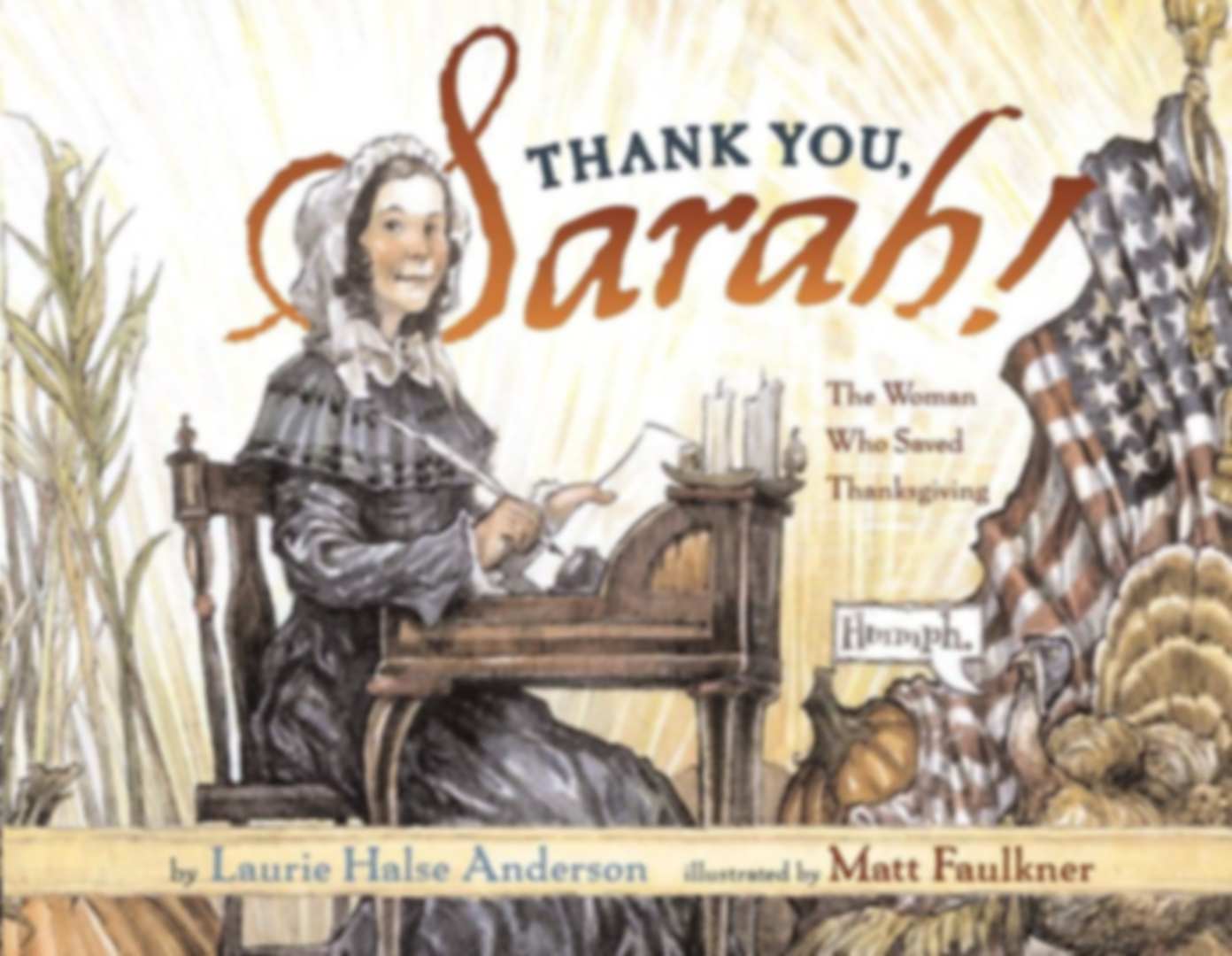

The first page of Thank You, Sarah by Laurie Halse Anderson is a dare. You think you know everything about Thanksgiving, the narrator says, over a hillside of autumn colour, and the next spread serves up the version every classroom knows: the Pilgrims rescued from hunger, a long table, turkey and pumpkin pie. Then the page turns and the tone flips. There is a news flash. Over a cartoon of a man gaping at a television that reads THANKSGIVING CANCELED, NO FOOTBALL TODAY, the book announces that America almost lost the holiday altogether.
It is a strong hook for a picture book about a nineteenth-century magazine editor, and it tells you exactly how the book means to work. History here is a rescue story, and the rescuer wears a bonnet.
How Thank You, Sarah Builds Its Case
The structure is a classic three-beat picture-book arc. First the problem: outside New England, the holiday is fading, shown on a map where turkeys wander off the South and the West. Then the hero, introduced through a joke. The book calls for a superhero and gets a muscle-bound Pilgrim with a P on his chest, flanked by a kid in a football suit and a man dressed as a turkey. Not that kind, the narrator says. The real hero is Sarah Hale, widow, mother of five, editor and poet.
The third beat is the long middle, where she writes. She writes to Zachary Taylor, Millard Fillmore, Franklin Pierce and James Buchanan, and each one refuses. The Civil War breaks out, states drop the holiday, and she writes to Abraham Lincoln. Every refusal is followed by the same question, did that stop Sarah, and the same answer. Small listeners will be shouting it by the third president, which is exactly the participation Thank You, Sarah by Laurie Halse Anderson is built to provoke.
A Pen Is the Whole Superpower
Anderson’s thesis is simple and good: you do not need a vote or an office to change your country, you need persistence and something to write with. Anderson’s text in Thank You, Sarah by Laurie Halse Anderson never lets children forget that Hale did this without the vote, and it closes its back matter by handing them the same tool.
What works
- The voice. The narration is cheeky and quick, full of kitchen jokes and asides. One line deserves a frame above every school library desk: “Never underestimate dainty little ladies.”
- Faulkner’s caricatures. The presidents loom as enormous carved heads, Taylor and Fillmore glowering down at a tiny Sarah holding her letter up to them. The scale gag makes the odds visible without a word.
- The quill as a visual thread. A giant feather pen runs along the bottom of spread after spread, a path Sarah literally walks on, until it becomes a bridge across the war years.
- The back matter. Several pages of real history follow the story: earlier Spanish thanksgivings in Florida and Texas, football and the first parade balloons, and the Franksgiving muddle of 1939 to 1941, when two states celebrated on both Thursdays. Older siblings will read this part for themselves.
Where It Gives Ground
- A date slip. The story has Sarah pressing for the fourth Thursday of November, and the back-matter timeline repeats it. Lincoln’s 1863 proclamation actually named the last Thursday. The fixed fourth-Thursday rule only arrived in 1941, which the book’s own Franksgiving section explains.
- Generous arithmetic. Thank You, Sarah by Laurie Halse Anderson credits Hale with thirty-eight years of campaigning. Most accounts date her letter-writing push to 1846, which makes it closer to seventeen.
- The opening is left standing. Those first spreads restate the familiar feast story, with Native people drawn in generic feathered headbands and never named as Wampanoag. The book sets the story up only to move past it, and never returns to examine it.
- The refrain wears thin. Bold, brave, stubborn and smart appears so often that adults reading aloud may start skipping it.
Read These Next
If Thank You, Sarah by Laurie Halse Anderson lands with your family, these sit well beside it.
- Sarah Gives Thanks by Mike Allegra, a gentler picture-book life of the same woman, with softer watercolour art.
- Keepunumuk: Weeâchumun’s Thanksgiving Story by Danielle Greendeer, Anthony Perry and Alexis Bunten, the Wampanoag telling this book’s opening lacks.
- Balloons Over Broadway by Melissa Sweet, for the parade balloons the back matter mentions.
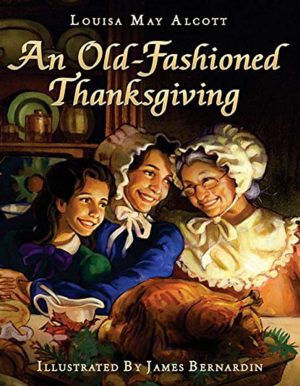
- An Old-Fashioned Thanksgiving by Louisa May Alcott, a New England farmhouse holiday from exactly the world Hale wanted to share with the whole country.
About Laurie Halse Anderson and Matt Faulkner
Anderson, born in Potsdam, New York, in 1961, is best known for teen fiction, above all Speak, but she started out writing picture books, and Thank You, Sarah by Laurie Halse Anderson came out in 2002, the same year as her teen novel Catalyst. Faulkner drew it with India ink, coloured inks, watercolour and gouache on Arches cold-pressed paper, which accounts for the etched, amber look of every spread.
- Speak was a National Book Award finalist in 1999.
- Anderson won the Astrid Lindgren Memorial Award in 2023, one of the richest prizes in children’s books.
- Her earlier picture book Turkey Pox grew out of her daughter catching chickenpox at Thanksgiving.
- The jacket flap notes that Anderson is a descendant of Hale herself.
- Faulkner, a Rhode Island School of Design graduate, later wrote and drew Gaijin: American Prisoner of War, a graphic novel set in a Japanese American internment camp.
Worth Your Shelf
For the week before the big Thursday, Thank You, Sarah by Laurie Halse Anderson is one of the most entertaining ways to answer a child who asks why the holiday exists at all. It is funny, the art rewards a second and third look, and the notes at the back carry real substance. Pair it with a Native-authored book about 1621, check the date against the back matter, and let it do what it does best, which is make a stack of letters look like the most exciting weapon in American history.
Then hand your reader a pen.