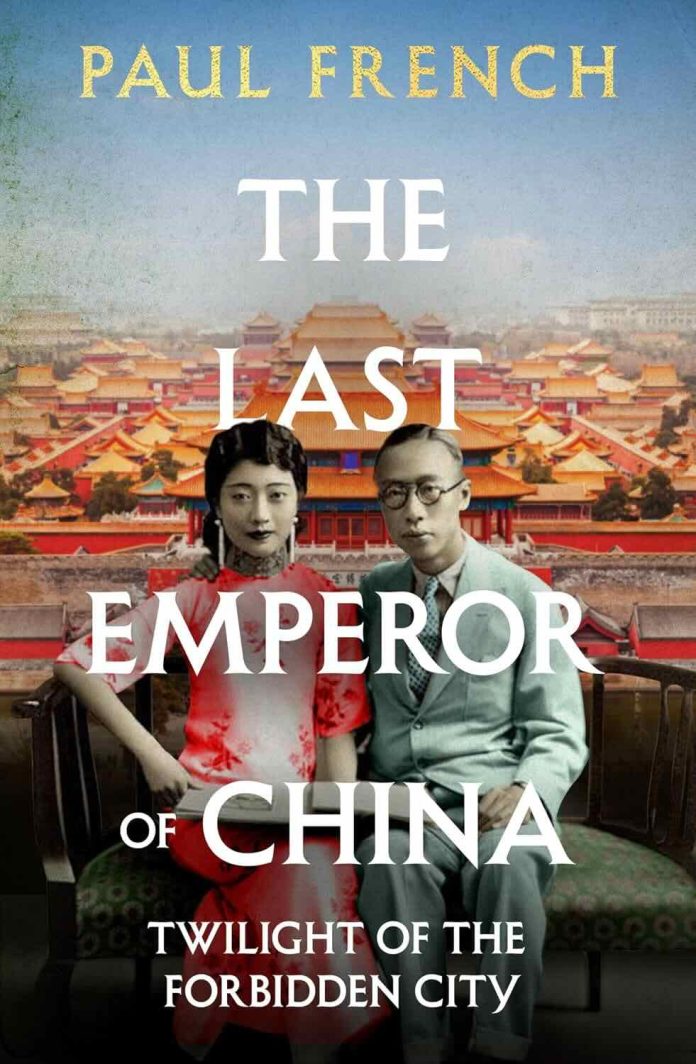
Since 1934 the standard account of the last two years anyone spent living as royalty inside the Forbidden City has come from a Scotsman who was quietly in love with a woman he almost never mentions. Reginald Johnston’s Twilight in the Forbidden City runs to five hundred pages and gives the empress’s own tutor exactly one sentence. The Last Emperor of China by Paul French is built out of what that tutor wrote instead, and it revises the received story further than any footnote correction has a right to.
Where The Last Emperor of China Sits
French has spent two decades as the chronicler of foreign Peking and Shanghai: Midnight in Peking on the killing of Pamela Werner, City of Devils on wartime Shanghai’s nightclub operators, a biography of the adman Carl Crow. The method holds steady. Take a narrow window, work the newspapers and the private papers until the period stops being scenery, and put the reader in the room.
The window here is twenty-three months. It opens with a wedding procession setting out at four in the morning on 1 December 1922 and shuts with warlord troops giving Puyi three hours to pack on 5 November 1924. Everything a general reader associates with the last emperor, Manchukuo and the Tokyo tribunal and the re-education centre, is compressed into one late chapter.
That narrowness is the argument. Three sources supply the popular version, and The Last Emperor of China by Paul French treats all three as interested parties: Johnston’s memoir, which French calls somewhat vainglorious; Puyi’s ghostwritten From Emperor to Citizen, produced under communist supervision and revised again as recently as last year to fit the current line in Beijing; and Bertolucci’s film, which cast Peter O’Toole and settled the Scotsman’s face in everyone’s head for good.
What the Ingram Papers Change
Isabel Ingram was born in Peking in 1902 to American missionaries, graduated from Wellesley in 1922, spent that summer riding four days into the mountains after a supposedly lost tribe, then took over from her older sister as English tutor to the Empress Wanrong. She kept a diary. She wrote constantly to her sister Miriam. Both survive with her family, along with Johnston’s letters to her, which is more than can be said for Johnston’s own forty-year archive.
What Ingram wrote down contradicts nearly everything the received account insists upon, and The Last Emperor of China by Paul French rests its whole case on it. The marriage is supposed to have been cold, sexless and humourless, the emperor feeble and unmanned. Edward Behr called Puyi bisexual, Bertolucci called him homosexual, Ian Buruma calls him most probably gay, and French notes that not one of them produces a scrap of evidence for it.
The counter-evidence is domestic and it accumulates. Bicycles ridden indoors, which meant prising out wooden thresholds that had spent five hundred years keeping spirits out of imperial buildings. A tennis court laid on the levelled ashes of a burned palace, Johnston umpiring because nobody else could plausibly call a ball out on the Emperor of China. Harold Lloyd shorts watched on a loop by a short-sighted young man who had just been given his first pair of glasses. Kite string let out over the eaves. Chewing gum, smuggled in by somebody who denied it.
What works
- The bureaucracy. The chapter on the Imperial Household Department is the sharpest institutional history in The Last Emperor of China by Paul French. Every candle, block of ice and grade of toilet paper had its own bureau, and the Imperial Buttery invoiced for 240 chickens and ducks a month on behalf of two people. Johnston called the department vampires draining the life-blood of the dynasty. French supplies the arithmetic behind the insult.
- The fire. The blaze of 27 June 1923 is handled as a crime scene: an audit due that morning, a storehouse of uncatalogued treasure at the epicentre, fire crews held at the gate on a technicality, fewer than 400 of 6,643 catalogued items recovered. No verdict is forced. The timing is left sitting there.
- Wenxiu. The consort is normally a footnote sulking in a distant courtyard. Here she has a tutor of her own and a habit of giving away the jasmine she is wearing.
- The footnotes. A parallel book. Japanese knotweed reaches Sandringham, a bamboo fire pump is weaponised with quicklime, and a Ming aristocrat with a magnificent title is found living in a hovel.
- The candour about sources. French flags the famous mislabelled-portrait anecdote as probably invented, sets Puyi’s version of the 1923 escape plot against Johnston’s flat denial without choosing, and says plainly when he is surmising rather than showing.
Where The Last Emperor of China Gives Ground
Four things stop The Last Emperor of China by Paul French from being as tight as its own premise.
- Chapter three is an anthology. Twenty pages of foreign visitors describing yellow roofs and vermillion walls, Pierre Loti through to Peter Quennell. French concedes mid-chapter that such accounts become repetitive, then runs four more.
- The eunuch chapter travels a long way from 1923. A good essay on castration, imperial employment and the trade in palace treasure, spent mostly in the Ming while the two-year clock stops dead.
- The diary material is slighter than the framing promises. Bolts of satin admired and immediately gifted, pastries from a Tianjin bakery, a braid rebraided because the first attempt was too tight. Charming, and cumulative, and the case is made long before the last of it arrives.
- The last chapter sprints. Twenty-two years are covered at a pace that would seem indecent if the preceding 250 pages had not been so patient.
Do You Need to Know the History First?
No, and that is one of the real strengths of The Last Emperor of China by Paul French. The Qing collapse, the Articles of Favourable Treatment, the warlord factions and the New Culture Movement are explained where they are needed, without the tone dropping into a textbook. A cast of characters, a list of Qing emperors, two maps and a note on romanisation sit front and back. Readers arriving from the Bertolucci film will find it corrected on several points and quietly endorsed on one: its portrait of three young people who mostly got along.
Content notes for The Last Emperor of China
The Last Emperor of China by Paul French is a work of history and does not soften what it records. The castration procedure is described clinically and at length, including a father operating on his own eight-year-old son. Two suicides, one by opium and one by drowning. Physical punishment of servants, including a bureau that existed to administer beatings. Addiction and a forced withdrawal described in detail. The killing of a newborn. A fatal shooting during a burglary. Colonial and racist attitudes are quoted from the period sources rather than endorsed.
Read these next
Five for readers who finish The Last Emperor of China by Paul French and want the same register:
- Killers of the Flower Moon by David Grann. The closest match for method: a narrow window and archives doing the accusing.
- The Billion Dollar Spy by David E. Hoffman. For readers who like a historian showing which document supports which claim.
- Risky Business in Rising China by Mark Atkeson. The far end of the same century, and useful on how much of this is still live politics.
- Hundred Beam Bridge by Ted Marr. Chinese history worked as story rather than survey.
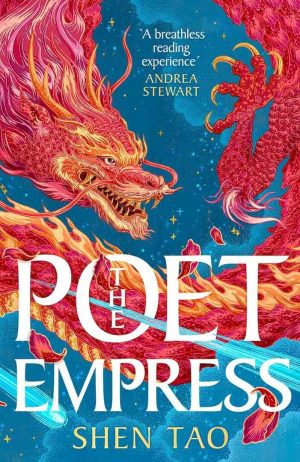
- The Poet Empress by Shen Tao. The fictional counterpart: the inside of a court rather than its ledgers.
Tagore’s 1924 visit, one of the best set pieces here, lands harder once you know he had been the first non-European laureate in literature a decade earlier.
The Last Word
Two years that every previous account agreed were miserable turn out to have been rather happy, and the pleasure of The Last Emperor of China by Paul French is watching a settled story come apart under ordinary domestic evidence: hats, cake, a borrowed camera, a swing in the Imperial Garden. It drifts whenever it leaves that evidence, and it drifts more often than a twenty-three-month subject should allow. What holds is the shape. Two tutors, four young people, one enormous cold building, and a clock nobody in the room could hear. The epilogue puts the emperor back at his own front gate in 1960, in a gardener’s uniform, queuing with everybody else to buy a ticket into the house he grew up in. He pays. He goes in. And he looks for the ants.