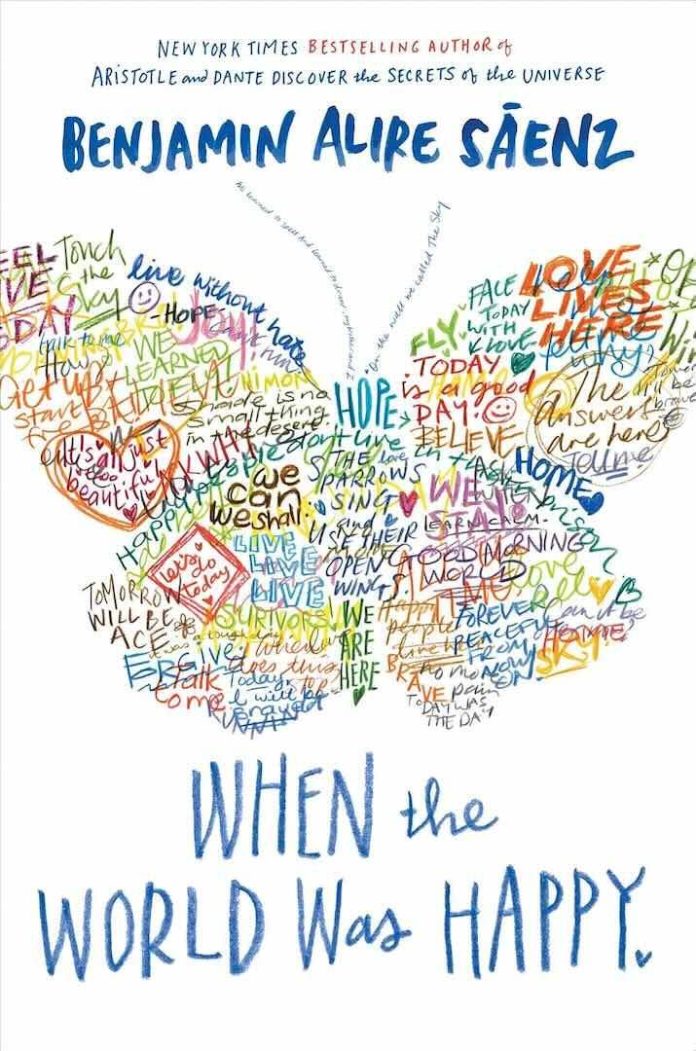


In the Cervantes house there is a hallway wall the children are allowed to write on. CheChe and his twin sister, Emma, cover it in drawings, jokes and passing thoughts, and when it is full their father photographs it, paints it over and lets them start again. Only one thing is never covered: a poem Emma wrote at twelve about the wall itself, which the family calls the Sky. When the World Was Happy by Benjamin Alire Sáenz uses that wall as its running record. You can read the whole novel in what gets written there, from birthday nonsense in the summer to a drawing of a rifle in the autumn, and the change is the book’s argument in miniature.
The first half is the before. CheChe is seventeen, gay, bookish and, by his own account, chronically happy, in a family with no television and books in every room. Then gunmen walk into El Paso High on the third day of junior year. The publisher’s copy tells you the rest of the premise, so we can too: CheChe loses a leg, friends die, and the remainder of the novel follows one year of trying to live in a house where sadness has finally got through the door.
The Twins and the Year That Splits Them
The spine of the book is CheChe and Emma. Sáenz writes their bond as a running double act. They trade mock definitions, accuse each other of mockery and admit to it, and finish each other’s arguments. Emma is the serious one, a pianist who claims to see angels and dreams things before they happen; CheChe is the wisecracker who wants to feel everything. In Book One that pairing is a pleasure. After the shooting it becomes the novel’s best instrument, because the twins grieve in opposite directions. Emma refuses to fall apart, and CheChe falls apart loudly.
Structurally, Sáenz takes risks here that YA rarely does. Each of the three Books opens with a short italic passage addressed to someone the narrator loves. Some chapters run for pages and some are a single paragraph of shock. One chapter is little more than a bare count of the dead and wounded and what happened to the survivors afterwards, and it is among the most painful pages in When the World Was Happy by Benjamin Alire Sáenz precisely because it refuses to dramatise.
The physical recovery is handled with real care. CheChe’s phantom pain, the crutches he hates, the prosthetic he eventually names, and a physical therapist called Santiago who jokes his way past every defence are all specific and unsentimental. Sáenz is clear that phantom limb pain is real pain, not a figure of speech, and the book’s slow account of it coming and going is one of its quiet achievements.
Spigot and the Family That Grows
If the twins are the heart, Spigot is the surprise. He arrives in Book One as the father’s summer art intern: a smoker with a bitter mother at home, a younger brother he adores and a firm belief that he is worth nothing. Sáenz lets him be prickly and funny before he is anything else. His arc across When the World Was Happy by Benjamin Alire Sáenz is the clearest line of change in the novel. A boy who wants to disappear learns, slowly and against his own resistance, that a family can be chosen.
Against that warmth Sáenz sets rage, and he does not soften it. CheChe hates the shooters, then hates himself for hating, then hates the adults who let it happen. His father, a gentle painter, turns his own grief into a project, painting a portrait of each of the dead for their families. Their best friend J sends a letter about what he saw that is harder to read than any of the action. The tension between the family’s creed, that love is the only thing worth carrying, and the anger everyone now carries is the real subject of When the World Was Happy by Benjamin Alire Sáenz, and Sáenz never pretends it resolves neatly.
Where It Gives Ground
- The idyll runs long. Book One of When the World Was Happy by Benjamin Alire Sáenz takes up roughly half the novel, in near-frictionless happiness. The design is deliberate, but the first half can feel like a fond family portrait waiting for its plot.
- Everyone is wise. The Cervantes household is uniformly eloquent and saintly, and Emma in particular reads closer to an angel than a girl. Less friction would have meant more drama.
- Speeches replace scenes. Adults, and later students, often deliver the book’s politics on guns and book bans as long addresses. The passion is sincere, but CheChe’s small private reactions do more work than any of them.
- The word beautiful is overused. Characters call each other beautiful so often that the word stops landing.
Read These Next After When the World Was Happy
If When the World Was Happy by Benjamin Alire Sáenz leaves you wanting more, start here:
- Twenty-Four Seconds from Now by Jason Reynolds for a tender, funny teen love story from one of YA’s sharpest voices.
- The Survivor Wants to Die at the End by Adam Silvera for queer teens, mortality and a story about who gets to keep living.
- This Is Where It Ends by Marieke Nijkamp, for a school shooting told minute by minute from several students’ views.
- The Hate U Give by Angie Thomas, for a teenager forced to speak after an act of violence that the country turns into a debate.
- Aristotle and Dante Discover the Secrets of the Universe by Benjamin Alire Sáenz, for the El Paso boys who made his name.
For more on the patterns these books share, see our guide to young adult book tropes.
About Benjamin Alire Sáenz
Sáenz, who died in El Paso in July 2026 at 71 after a long illness, did not live to see When the World Was Happy by Benjamin Alire Sáenz published. A poet before he was a novelist, he wrote for adults, teenagers and young children, and this book is dedicated to his sister and her murdered daughter. Some facts worth knowing:
- Aristotle and Dante Discover the Secrets of the Universe (2012) won the Stonewall and Pura Belpré awards and was a Printz Honor book.
- Its sequel, Aristotle and Dante Dive into the Waters of the World, followed in 2021, and a film of the first book was released in 2023.
- In 2013 he became the first Latino writer to win the PEN/Faulkner Award, for Everything Begins and Ends at the Kentucky Club.
- He taught creative writing at the University of Texas at El Paso until he retired in 2016.
- His author’s note says the 2022 school shooting in Uvalde, Texas, was what finally made him write this book.
Worth Your Shelf
This is not an easy book and it is not a perfect one. It is long, it preaches, and its happy family is happier than any family has a right to be. But the shooting lands as a personal loss rather than a news event, the recovery is honest about anger, and Spigot alone is worth the trip. As a last book, When the World Was Happy by Benjamin Alire Sáenz ends where its author always did: insisting that love is work you do every day, even when the wall has to be painted over and started again.