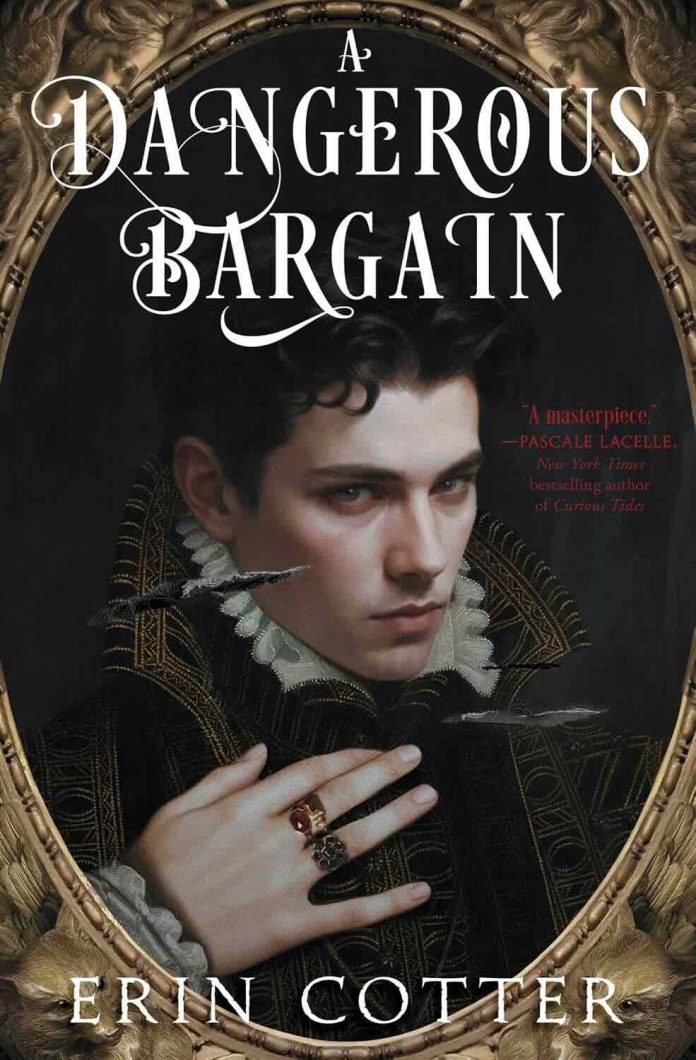
Here is the argument worth having about A Dangerous Bargain by Erin Cotter, and it is not the one the cover is selling. This is a novel about paying for your own talent. Its narrator is an apprentice painter who has traded away, by his own estimate, decades of his remaining life for a steady hand, an unerring eye for colour, and paints that never dry out. Each transaction is a black mark on his skin. There are hundreds. He is seventeen, he supports his mother and sisters on those skills, and has no idea how little he has left until somebody does the arithmetic aloud.
The Ledger on His Arms
The system in A Dangerous Bargain by Erin Cotter is the best thing in it, because it is an economy rather than a spell list. An angel bound to a workshop grants magic; the artist pays in blood, and in time or memory. Small bargains give good value; large ones ruin you. A day for a perfect recalled image of a snowy tree in midsummer. Half a year for paints that stay wet. Ten years in one gulp, after his brother disappears, for the ability to feel when a painting is going wrong.
Florence’s wealthy compete to attract angels, so the city’s appetite for beauty is an arms race, so there is always more work, so every artist has a reason to keep cutting. One apprentice swaps the memory of his grandmother’s house for a party trick. A painter in an earlier generation gave away the memory of his dead wife for colour sense, and spent a year losing the ability to see colour at all. That is a very good piece of invention, and it does the thematic work without a speech.
What A Dangerous Bargain by Erin Cotter Does With Leonardo
Putting the historical Leonardo da Vinci in your romantasy as a seventeen-year-old apprentice is an enormous swing, and it mostly connects, because Cotter does not write a genius. She writes him as somebody who cannot start work to order.
He is late for everything, misses every deadline, is punished with chores, and is kept on because the things he does finish make patrons weep. He cannot draw the fresco he has been assigned and spends the day on blueprints for a flying machine instead. And he needs another person in the room before his attention settles. He tells the narrator that his mind does not work like other people’s, that his stepmother called this a gift, and that four years in he is no longer sure she was right. Anyone who has failed to begin a task they genuinely wanted to do will recognise the portrait, drawn with affection rather than diagnosis.
Where the Angels Actually Come From
The reveal in A Dangerous Bargain by Erin Cotter arrives in three stages, each landing harder. First: the angels are demons, and the Medici know. Second: the bargains do not cost time, or not only time. Third, and this reorganises the novel, demons do not descend from anywhere. They wear people. Florentines are killed so a demon has a body to occupy, tethered by a painted portrait, and the ruling family has spent generations supplying the bodies and calling it a holy honour.
It converts a pleasant magic system into a political one. The city’s beauty runs on disposable people, the church blesses it, the bank collects, and the poor may not bargain at all. There is a superb scene in which a slum crowd, denied the magic their city is famous for, cut their own arms open in front of an angel and beg.
A Dangerous Bargain by Erin Cotter and the Girl in the Corner
Lupa is the reason to read this. The replacement angel arrives feral, filthy and furious, refuses the name a priest gave her, and accepts the one the narrator offers instead, because it means she-wolf and she likes that men should be afraid. She asks why humans eat deer but not dogs. She steals a cake so somebody can have a birthday. And she has a healing scar behind her ear, which angels should not have, and magic the bargain system cannot account for.
What Cotter does with her is the novel’s real achievement, and I will not spoil it beyond saying that the question of whether a predator can be judged for being hungry is asked early, answered honestly, then asked again from the other side. Her last line in Florence is a joke. It is also a plan.
Where A Dangerous Bargain by Erin Cotter Overspends
- Fifty-nine chapters and an epilogue. Most end on a hook, several deliver one beat, and the middle third reads like a serial paid by the instalment.
- The Medici are cardboard. The father is a sneer with magic and is never tested; the son’s change of heart is the only complication, and it arrives as a single thrown object.
- The voice has two moves. A self-deprecating aside, then an italic self-rebuke. Delightful for two hundred pages, mannered by four.
- The narrator’s illiteracy is a plot device as often as a character trait. It stops him reading the one ledger that matters at precisely the moment the story needs a delay, then goes quiet for a hundred pages.
- The underworld sequence is the weakest stretch, a shame with Dante’s poem sitting in the narrator’s chosen name. Three obstacles, three offers of a bargain, three acceptances.
- The most daring choice in the ending is under-tested, recovering most of what it costs within a single scene.
Content Notes
A Dangerous Bargain by Erin Cotter runs on blood, so expect repeated, casual self-cutting to pay for magic. A politician has his throat cut on the page while the narrator hides in the spreading blood. Several stabbings, one fatal. Suicide as a deliberate plot action: the narrator takes his own life in order to reach the underworld, and the novel frames it as sacrifice; there is also an earlier passage about standing on bridges after his brother vanished and wondering whether he would save himself. A corpse displayed as a threat. A young woman is killed so a demon can wear her, and her history of domestic violence is given. Souls are tortured, and a brother’s screams are heard offstage. A father’s sustained emotional cruelty and one recalled beating. Two sex scenes between the leads, not explicit.
Read These Next
- Graceless Heart by Isabel Ibañez. The closest match for Renaissance Italy as a place people work rather than a backdrop.
- The Rose Bargain by Sasha Peyton Smith. For readers who came for a magic system built out of contracts.
- As Many Souls as Stars by Natasha Siegel. Queer historical romance with a heavier literary hand.
- The Once and Future Queen by Paula Lafferty. For the enemies-in-a-workplace pairing at a larger scale.
- The Best Historical Fiction Books That Will Make You Travel Through Time. Useful for placing this beside the straight historical version.
The Last Word
The workshop detail is the quiet pleasure. Apprentices grind pigments and prep panels with glue, linen and gesso. Commissions are collaborative, so several hands touch one painting and nobody signs it. Verrocchio makes them sketch together every morning and they all resent it. A dog comes out looking like a millipede and has to be fixed by somebody better. Cotter has done the reading and uses it for character rather than texture: the narrator cannot bear to hand over his brush because handing it over admits the magic is gone.
What the book finally argues is that the magic was never the point, and the evidence is aesthetic rather than stated. The art that matters in this novel is all technically poor. A child’s sketch of two foxes bought for a single coin. A lopsided homemade locket. A set of clumsy finger-paintings hung in a garden as a trail of breadcrumbs for somebody who has forgotten you. A Dangerous Bargain by Erin Cotter is too long and too fond of its own hooks, and it ends on a pun about a rebirth that I laughed at and then thought about for an hour. “A renaissance, if I may.”
On the matter of bargains: Simon & Schuster Books for Young Readers sent this copy, on the terms the narrator never once gets offered. Nothing was taken in blood, no memory was required, and the only thing owed back was an honest opinion. In a book where every transaction leaves a mark on somebody’s arm, this one left none, and the review would have said exactly this either way.







