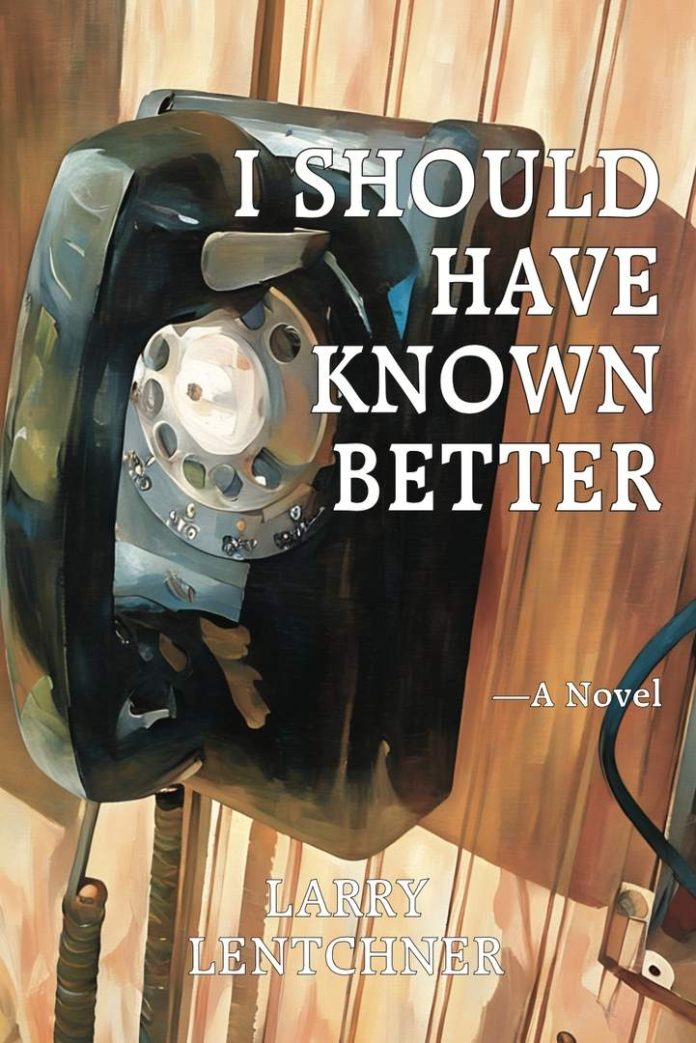





At a party in an Alphabet City walk-up in the Sixties, a young social worker who knows nobody retreats to the kitchen and starts making pancakes for fifty stoned strangers. Before the bowl reaches the stove, a woman he has never met dips a finger in for a taste and tells him it was just what she needed. Her name is Sheila Allenberg, and he will spend the next sixty years working out what happened in that kitchen. I Should Have Known Better by Larry Lentchner begins there, and the scene earns the weight the book puts on it. Phil Green is already complete in it: a man who hides in useful work and mistakes being chosen for being known.
I Should Have Known Better Plot Summary
In I Should Have Known Better by Larry Lentchner, Phil Green, an old man now, sets down his life in seventy-nine numbered entries because he promised a woman he would. He sorts it by the women he loved. Sheila is a rising editor at Random House who leaves him after nine and a half months. Caroline is an environmental engineer who is his best friend long before she is his wife. Vera is the secretary who quietly runs his office. Around them run his work with homeless alcoholics at the Bowery Project, his own short and ugly spell of drinking, a baby sister who arrives when he is thirty-one, a daughter who does not speak until she is two and a half, a lucrative detour into corporate life, and a serious illness in his late fifties. Sheila keeps coming back.
The Ghost in the Batter
The title is the refrain. Phil says it at the end of most entries, and for a while it sounds like a tic. Then, in the sixth entry, Lentchner shows what it is for. Sheila has left Phil for a wealthy investor and a better job, and Phil lists the stories he could have told himself afterwards: that she was a gold-digger, that it was only sex, that she was right for a fling and wrong for a life. Any of them would have let him move on. He picks the one that will not, which is that they were a perfect fit undone by bad timing. From then on she is the standard every other woman fails to meet. “I seem to lose women in my life like most folks lose their keys,” he says later, and by then the reader knows why.
This is the sharpest thing in I Should Have Known Better by Larry Lentchner, and it comes from the author’s day job. Lentchner is a psychologist, and he understands that Phil is haunted less by a woman than by a story about her. He gives that idea objects to live in. There is Polyphemus, a one-eyed toy dragon who fires matzo balls, born from his father’s bedtime tales and meant to make the young couple’s fortune. The prototype sits in every living room Phil ever has, and neither wife is told what it commemorates. At his wedding he wears a rubber band under his cuff, ready to snap it if Sheila enters his head. He also gives the self-reproach a name, the Inquisitor, and a voice that is foul-mouthed and very funny.
The voice carries the book. Phil talks straight to the reader, with puns and football for punctuation, and he is honest about his own imposter syndrome, which makes every success feel precarious.
The People Who Pull Him Out
Against the ghost, the novel sets a crowd of people who are actually there. The first is George Bloomstein, who finds Phil face down outside a bar, hears him protest that he is a social worker who helps people, and laughs until he cries. The card George leaves in his pocket says he is a social worker too. The sober years at the Bowery Project that follow are written with real feeling for the receptionist who runs the door and the cook who runs the kitchen.
Caroline is the book’s finest portrait. Their friendship is built on Giants games and bodega empanadas, and when it tips into something else, the two of them negotiate it over dinner with a pinky swear. He later proposes with a Life Saver. Lentchner lets her be sharper than Phil throughout, and what becomes of the marriage is handled without a villain.
Phil’s parents are just as vivid: a mother who welds steel sculptures in a backyard shed in Reading, Pennsylvania, and a father who owns a dental lab and spends each year carving toys to hand out in a Santa suit. At fifty-seven they take in an orphaned newborn, and ask their son to stand behind her.
The later entries turn to the body. I Should Have Known Better by Larry Lentchner is frank about male illness in a way few novels manage, and it stays comic under pressure. Of one humiliating hospital moment Phil says, “I wasn’t taking a leak, the leak was taking me.”
What works
The strengths of I Should Have Known Better by Larry Lentchner are easy to name.
- A voice you would follow anywhere. Phil is funny on the first page and still funny on the last, and the jokes never cancel the feeling.
- Entries that read like visits. Each one is short, shaped and complete, so the book suits a chapter a night as well as a long weekend.
- Grief handled with tact. When the losses come, Lentchner writes them briefly and lets the silence do the work.
Read These Next
- Oh William! by Elizabeth Strout, for another narrator turning over a first marriage decades on, in a voice just as direct.
- A Forty Year Kiss by Nickolas Butler, for a first love revisited late in life, with drink in the background.
- Tom Lake by Ann Patchett, for a youthful affair retold from the calm of a long family life.
- Everyman by Philip Roth, a short novel that tells one man’s life through his illnesses.
About Larry Lentchner and I Should Have Known Better
Larry Lentchner, Ph.D., is a practising psychologist with half a century of psychotherapy behind him, and the consulting room is audible in every entry of I Should Have Known Better by Larry Lentchner. According to the book’s own author note, he divides his year between New Jersey and Florida and keeps a small practice so that he has time to write.
- Earlier books: Onederland, The Reluctant Guru of Alphabet City and Sexual Survivors
- Father of four and grandfather of five
- This novel was published in 2026 under the Absolutely Amazing Books imprint and runs to 335 pages
The Last Word
What stays is the generosity. Phil Green is a comic creation with a serious purpose, and by the final entry the refrain has changed its meaning without the author forcing it. I Should Have Known Better by Larry Lentchner argues, through one long and ordinary life, that regret is a story a person chooses, and that a kinder one is usually available. Readers who have loved the right person at the wrong time will recognise themselves in it.
The pancake adage Phil quotes says you throw the first one away. His novel is about the man who kept it.
Content notes tap to reveal
Where to read I Should Have Known Better
Amazon lists the current Kindle, print and audiobook editions, and shows whether the ebook is in Kindle Unlimited right now.
To borrow it free, try your library: Libby and OverDrive lend ebooks and audiobooks with a library card, and WorldCat finds print copies near you.
We don’t link to “free PDF” sites. Those copies are pirated and pay the author nothing.