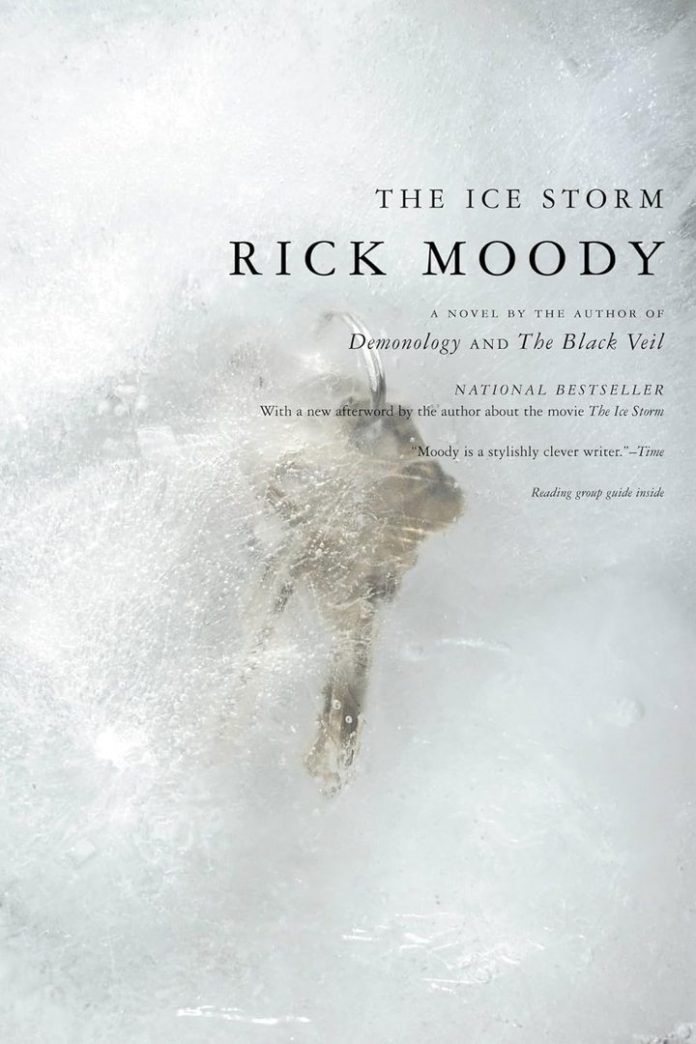


The hostess meets the Hoods in her front hall with a celery stick of dip in one hand and a plain white salad bowl in the other. Inside the bowl, a dozen sets of house keys clink together on novelty fobs. Benjamin Hood thinks it is the setup for a joke. His wife understands first. They retreat to the car to argue, and he takes off the silk ascot he has just realised nobody wears any more. Then he goes back in, tosses his keys into the bowl like a valet, and heads for the bar. The Ice Storm by Rick Moody is built around that bowl, and around the weather that closes over the town while the adults are busy choosing from it.
How It Works
The novel covers roughly a day, from Friday afternoon to Saturday morning on Thanksgiving weekend 1973, in New Canaan, Connecticut. Rain turns to sleet, sleet to a glaze of freezing rain, and by midnight the power lines are coming down. Two neighbouring families share the stage. The Hoods are Ben, a securities analyst quietly being frozen out at his firm, Elena, and their children, Paul, sixteen, and Wendy, fourteen. The Williamses are Jim, Janey, and their sons, Mikey and Sandy.
In The Ice Storm by Rick Moody, each member of the cast gets a long section from close inside their head, and the author moves them around a small board: a guest room, a basement, a key party, a Park Avenue apartment, a stalled commuter train. Paul is the one kept away from home. He has gone into Manhattan chasing a girl from school, and his night runs parallel to everyone else’s.
Holding it all together is the book’s real device. The story is told by someone from inside the two families, looking back twenty years later. He announces himself on the first page as a gossip with a part to play, then mostly vanishes behind the characters, stepping forward again in the third section to admit that he is imagining scenes he could never have witnessed. Who he is, and why that matters, is the last thing the book gives you.
What The Ice Storm Is Really Doing
For most of its length, The Ice Storm by Rick Moody is a satire of a specific moment: the Summer of Love arriving in Fairfield County five years late, diluted to cocktail parties, transactional analysis and wife-swapping. The book opens with a list of everything that did not exist yet, from answering machines to AIDS, and it means the list as a warning. These people are freer than their parents and have no idea what to do with it.
Then the weather stops being a backdrop. The machine Moody has been assembling, with every character out of place and out of contact, starts to turn, and the separate threads converge on one dawn. The comedy does not disappear so much as freeze over. It is a long setup for a very sudden payoff, and the payoff earns it.
The holiday matters. Nobody sits down to a Thanksgiving dinner on the page; the meal is already over when the book begins. What remains is the long weekend after it, when everyone is home, bored and slightly drunk, and the children have been let off the leash. As a book for that weekend, it is the opposite of comfort reading.
What works
- The key party. The draw from the bowl is a set piece of social cruelty, timed like farce, and Ben’s public collapse is both very funny and painful to watch.
- Ben himself. Lonely, self-deceiving, crippled by mouth ulcers and anxiety, he should be unbearable. Moody makes him human, and gives him one stretch of unexpected decency late on that is the moral centre of the novel.
- The Fantastic Four frame. Paul reads his family through Marvel comics, with his father as the Thing and his mother as the Invisible Girl, and issue #141, about a father who harms his own son, shadows the whole book.
- The period detail. Watergate on every radio, Jonathan Livingston Seagull at the cinema, Duraflame logs, waterbeds. It is dense without ever feeling like a museum.
Where It Gives Ground
- The young teenagers. Long, explicit scenes involving a thirteen-year-old and a fourteen-year-old are written from inside an eroticised point of view. The Ice Storm by Rick Moody means to show children left unsupervised by their parents’ revolution, but the camera lingers, and some readers will stop there.
- The digressions. The second part opens with a page on polyurethane seating units, and a later aside on glitter rock reads like research pasted in. Some of it is satire; a lot of it is padding.
- The narrator’s game. A voice that claims to have imagined everything can say anything, and the self-conscious asides sometimes feel coy rather than revealing.
- Dated passages. Ben’s racist outburst at the television is characterisation, but a meandering section on Paul’s Black classmates has aged badly.
Read These Next
If The Ice Storm by Rick Moody leaves you wanting more families coming apart over a holiday, start here.
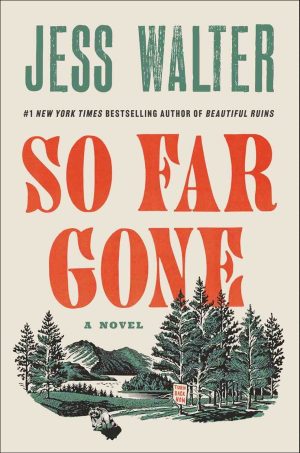
- So Far Gone by Jess Walter, whose whole plot turns on a Thanksgiving dinner argument. Funnier and kinder.
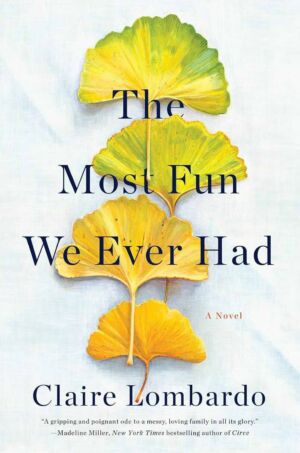
- The Most Fun We Ever Had by Claire Lombardo, for a big family saga that shares Moody’s interest in what parents’ marriages do to children.
- Revolutionary Road by Richard Yates, the 1961 ancestor of every Connecticut-commuter tragedy.
- The Corrections by Jonathan Franzen, another sprawling family converging on a holiday table, for readers who want more novel and less satire.
- Dinner at the Homesick Restaurant by Anne Tyler, for family meals that never quite get finished.
About Rick Moody and Some Ice Storm Trivia
Rick Moody was born in New York City on 18 October 1961 and grew up in the Connecticut suburbs where he set this novel. The Ice Storm by Rick Moody was his second book, and it became the breakthrough that made his name. He has since written the story collection Demonology, The Diviners, a satire of the television business, and Hotels of North America, a novel told entirely through online hotel reviews.
- Little, Brown published the first edition in 1994, two years after his debut, Garden State, won the Pushcart Press Editors’ Book Award.
- Ang Lee filmed it in 1997 from a script by James Schamus, who won the screenplay prize at Cannes that year.
- The film renamed the Williamses: on screen they are the Carvers.
- Much of the film was shot in New Canaan itself, and for the storm scenes a crew drove a water truck around at night, soaking streets and trees to make their own ice.
- Junot Díaz has said the book gave him the underlying structure for The Brief Wondrous Life of Oscar Wao.
What Stays With You
The comedy fades first. What remains of The Ice Storm by Rick Moody is the slow, almost silent final stretch: a family assembling in the cold, not yet knowing everything, and a narrator who finally tells you why he has been telling it. It is a flawed book and a cold one, uneven in its middle and careless about where its gaze rests. But Moody built the trap carefully, and when it shuts, it shuts.
Read it the weekend after the turkey, when the house is full and nobody is talking.