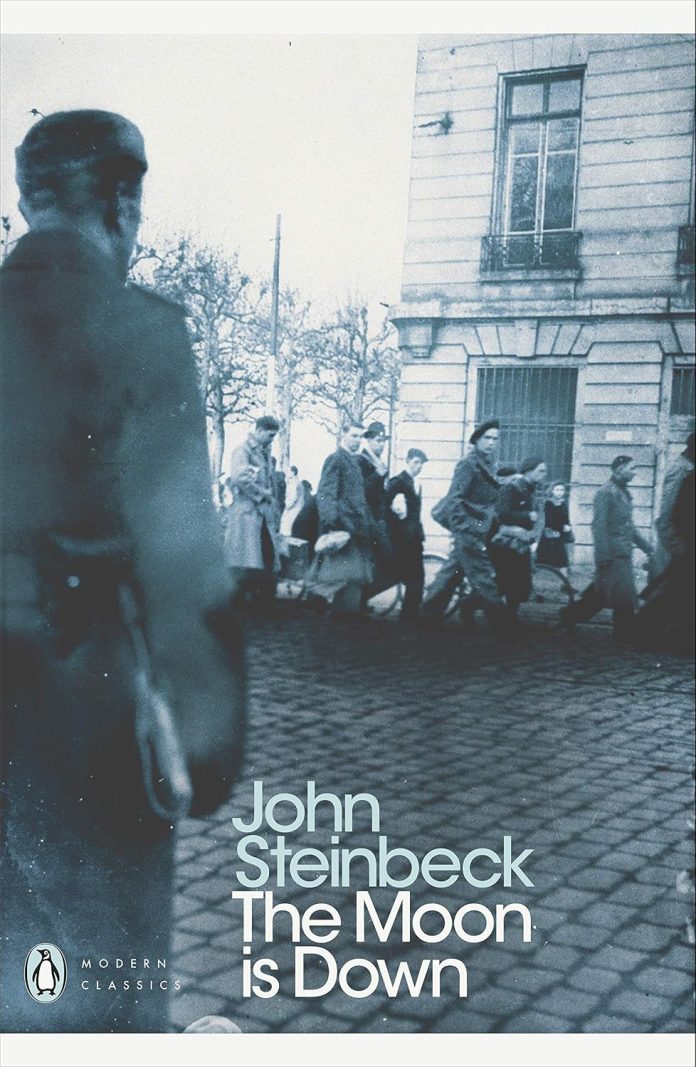
The Moon Is Down by John Steinbeck opens with an invasion that takes forty-five minutes. Six men die, the parachutes are folded away, the battalion is billeted in a warehouse that already held cots and blankets for exactly that number, and by ten forty-five the mayor has received a polite request for an audience.
That opening is the whole method of The Moon Is Down by John Steinbeck in miniature: brisk, procedural, and quietly appalling. The town has been sold by a local shopkeeper who stocked the warehouse in advance. Nobody shouts.
How The Moon Is Down Works
The Moon Is Down by John Steinbeck is the second of his play-novelettes, written to be performed directly from the published text as Of Mice and Men had been. The consequences are everywhere.
There are two main settings, the mayor’s drawing room and the invaders’ headquarters, and almost everything happens in dialogue inside them. Nobody is given an interior monologue. Characters are sketched in a line and then revealed by what they say to each other under pressure.
The most important formal decision is that no country is named. The invaded town has a coal mine, deep snow and a mayor called Orden. The invaders have ranks, a Leader and a doctrine. Neither nation appears on any page. The effect is to turn a specific 1942 argument into a portable one, and it is the reason the book travelled as it did.
What works
- Colonel Lanser is the achievement. The commanding officer is intelligent, weary, veteran of the previous war, and entirely aware that his orders will fail. He carries them out anyway.
- The dialogue is extremely efficient. Two pages of a cook and a manservant arguing about a trial tell you more about the town’s mood than any crowd scene could.
- The town’s resistance is unglamorous. No heroics. Slowed work, broken machinery, a request smuggled out asking the British to drop not troops but dynamite, small explosives and poison, so that the occupiers will never know which townsman is armed.
- The final act is genuinely moving without raising its voice, and Mayor Orden’s last scene turns on him trying to remember a passage of Socrates.
Where The Moon Is Down Gives Ground
- The characters in The Moon Is Down by John Steinbeck are positions before they are people. Tonder the romantic poet, Prackle the lecher, Lanser the professional. The schema is visible, and on the page it sometimes reads as allocation rather than characterisation.
- The townspeople are better in the aggregate than individually. Only Molly Morden acquires a real inner life, and she gets it in one scene.
- The anonymity has a cost. Keeping the countries unnamed buys universality and loses texture, and the town can feel like a diagram of a town.
- The women are thinly served. Molly Morden is given one excellent scene and a decisive act, and the rest of the town’s women appear mainly as a cook, a servant and a complaint.
- It is a thesis novel and knows it. The argument about free men and herd men is stated outright, more than once, by people who agree with each other.
The Mayor Is the Quiet Achievement
Orden is not a hero and The Moon Is Down by John Steinbeck is careful to say so. He describes himself as a simple man who
does not understand many things, and he is right. He has no plan, no network and no particular
courage until the moment arrives when courage is the only thing left on the table.
What makes him work is that the office outlasts the man. Early on he realises the invaders need
him to sign things, and that his signature is the only asset the town possesses. He therefore
does the one thing available: he refuses to be useful, slowly, politely, in a way that costs them
far more than a riot would have.
His last scene is the best in the novel. Facing execution, he tries to recall a passage of Socrates
from the Apology, gets some of it wrong, and is corrected by the town doctor. Two elderly men
getting a quotation slightly wrong, minutes before one of them is shot, is a stranger and better
ending than defiance would have produced.
Read it if
- You want The Moon Is Down by John Steinbeck for being the most unusual thing in his bibliography: a wartime commission that outlived its war.
- You liked the stripped form of Of Mice and Men and want to see it applied to politics.
- You are interested in propaganda that works by being fair.
Skip it if
- Schematic characters put you off.
- You want combat, or a thriller shape.
- You prefer his California books and their density of place.
The Charge Laid Against The Moon Is Down
On publication in 1942, a substantial body of American criticism attacked The Moon Is Down by John Steinbeck for being soft on the enemy.
The complaint had a basis. Lanser is reasonable. His junior officers are lonely, bored and frightened rather than monstrous. One of them is murdered by a widow he has tried, pathetically, to court. Nobody in the occupying force is a cartoon, and in 1942 a good many readers believed cartoons were what the moment required.
Steinbeck’s answer is built into the design. An occupier who is merely evil can be dismissed; an occupier who is competent, tired and under orders is a far more frightening proposition, and a far more useful one to describe to people actually living under occupation. The book’s position is that the system does the damage and that the men inside it cannot stop it, which is why Lanser is allowed to be clear-eyed about his own defeat.
Read these next
- A Literary Analysis of Of Mice and Men by John Steinbeck. The first play-novelette, and the better demonstration of the form.
- A Literary Analysis of The Grapes of Wrath by John Steinbeck. The other book where he writes to change what readers do, with far more anger.
- Travels with Charley by John Steinbeck. Late Steinbeck looking at his own country rather than somebody else’s.
The Verdict
Read it, and read it knowing what it was for.
The line the town invents is what lasts from The Moon Is Down by John Steinbeck. An officer says, carelessly, that the flies have conquered the flypaper, and within days it is a song everybody is singing. That is the whole book: an occupying force that holds every building and cannot hold the place, told in a voice too cool to gloat.
It was translated in secret and moved through occupied Europe by people who could have been shot for carrying it. Very few novels have been that useful to anybody, and fewer still are worth reading once the use has passed. The Moon Is Down by John Steinbeck is both.