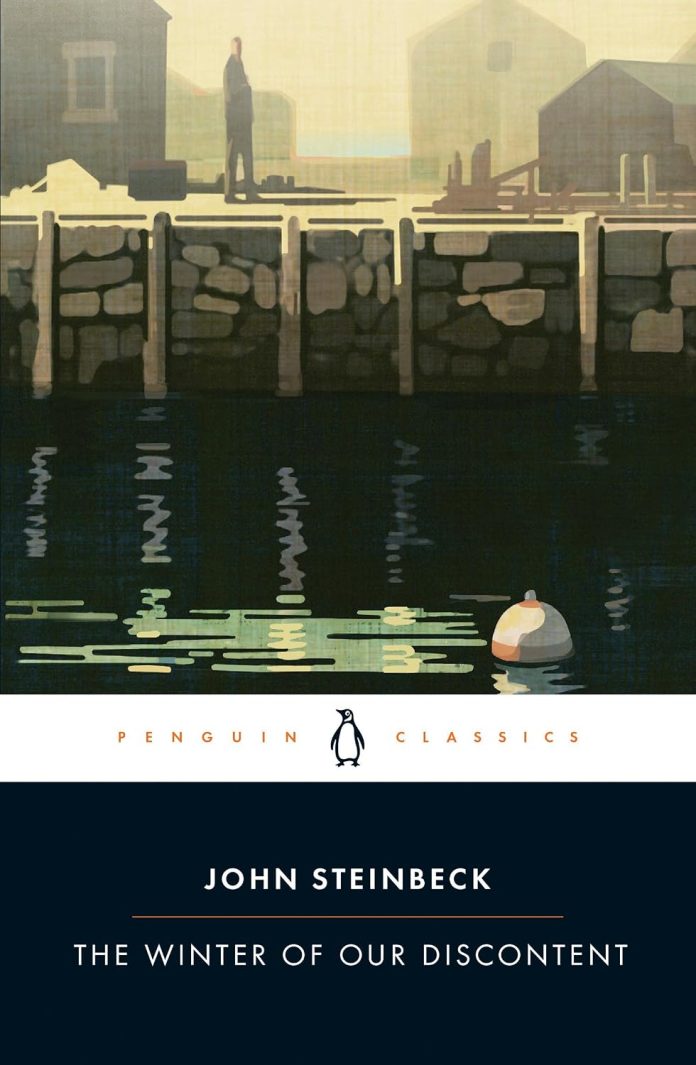
The Winter of Our Discontent by John Steinbeck opens on Good Friday with Ethan Allen Hawley waking his wife by pulling faces at her and quoting Browning badly. He is charming, literate, affectionate, and he clerks in a grocery store his own family used to own before it was sold to the Sicilian immigrant who now employs him.
By Independence Day he has informed on that employer to immigration, arranged for his oldest friend to drink himself to death in exchange for a piece of land, and planned a robbery. The Winter of Our Discontent by John Steinbeck is the record of that summer, and the unsettling part is how reasonable every individual decision sounds at the moment it is made.
Where The Winter of Our Discontent Sits in the Backlist
This was the last novel, published in 1961, seven years before his death and a year before the Nobel Prize.
The two facts are connected, and not flatteringly. The Nobel citation leaned on it, and the American critical reaction was hostile, with reviewers arguing that the award was decades late and that the recent work did not justify it. Steinbeck himself, asked whether he deserved it, said no.
That history has shaped how the book is read ever since. It arrives carrying an argument about its author’s decline, which is unfair to it, because The Winter of Our Discontent by John Steinbeck is a far more controlled novel than the Monterey books and considerably angrier than anything he had written in twenty years.
What The Winter of Our Discontent Adds
The subject is new for him. Every major Steinbeck novel before The Winter of Our Discontent is about people with nothing. This one is about a man with just enough to be ashamed of, which turns out to suit him.
New Baytown is a small Long Island harbour town, and the moral weather is entirely post-war American: zoning, kickbacks, a bank, a town manager, an airport site worth a fortune to whoever holds the meadow. Ethan is surrounded by people doing small corrupt things competently and being admired for it. A travelling salesman offers him a bribe and tells him flatly that everybody does it.
What works
- The first-person voice is the best technical thing in The Winter of Our Discontent by John Steinbeck. Ethan narrates his own corruption in the same light, allusive, self-amused register he uses for everything else, and the gap between the tone and the acts does the work that outrage would have ruined.
- The structure is genuinely tight. Two movements, Easter to July, each ending on a betrayal, with the second mirroring the first.
- Danny Taylor is a real achievement. The town drunk, from an old family like Ethan’s, educated like Ethan, and the only person who sees exactly what is being done to him and signs anyway.
- Ellen, the daughter, is written with unusual care for a Steinbeck child, and the novel turns on her at the end.
Where The Winter of Our Discontent Gives Ground
- Margie Young-Hunt never quite works. She is the weakest invention in The Winter of Our Discontent by John Steinbeck. She reads cards, predicts the plot, and functions as a device that keeps announcing the themes. The novel would be stronger with less of her and no fortune telling at all.
- The symbolism is applied with a trowel. A family talisman in a glass case, Good Friday, a boy’s plagiarised essay on patriotism. Any two of these would have been plenty.
- The son’s subplot resolves too neatly and reads as a point being made rather than an event occurring.
- The last chapter strains. The ending is powerful but it arrives through a coincidence the book has not quite earned, and readers who find it contrived are not wrong.
The Betrayal That Costs Most
The informing on Marullo is the more shocking act in The Winter of Our Discontent by John Steinbeck. The one that lingers is Danny Taylor.
Danny is the town drunk and everybody knows it, in the way small towns know things: good family, old family, last of the line, a decent education and some trouble at the Academy that nobody quite specifies. He and Ethan grew up together. He is also the registered owner of the meadow outside town, worthless scrub that will be worth a fortune the moment the airport is approved.
Ethan gives him money. He knows exactly what Danny will do with it. He knows it with enough precision that the novel does not need to explain the arithmetic, and Danny knows too, and signs the paper anyway, and says so.
What makes the scene unbearable is that Ethan tells himself it is a loan toward a cure. The narration lets him have the thought and then quietly declines to endorse it. There is no moment where he admits what he is doing, because the whole method of The Winter of Our Discontent by John Steinbeck is that the admission never comes.
Read it if
- You want The Winter of Our Discontent by John Steinbeck for what it uniquely is: late Steinbeck at his most controlled, and the only novel where he writes about money rather than hunger.
- You like first-person narrators who are more charming than they should be.
- You have read the famous books and want the one that argues with them.
Skip it if
- You need a sympathetic protagonist, or a plot that punishes on schedule.
- Heavy symbolic machinery irritates you.
- You came to Steinbeck for the migrant novels and want more of that.
About That Title
It is the opening of Richard III, and the choice is doing more than decoration. Richard announces that the winter of discontent has been made glorious summer, then spends the play demonstrating that he intends to be a villain because the peace has no use for him.
Ethan’s version is quieter and the mechanism is identical. He is a decent man in a town where decency has become a form of failure, and he works out, over about ninety pages, that he can simply stop. The novel never lets him claim he was forced.
Read these next
- A Literary Analysis of East of Eden by John Steinbeck. The other late book about whether a man is free to choose, and the one with the architecture to prove it.
- Cannery Row by John Steinbeck. The opposite argument, made fifteen years earlier: poverty as the only honest condition.
- Tortilla Flat by John Steinbeck. Where the idea that money corrupts first appears, played for laughs.
Readers new to his later work will find our guide to reading classics without feeling intimidated useful, and this is a better entry point than its reputation suggests.
Worth Your Shelf
Yes, with a caveat about the last twenty pages.
What The Winter of Our Discontent by John Steinbeck understands, and what makes it worth reading now rather than as a footnote to a Nobel argument, is that moral collapse does not announce itself. It arrives as a series of sensible decisions taken by a likeable man who can explain each one.
He goes down to the water at the end with razor blades in his pocket, and finds that his daughter has slipped the family talisman in there while hugging him, so that the light would not go out. Whether that rescue is earned or convenient is the argument the book leaves you with. That it is the daughter, and that she does it without being asked, is the part that holds.

