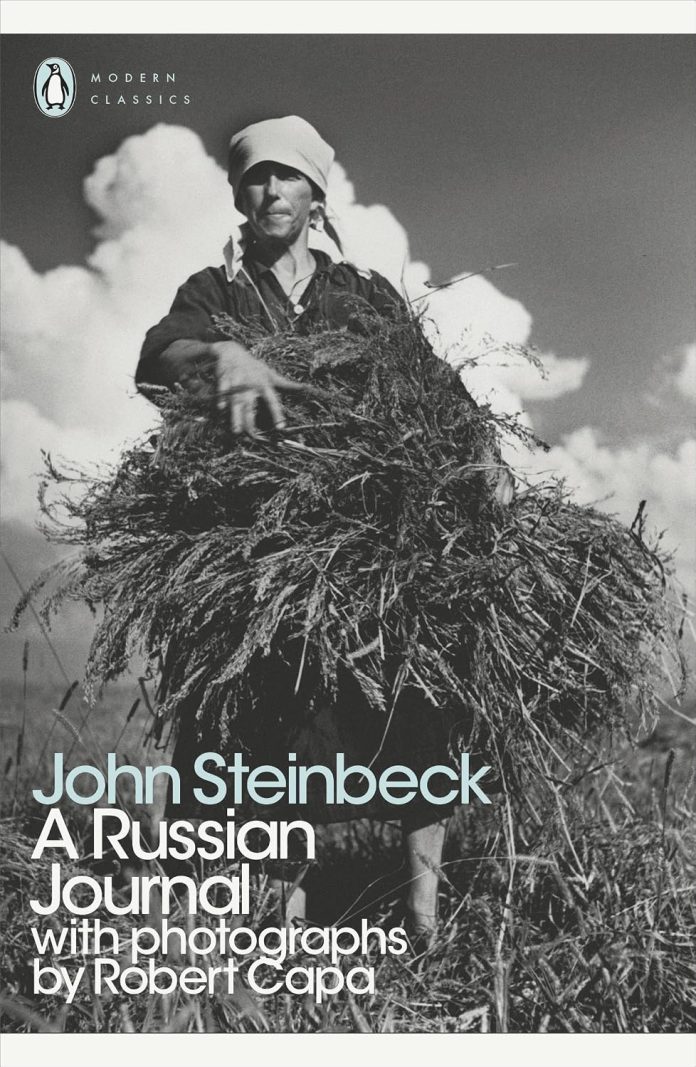
Two thirds of the way through A Russian Journal by John Steinbeck the travellers reach Stalingrad, and behind their hotel there is a garbage heap with a small mound beyond it, like the mouth of a gopher hole. Every morning a girl crawled out of it. She was filthy, barefoot, long-legged, and when she lifted her face it was one of the most beautiful faces the two men had ever seen. Her eyes were not quite human. She ate melon rind and sucked other people’s soup bones for two hours, then slept in the weeds. One morning a woman gave her half a loaf of bread and she snatched it and watched the woman until she had gone. While she ate, her shawl slipped, and her free hand came up automatically and put it back over her breast.
A Russian Journal by John Steinbeck contains about four pages of that quality, and they are the reason to read it.
The Rule They Imposed on A Russian Journal
In March 1947 Steinbeck was in a hotel bar on East Fortieth Street with a play that had failed four times. Robert Capa came in with a dead poker game behind him. Over three drinks they decided the newspapers were full of men explaining Russia who had never been, and that nobody was reporting what Russians wore, ate or laughed at.
So they went for forty days, from late July to mid-September 1947, paid for by the New York Herald Tribune. Steinbeck was forty-five and had shattered his knee falling from his apartment window that May. Capa was thirty-three and packed duplicates of every camera he owned.
The rule of A Russian Journal by John Steinbeck is explicit and gets repeated twice: set down what they saw and heard, offer no editorial comment, and draw no conclusions about anything they did not know sufficiently. Avoid the Kremlin, the military, and the larger issues. The last line of the book says it is not the Russian story but simply a Russian story.
What works
- The Stalingrad chapter of A Russian Journal by John Steinbeck is first-rate reportage. A city twenty miles long and two wide, flattened by shellfire rather than bombing, with its population living in the cellars of the flats they used to own, and women emerging from the rubble each morning combing their hair.
- It is much funnier than its reputation. A customs officer with a rubber stamp and no ink pad, who gets his impression at last by borrowing ink off the visitors’ fingers. A Georgian banquet at which the hors d’oeuvre was half a fried chicken each.
- Capa is the best character in the book. A thief of other correspondents’ detective novels, a man who occupies the only bathroom for three hours reading in the tub, who treats rain as a personal insult from the deity, and who after four thousand negatives decides every one of them is worthless.
- The small picture is always the right one. At a mass grave in a Stalingrad park, a child of five explains flatly that his father is buried there and he calls in each evening. A bookkeeper rebuilding his own house by hand stops to produce the scrapbook he rescued, which holds his wedding, his army service and some seaside holidays, and is the only thing he still owns from before.
Where A Russian Journal Gives Ground
- In A Russian Journal by John Steinbeck the no-conclusions rule becomes an alibi. When a man explains that nobody in a Soviet office will say yes or no without telephoning somebody senior, Steinbeck notes it is the same in any bureaucracy and moves on. The method forbids him from asking why this particular one was like that.
- It is padded. Long stretches of aircraft interiors, hotel plumbing, which restaurant has the better service, and a great deal of vodka. Whole pages exist because something happened that day.
- He only ever saw the approved route. Moscow, Kiev, Stalingrad, Tiflis, the circuit every Western visitor was shown. The book has no way of registering what lay off it.
- One devastating aside passes without comment. A decade of hard labour, handed down to two women over three pounds of stolen potatoes. He gives it a single sentence and keeps walking.
The Detail in A Russian Journal That Convicts Its Own Method
On the last morning of A Russian Journal by John Steinbeck the censors handed Capa a sealed cardboard box he was not allowed to open until the plane had cleared Kiev. He sat with it on his knees for four hours saying it felt too light.
Almost everything was there. Gone were a few frames with too much landscape in them, some of prisoners of war, and one more: the long-lens shot of the girl from the hole behind the hotel.
So the most extraordinary thing the trip produced survives only as Steinbeck’s prose. A book built on the principle that the camera has no preconceptions and simply sets down what it sees ends with the state removing the one frame that mattered, and with the writer noting that nothing important was withheld. He may have believed that. It is the most revealing moment in the book and he does not appear to notice it.
Read it if
- You want A Russian Journal by John Steinbeck for the Stalingrad material, which is as good as his war reporting gets.
- You like travel writing where the two travellers are funnier about each other than about the country.
- You are interested in the first winter of the Cold War as a thing people were living in rather than analysing.
Skip it if
- You want to understand the Soviet Union in 1947, because this book has decided in advance not to tell you.
- Long passages about airline seating and hotel bathtubs will test you.
- You need a travel writer to have a position.
Where A Russian Journal Sits in the Backlist
A Russian Journal by John Steinbeck was published in April 1948, after serialisation in the Herald Tribune through late January, and it is the last piece of the war journalism that began when the same paper sent him to England and North Africa in 1943.
The reviews split. The New York Times allowed it was better written than most books about Russia and more superficial than many. One critic praised only Capa’s photographs. A Ukrainian academic in Munich published a response titled, roughly, why did you not want to see. Soviet papers, which might have been expected to approve, called the pair gangsters and hyenas once the book appeared.
What is genuinely important about it is what it did to him. He went home and started thinking about the long novel that became East of Eden, and his subject from then on is individual moral choice rather than the group. He had just spent forty days in a country where the group had absorbed everything, and it changed what he wanted to write about.
Content notes
Extensive description of war destruction and civilian casualty figures, a traumatised child living in the ruins at Stalingrad, an account of a soldier warming his hands in a dead friend’s blood, and columns of prisoners of war at forced labour.
Read these next
- A Literary Analysis of East of Eden by John Steinbeck. The book he began thinking about on the way home, and the one this trip pointed him toward.
- A Literary Analysis of The Grapes of Wrath by John Steinbeck. The documentary impulse at full strength, with an argument attached.
- A Literary Analysis of Of Mice and Men by John Steinbeck. The other side of him, and a useful reminder of what he could do with invention.
- The Timshel Debate. On the word that carries the moral individualism he came back from Russia believing in.
What Stays With You
Not the vodka and not the banquets. The girl in the hole, and the fact that you cannot see her.
A Russian Journal by John Steinbeck set out to prove that a camera has no opinions, and spends two hundred pages being charming and evasive in roughly equal measure. Then it arrives at a flattened city where people live underground and keep themselves clean, and for a few pages the self-imposed shallowness stops mattering, because what he is looking at does not need a conclusion attached to it.
He is right that Russians turned out to be people, and he knew it before he left. What he learned and would not say is how little of a country a visitor is permitted to photograph.