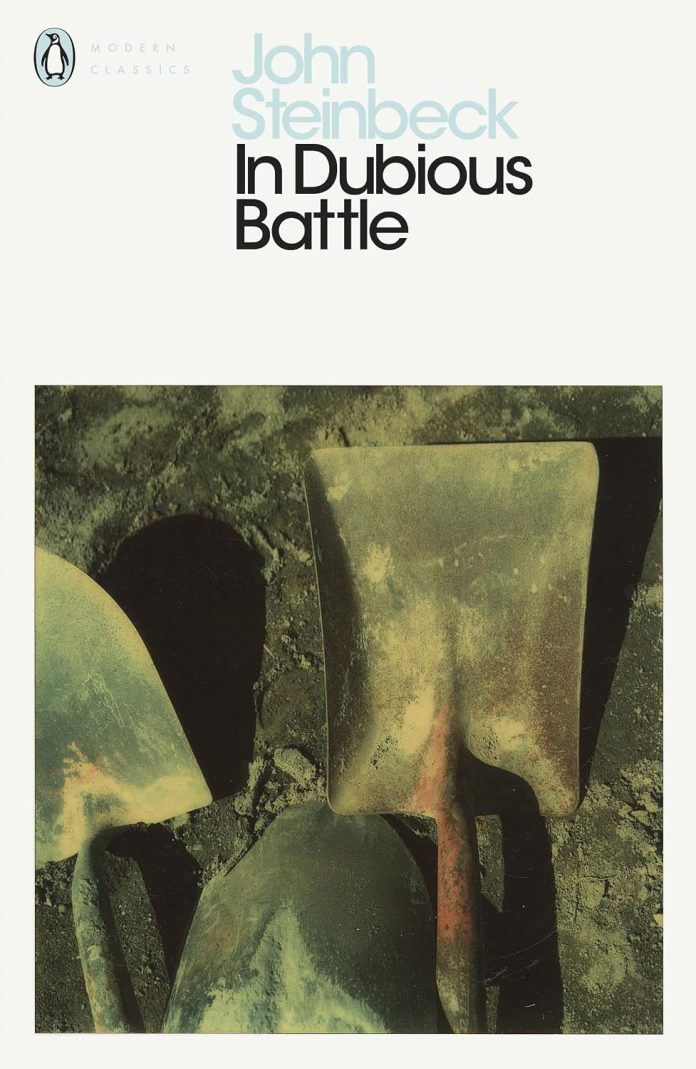
In Dubious Battle by John Steinbeck begins with a young man in a rented room, the Neon sign from the restaurant opposite throwing red light across his bed. He has nothing, has lost everyone, and is about to walk downstairs and join the Party because there is nothing else to join.
In Dubious Battle by John Steinbeck opens on that image and the first sentence is a defeat: at last it was evening. Nine days later the same young man is dead in an orchard with his face shot away, and the novel stops in the middle of a sentence.
How In Dubious Battle Works
The mechanism of In Dubious Battle by John Steinbeck is a strike, run as a deliberate operation.
Mac is an experienced organiser. Jim Nolan is his new recruit, and the book is largely Jim’s education in method. They go into the Torgas Valley where the apple growers have cut the picking rate, attach themselves to a camp, and set about turning grievance into action.
What makes it unusual is how openly the organising is shown as technique. Mac delivers a baby in the camp, not from compassion but because it buys the trust of two hundred men in an afternoon. He identifies London as the natural leader and works through him rather than around him. When an old organiser is shot, Mac’s immediate thought is how useful the funeral will be. He says so, out loud, to Jim.
The growers are barely characterised at all. They operate through vigilantes, a sympathetic newspaper and the county health authority, and they are more effective than the strike ever is.
What works
- The refusal to editorialise is total. Nothing in In Dubious Battle by John Steinbeck tells you what to conclude. No narrator steps in to approve or condemn. You are given Mac’s reasoning and left to decide what you think of it.
- Mac is one of the best things Steinbeck wrote. Generous, funny, personally brave, and willing to use any human being in front of him. All of that is the same man.
- The crowd scenes are superb. The shifts of mood in a camp of a thousand men are tracked with real precision.
- Doc Burton earns his place. A non-Party doctor who comes to handle sanitation and ends up supplying the book’s only analysis.
Where In Dubious Battle Gives Ground
- Jim’s conversion is too fast and too complete. He goes from recruit to zealot in about a hundred pages with little interior resistance, and the speed serves the thesis more than the character.
- Doc Burton occasionally stops the book to deliver his theory in blocks of dialogue nobody would actually speak.
- The women barely exist. Lisa, who gives birth early on, is the only one with any presence, and she is mostly a function.
- The growers are a weather system rather than people, which is defensible as a choice and still makes the opposition abstract.
The Theory at the Centre of In Dubious Battle
Doc Burton supplies the idea In Dubious Battle by John Steinbeck is built on, and it is not a Marxist one.
His argument is that a crowd is not a sum of individuals but an organism with its own behaviour, and that when this group-man wants to move it invents a slogan to justify the movement. God wills that we recapture the Holy Land. We fight to make the world safe for democracy. We will wipe out social injustice with communism. The group, Burton suggests, does not care about any of these things. It wants to move, and the words exist to reassure the individual brains inside it.
That is a profoundly unhelpful thing to put in a strike novel, and Steinbeck puts it there deliberately. It applies equally to the vigilantes and to the strikers, and it denies both sides the dignity of their stated reasons.
Joy, and What the Book Thinks the Work Costs
One minor character in In Dubious Battle by John Steinbeck does more damage to any romantic reading of the cause than all of Doc Burton’s
theorising.
Joy is an organiser of long standing. He has been beaten so many times that his face no longer
works properly, his jaw hangs sideways, his nose is flattened against his cheek and his hands are
a mass of scar tissue. His conversation has been reduced to a few repeated phrases delivered with
great conviction. Mac introduces him to Jim as a veteran, affectionately, and then explains
privately that he will have to be locked up before long.
This is what thirty years of the work produces, set in front of a recruit on his first day as a
kind of advertisement.
When Joy is shot dead in the street some two hundred pages later, nobody in the Party pretends to
be surprised and Mac is openly pleased about the funeral. In Dubious Battle by John Steinbeck
puts the end state next to the beginning and lets the reader do the arithmetic.
Read it if
- You want In Dubious Battle by John Steinbeck for its refusal to take the side it obviously sympathises with.
- You like political fiction that distrusts politics.
- You have read the later novels and want the cold version of the same material.
Skip it if
- You need a protagonist to root for.
- Detailed violence against strikers, including a lynching and a shooting, is not something you want.
- You want the moral clarity of The Grapes of Wrath.
About That Title
It comes from Paradise Lost, from the passage describing the rebel angels and the war in heaven as a doubtful battle on the plains of heaven.
Readers have argued about the analogy ever since, and the argument is a trap. Milton’s rebels are damned and magnificent at once, and Steinbeck took the phrase precisely because it refuses to settle which. Applying it to the strikers makes them Satanic; applying it to the growers makes them so too. The title’s job is to withhold the verdict, not to deliver one.
Read these next
- A Literary Analysis of The Grapes of Wrath by John Steinbeck. Three years later, the same valley and the same growers, with the sympathies declared.
- A Literary Analysis of Of Mice and Men by John Steinbeck. The following year, the same migrant workforce at the scale of two men.
- Tortilla Flat by John Steinbeck. Published the year before this, about the same coastal poor, and played entirely for laughs. The gap between them is the most startling thing in his bibliography.
Worth Your Shelf
Yes, with the warning that it is the least comfortable book he wrote.
The last page is the proof. Jim is shot in the face in the dark. Mac carries the body back to the camp, props it against a post on the speaking platform, sets a lantern so the light falls on what is left of the head, and begins: this guy didn’t want nothing for himself.
The sentence is never finished. In Dubious Battle by John Steinbeck ends there, with a man he loved being used as a prop, in a speech the reader has already been taught to recognise as a technique. Whether that is a tragedy or a necessity is the question the novel declines, very deliberately, to answer.