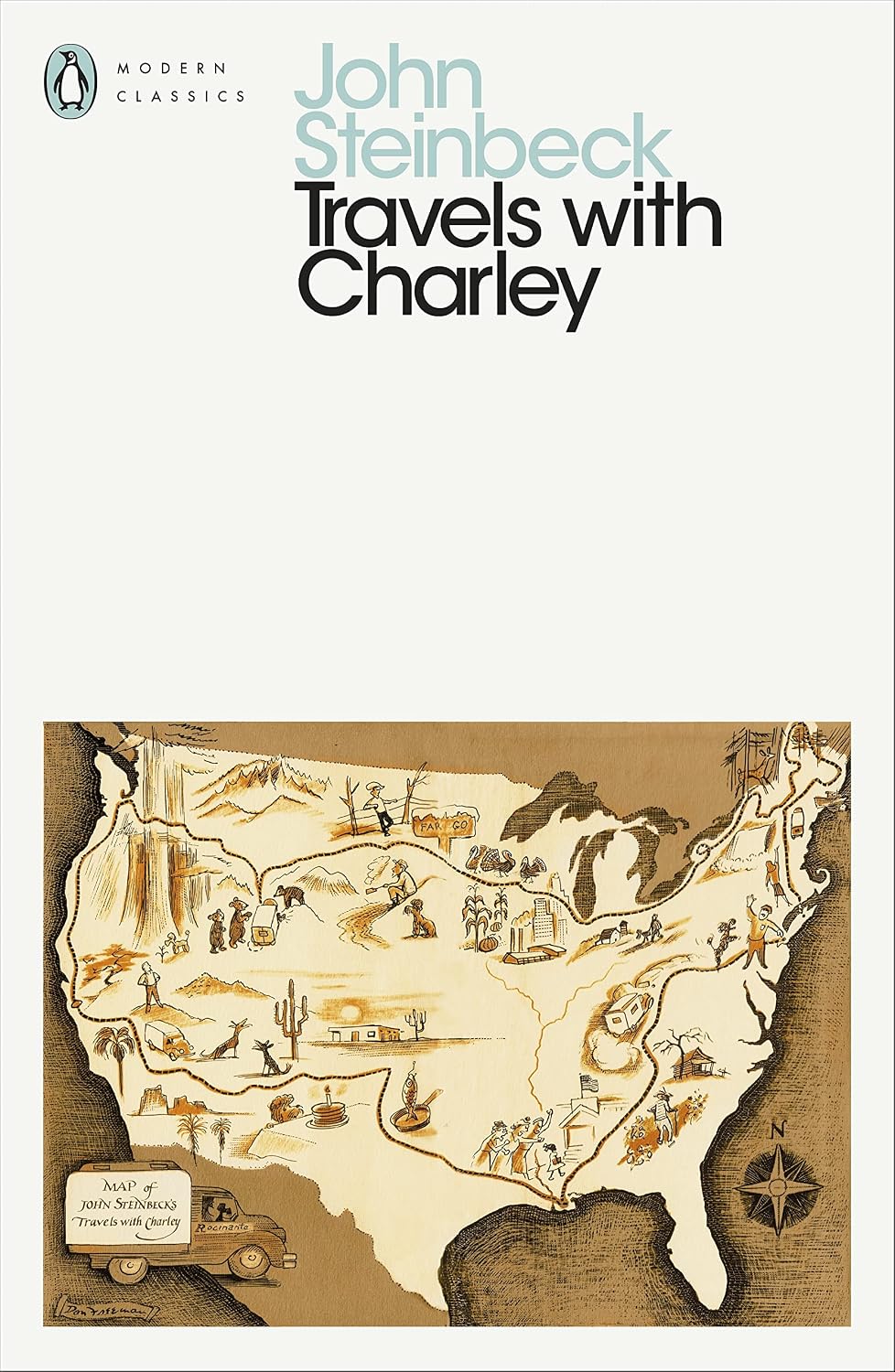
Travels with Charley by John Steinbeck begins with a man of fifty-eight ordering a truck with a camper on the back, names it Rocinante after Don Quixote’s horse, and sets off in September 1960 to drive around his own country because he has realised he no longer knows it. He takes a ten-year-old standard poodle called Charley, who was born near Paris and takes commands in French.
That is the premise of Travels with Charley by John Steinbeck, and for fifty years it was read as a report. It is better understood now as something closer to a novel, and the interesting question is whether that ruins it.
How Travels with Charley Works
The structure of Travels with Charley by John Steinbeck is loose by design. Rocinante goes up through New England, west across the northern states, down the Pacific coast to the Salinas Valley of his childhood, then east across Texas and into the Deep South before running for home.
Steinbeck claims over ten thousand miles and thirty-four states, and says that in all of it he was recognised exactly once, which is to say never. That claim is doing a lot of work. The book depends on him being an anonymous man in a truck, falling into conversation with strangers who speak freely because they have no idea who is listening.
The chapters are episodes rather than stages: a Vermont farmer, a travelling Shakespearean actor, a family of migrant Canadians picking potatoes in Maine, a long and tender passage among the redwoods. Charley is the connective tissue, a device for starting conversations and a running joke, and he is genuinely well drawn. He has a roar like a lion and could not bite his way out of a paper cone.
The One Chapter in Travels with Charley That Matters
Travels with Charley by John Steinbeck is affable for three hundred pages and then stops being affable.
In New Orleans, Steinbeck goes to watch the Cheerleaders: a group of white women who gathered daily outside a newly desegregated school to scream at the small Black children walking in. He admits his own motive without flattering himself, comparing the draw to a sideshow attraction, the five-legged calf you pay to see in order to confirm your own normality.
What he then writes is the best thing in the book and among the best things he wrote in his last decade. He reports the chant without quoting it in full, describes a city where everyone of every class lived inside a fear they treated as weather, and admits he wanted to leave, calling that cowardly and the denial of it more cowardly still.
Whatever else is invented here, that chapter reads as witnessed.
What works
- The prose is loose and warm in a way the late novels are not, and the redwood passages are among his finest descriptive writing.
- Charley earns his place. The dog is a real character rather than a prop, and the comic timing around him is excellent.
- The New Orleans section is morally serious and does not let the author off.
- It is honest about aging. The book opens with a man admitting the urge to be somewhere else never left him, and closes with him lost in his own city.
Where Travels with Charley Gives Ground
- Much of Travels with Charley by John Steinbeck did not happen. This is now a publisher’s position rather than a critic’s. Penguin’s fiftieth-anniversary edition of 2012 carries a note in the introduction warning that Steinbeck took liberties with the facts, inventing freely when it suited him.
- The people he meets talk like Steinbeck. Once you know the conversations are composed, the ear that makes the book pleasurable starts to sound like ventriloquism.
- He was not alone nearly as much as it suggests. His wife Elaine joined him for substantial stretches, and comfortable hotels featured more often than Rocinante does.
- The “state of the nation” conclusions are thin. The complaints about homogenisation, chain motels and plastic-wrapped food were already familiar in 1962 and have not aged into insight.
What Charley Is Actually For
The dog is not decoration, and Travels with Charley by John Steinbeck would collapse without him.
Charley is a blue standard poodle, born on the outskirts of Paris, trained in France, and possessed of only a little poodle-English, so that commands in any other language have to be translated before he will act on them. He is a born diplomat who prefers negotiation to fighting
and is very bad at fighting, having lost part of one ear the single time an opponent declined to negotiate.
Mechanically, he is a conversation-opener. A man alone in a truck is a stranger; a man with an unusual dog is an invitation, and almost every encounter in the book begins with somebody approaching the animal. Steinbeck knew this and says so.
Emotionally, he does something harder. He gives a solitary narrator someone to talk to, which means the reader gets Steinbeck thinking aloud rather than Steinbeck composing. The passages where he explains America to a poodle are the most relaxed prose in the late work, and when Charley falls ill in the middle of the trip the worry is the most unguarded thing in the book.
Read it if
- You want Travels with Charley by John Steinbeck for the prose and the dog rather than as a document.
- You like travel writing where the traveller is the real subject.
- You are interested in how a famous writer handled the civil rights crisis in real time.
Skip it if
- A travelogue that invents its encounters is not something you can read past.
- You want reportage with a verifiable spine.
- You are after the Steinbeck of the 1930s.
The Honesty Problem, and How to Read Around It
The case against Travels with Charley by John Steinbeck was assembled by Bill Steigerwald, a former Pittsburgh newspaperman who retraced the route and compared the book against Steinbeck’s own letters and the manuscript. The timeline does not fit. Several meetings could not have taken place as written.
Two responses are available and both are defensible. The first is that a travel book which composes its encounters is a fraud, and that the pleasure it gives was obtained under false pretences. The second is that Steinbeck was a novelist doing what novelists do, that nobody was harmed, and that the New Orleans chapter is true in every way that matters.
What is no longer available is reading it as straight reportage, and the useful approach now is to treat it as autobiographical fiction with real places in it. Note that older printings, including the Penguin Classics edition with Jay Parini’s introduction, predate the 2012 disclaimer and carry no warning at all.
Read these next
- The Winter of Our Discontent by John Steinbeck. Written immediately before this, and the two share a preoccupation with what America had become.
- A Literary Analysis of The Grapes of Wrath by John Steinbeck. The young man’s version of looking at his country and not liking it.
- Cannery Row by John Steinbeck. For the register, which is the closest thing in the fiction to this book’s voice.
The Last Word
It ends with Steinbeck back in New York, hopelessly lost a few streets from his own house, being cheerfully redirected by a policeman who got lost in Brooklyn himself on Saturday.
That is a good last page, and it is probably invented. Travels with Charley by John Steinbeck is now best read the way you would read a novel built out of a real journey: a wonderful voice, a very good dog, one chapter of genuine moral weight, and a narrator who should not be taken at his word about the rest.