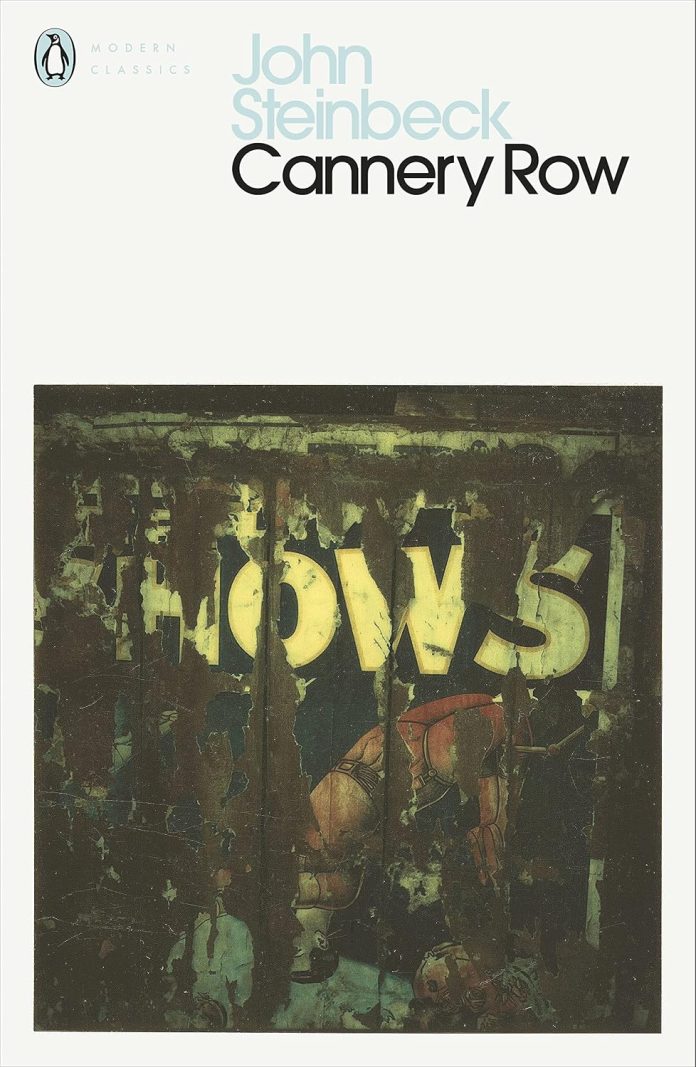
A street is introduced as a poem, a stink, a grating noise, a quality of light, a tone, a habit, a nostalgia, a dream. That is the first sentence of Cannery Row by John Steinbeck, and it tells you immediately that nothing is going to be organised. There is no inciting incident here, no antagonist, no arc. There is a run-down block of sardine canneries in Monterey, about a dozen people who live on it, and roughly two hundred pages of the author declining to make a plot out of them.
Published in 1945, straight after he came back from reporting the war, it reads like a man deliberately writing the opposite of what he had just seen. Readers who know him only from the Dust Bowl novels will not recognise the register at all.
The Only Plot in Cannery Row Is a Party
Such shape as the book has comes from a single idea. Mack, who runs a loose confederacy of unemployed men out of a building they call the Palace Flophouse, decides that Doc deserves something.
Doc runs Western Biological across the street, collects marine specimens from the Great Tide Pool, plays records loudly, and is owed small kindnesses by everybody on the Row. Mack’s plan is to throw him a party. To pay for it the men agree to collect frogs for Doc’s laboratory at five cents each, which requires borrowing a truck, which requires Lee Chong, who runs the grocery and holds everybody’s debt.
The first party is a catastrophe. Doc is away, the men get into his whisky, the laboratory is wrecked, and the Row turns on them so completely that the story circulating within a day is that they broke in out of pure malice. Cannery Row by John Steinbeck then spends its second half on the attempt to do it again properly.
That is the entire narrative engine. Everything else is vignette: a boy called Frankie who attaches himself to the laboratory and cannot be helped, a painter called Henri building a boat he will never launch, the history of Lee Chong’s Model T traced through three previous owners, gophers pulling flowers into their holes at dawn.
What Cannery Row Buys With Its Looseness
The structure of Cannery Row by John Steinbeck is doing something a plot could not. By refusing to make Mack’s scheme into a story with stakes, Steinbeck keeps the book at the level of the street itself, where nothing much ever resolves and the same people keep turning up.
It also lets him write some of his best prose. The tide pool chapters are superb, precise about starfish and nudibranchs in a way that has nothing to do with the human business and everything to do with the book’s argument that this is one ecosystem with people in it.
What works
- Doc is the best character Steinbeck ever wrote. Generous without being saintly, lonely in a way the book never underlines, and allowed a real interior without a speech explaining it.
- The comedy is genuinely funny. The frog hunt is a set piece, and the Model T chapter is a small masterpiece of deadpan.
- The prose loosens without going slack. Long catalogues, sudden shifts of register, and an ear for the way men talk when they have nothing to do.
- The interchapters earn their place. Short vignettes about people we never meet again, which build the street rather than decorate it.
Where It Gives Ground
- The sentimentality is real. This is the softest book Steinbeck wrote in his strongest decade. The book’s thesis, that the idle and the broke are the only people living correctly, is asserted far more often than it is tested. Doc gets a speech about how the qualities we admire are the ones that guarantee failure, and nobody in the book is allowed to argue with him.
- Mack and the boys are never seriously inconvenienced by poverty. Hunger is comic here. Debt is comic. A reader coming from The Grapes of Wrath will notice how much softer the economics have become.
- The women are furniture. For a book this attentive to everyone else on the street, that is a conspicuous blank in Cannery Row by John Steinbeck. Dora runs the Bear Flag and is treated with affection, but the women who work there have no interiority at all, and the book’s warmth plainly does not extend to giving them one.
- The racial caricature in Lee Chong’s introduction has dated badly, even allowing for 1945, and the Chinese man who walks through the book is a device rather than a person.
Read it if
- You want Cannery Row by John Steinbeck for the register rather than the story: least didactic, most affectionate.
- You like novels built from vignettes, where the pleasure is accumulation rather than momentum.
- You have read the big books and want to know what he sounded like relaxed.
Skip it if
- You need a plot, or characters who change.
- You want the political clarity of his 1930s work; this is the book where he stops arguing.
- Period caricature in an otherwise warm book is something you would rather not navigate.
The Real Man Behind Cannery Row’s Doc
The character is closely based on Ed Ricketts, the marine biologist who was Steinbeck’s closest friend and who co-wrote Sea of Cortez with him. Ricketts died in 1948 when a train hit his car at a Monterey crossing, three years after this book appeared.
Knowing that changes the reading. The affection in Cannery Row by John Steinbeck is not a literary strategy; it is a man writing a friend down while the friend was still there to read it. Steinbeck went back to the same street and the same character nine years later in Sweet Thursday, after Ricketts was dead, and the difference between the two books is mostly the difference between describing someone and missing them.
Read these next
- A Literary Analysis of East of Eden by John Steinbeck. The late masterpiece, and the clearest demonstration of how much structure he could impose when he wanted to.
- A Literary Analysis of Of Mice and Men by John Steinbeck. The same valley, the same drifting men, and none of the tenderness.
- Homegoing by Yaa Gyasi. A very different book that also builds its whole from short self-contained chapters.
- The Acorn Stories by Duane Simolke. Linked small-town stories, for readers who find they like the shape more than the subject.
If the reputation rather than the book is what has kept you away, our guide to reading classics without feeling intimidated is a reasonable place to begin, and this is the shortest door into Steinbeck there is.
What Stays With You
Not the party. What stays from Cannery Row by John Steinbeck is the half-page about morning on the Row: the sea lions barking from the rocks, Lee Chong putting the bins out, one of Dora’s girls walking home with her makeup gone sticky and her feet tired.
Steinbeck does not comment on her. He just puts her in the sentence with the gophers and the garbage cans and the fresh air, and moves on. Cannery Row by John Steinbeck is at its best exactly there, in the places where it stops insisting that these lives are beautiful and simply looks at them instead.







