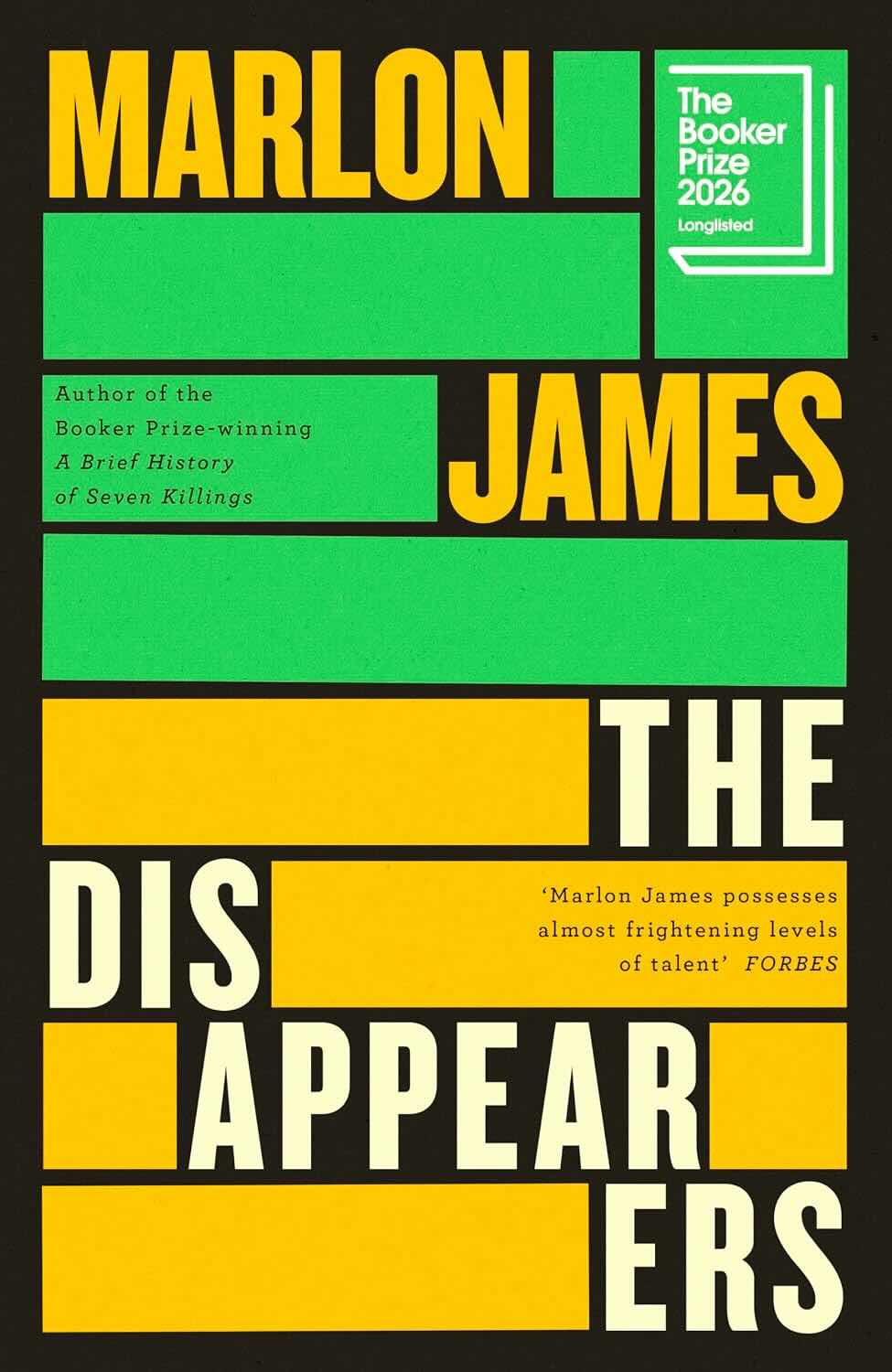
The Disappearers
Some men are killed. Some are simply mislaid.
This is the book most obviously trying to do what Okri described. Its starting point is public: a homophobic attack on a theatre company in Kingston in 1988, set against the AIDS years and the dancehall hits that made hatred singable. But its method is private to the point of obsession. James gives the story to a teenager's diary, to the attackers' own testimony, to a survivor whose only language is borrowed from rock records, to the letters of an ageing Wildean, and refuses to let anyone narrate twice.
The formal idea matters more than the size. The play the company rehearses, Fortune and Men's Eyes, takes its title from Shakespeare's Sonnet 29, and the novel is full of men using literature as equipment for survival. The judges call Wilde, Rechy and Auden "live ammunition" in the characters' arguments. In The Atlantic, Emma Sarappo called it a gay novel about the uses of a gay novel, and that is the best short description we have seen. The title works four ways: the men who vanish, those who make them vanish, those who erase themselves to stay alive, and the epidemic. Stephanie Burt, also in The Atlantic, drew the sharpest contrast with A Brief History of Seven Killings: that book was about men reaching for power, and this one is about what internalised rejection does to a person.
Why it could win. The judges' note says it holds, arguably, more truth than any work of nonfiction could manage in the same setting, a remarkable sentence for a panel to publish. Dwight Garner of The New York Times went further, calling it the novel of the decade. It meets Beard's test: nobody will call it cosy. A Caribbean novel of this reach also answers a line the judges drew themselves, placing James in descent from V.S. Naipaul and Jean Rhys.
Why it might not. The dissent is serious and it is not about taste. In the London Review of Books, Adam Mars-Jones argued that the book lacks the historical need for its length that Seven Killings had, and that its characters' reading has little to do with their lives. That goes straight at the novel's central conceit. Anthony Cummins in the New Statesman wondered whether the subject, rather than the writing, explains its force. Our own review found a middle that circles. It also failed to reach the National Book Award's five finalists after being longlisted. Different jury, same question: is it an event, or a great novel?
We still think it wins, because Liu's test rewards exactly this kind of overreach. Our review of The Disappearers has the detail, and it comes with the strongest content warning on this list.
 Even More Spooky Books: 66 Wicked Reads for Halloween
 Horror Books Set at Sea: 7 Novels Where the Tide Comes In
 Dark Academia Books: 28 Novels of Ivy, Ink and Bad Intentions