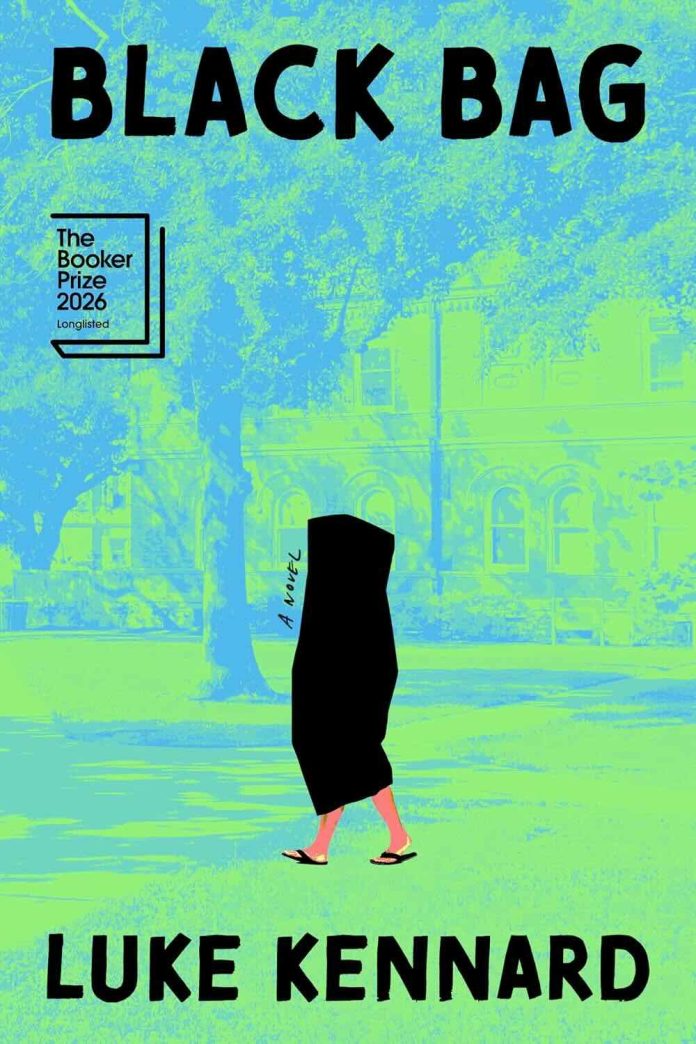
Black Bag by Luke Kennard begins with a warning. If you met anyone as whiny and self-absorbed as the average narrator of a novel, the narrator tells you, you would give them five minutes before you moved to a different carriage. He is not like that. He loves being alive. Sometimes he doesn't. Nobody does.
He is an actor. He will be speaking in the present tense, which he calls the silliest tense and also the closest we come to talking directly to God.
He is thirty-seven, five foot six, three months without paid work, a month behind on his rent, and he has been eating porridge and soaked beans. Then he answers an advertisement on a website for unusual acting jobs: male actor required, nonspeaking, no taller than 5'8", for a psychological inquiry. Duration three to four months. Fee to be discussed.
This is a real experiment, by the way. Charles Goetzinger ran it at Oregon State in 1967 to test the mere-exposure effect: a student sat through every class inside a black bag, and the class went from hostility to curiosity to friendship. Kennard says in his acknowledgements that he read about it while researching a poem and was immediately, obsessively interested in the man in the bag.
What Happens in Black Bag by Luke Kennard
Dr Blend, an ageing psychologist being quietly managed out of his own department, zips our narrator into a bespoke black leather bag with two holes for the legs, later stabs two eyeholes into it with nail scissors, and pays him in wads of twenties because the university payroll will take months.
The job is to sit at the back of a lecture theatre and do nothing. No wiggling of toes. Nothing that could be read as reactive or derisive. Bag is to be characterless.
Within a fortnight he is wearing it on days off.
Around this three other things start happening. His oldest friend Claudio, a video-game streamer with over a million viewers and a genius for schemes, decides to monetise him. A professor from another department pulls him off a landing into her office and proposes an experimental relationship. And Claudio disappears.
Black Bag by Luke Kennard Is the Funniest Book on This Longlist
I want to be careful here, because "funny novel" undersells it and "comic novel" makes it sound like a genre. Nothing else on the Booker Prize 2026 longlist is trying to do this.
The comedy in Black Bag by Luke Kennard is load-bearing. There is an audition, early on, for a devised piece about the climate catastrophe, where the narrator is asked to announce a flood. He sings one long note until the entire panel joins in, holds it, stops, and then tells them that the only real question is whether, in a theatre slowly filling with water, you would rather see their play or Hedda Gabler. The director writes this down and says it is exactly the honesty they are looking for.
There is a page-long single sentence listing everything wrong with living in a ground-floor flat, which ends: but I actually rather like it.
There is a chapter in which, suddenly solvent, he buys good curtains from a nearly abandoned curtain shop for a hundred and fifty pounds in cash and is happier than at any other point in his life.
And there is a date at a French restaurant that ends with him pulling his companion's handbag over his own head at the table, which I laughed at and then, about four seconds later, did not.
What Works
- The narrator. Pedantic, self-lacerating, snobbish about theatre and abject about everything else, and possessed of a genuinely unusual mind. He describes his own body and face as internal organs he has no reason to show his employer. He worries about damaging the bag.
- The economics of Black Bag by Luke Kennard are exact and furious. He needs £1,400 a month to stay housed. A ruby grapefruit costs fifty-five pence and is a luxury. A cancelled murder-mystery dinner costs him £450 he was relying on. Later an AI company offers him £250 an hour to be filmed from three hundred and sixty degrees, harvesting the movements of an actor in order, quite possibly, to make actors unnecessary. He takes it. Everyone has a price and the book says so.
- Birgitta. During dull lectures the narrator escapes into an imaginary Swedish town, where an elderly woman called Birgitta feeds him cake and dispenses proverbs. He gives himself a job at a sawmill and then, idly, a maimed arm. Very late in the book a stranger stops him in the street to tell him Birgitta has died, and he cannot un-kill her, because that is not how it works. It is the single best thing in the novel and it is about a person who does not exist.
- The refusal to describe his parents. He will not do it. Describing anyone is a disgusting business, and if he can spare anyone it should be them, so throughout the book they are two pillars of rough-hewn stone that he brushes the moss from and hangs a garland on. It starts as a gag, becomes an ethic, and ends up carrying the most moving passage in the novel.
- Elliott, the parents' badly behaved border collie, who talks, in a register somewhere between Hopkins and a pub landlord, and functions as the book's conscience.
Where It Stumbles
- The crypto satire is the weakest strand. Claudio sells shares in the performance, mints NFTs, launches Bag Coin, and hands out enamel lapel pins mapping the narrator's walks. An American investor turns up saying "as above, so below". These are broad targets, broadly hit, in a novel that is elsewhere surgical.
- The erotic set pieces run long. The professor phones the narrator to narrate her encounters with other men in enormous detail. One, set in a Paris patisserie at four in the morning, is effectively a standalone short story delivered down a phone line. It is very well written. It is also not the only one, and by the third the returns have flattened.
- The secret order arrives late. There turns out to be a whole movement of men in the same bag, meeting in a warehouse up a disused canal. The journey there, in a derelict swan pedalo, is glorious. What he finds is a fairly conventional cult joke, and the headquarters in Copenhagen is reported second-hand rather than seen.
- Justine is a fantasy more than a person. The book half-knows this. Two of her scenes are extraordinary and the rest of the time she is a delivery system for monologues.
- Eighty-nine chapters means several are a page of riffing that moves nothing. The looseness is the pleasure and also the cost.
What Black Bag by Luke Kennard Is Actually About
Shame. Specifically, what Claudio, stoned, calls the great river of shame that runs under masculinity, into which men dip at the least provocation. Everything else in Black Bag by Luke Kennard is scaffolding around that idea.
Every man in this novel has built something to stand between himself and that river. Claudio has an audience of a million people and a personality he has been deliberately toning down, episode by episode, to make the operation scale. Mason, the investor, has built an app in which children write two hundred words a night about their fathers and the father is then shown an AI projection of that child, sixty-five years older, being interviewed about him; he reports rooms full of grown men keening. Dr Blend has thirty years of the same experiment and a drawer of CVs of every previous man in the bag. The order in the warehouse has a creed about atonement taking two or three generations.
And the narrator has a bag, which is the cheapest and by some distance the most effective of these devices, because it asks nothing of anyone and sells nothing to anyone. As Blend puts it near the end, with black bag there is no comparison and no competition.
The book's real argument is quieter and it is about description. Narrators damage everyone they touch. To describe someone is to reduce them, to stand in judgement, to make them available. The parents stay stones for three hundred pages because that is the one kindness available to a man who cannot stop narrating.
The economics of all this are not invented, incidentally. If you want to know what a jobbing performer actually earns and what protections exist, Equity publishes the rates, and Kennard's arithmetic is not exaggerated.
A Word on Content Warnings
Black Bag by Luke Kennard contains explicit sex throughout, including extended phone-sex monologues. There is recurring suicidal ideation, described specifically. There is heavy drug use, a very bad trip, and a research chemical taken alone. There is a near-drowning after an unprovoked assault. A subplot concerns the sextortion of teenagers. There is sustained alcohol misuse, and a narrator convinced that a former partner intended to kill him.
Who This Is For
Reach for Black Bag by Luke Kennard if you want a novel that is properly funny on a sentence level, if you have ever been broke in a way that made you obsessive about the price of things, if you would like the masculinity discourse handled by someone with jokes rather than a thesis. Skip it if you need a plot that closes, if extended erotica is not what you came for, or if you would like to know how it ends.
Because it doesn't end. It stops, mid-sentence, at the moment of the narrator's greatest triumph, and I have not decided whether that is perfect or a cheat.
Read These Next
Five books to go to if Black Bag by Luke Kennard has left you wanting more of this weather.
- The Transition by Luke Kennard. His first novel, and the other one about a scheme that sounds mad and turns out to be how things already work.
- Notes on the Sonnets by Luke Kennard. The Forward Prize-winning prose poems. If you liked the voice more than the plot, this is the voice undiluted.
- The Bee Sting by Paul Murray. Comic despair over hundreds of pages, money trouble as the engine, and a blurb on this very book.
- Lucky Jim by Kingsley Amis. The ancestor: a man performing competence inside an institution that is quietly humiliating him, and drinking about it.
- The Diary of a Nobody by George and Weedon Grossmith. The original narrator who is certain he is doing rather well. Read alongside this and the resemblance is uncanny.
The Last Word on Black Bag by Luke Kennard
There is a moment when the narrator, out of the bag for once and visiting his parents, finds a photograph on their wall of himself at sixteen, playing Ariel in a school production of The Tempest. Painted silver, false antennae for eyebrows, gazing up at something just outside the frame.
He looks at it and thinks: God, I really was good. Then he corrects himself, because plenty of people are good and hardly anybody gets what they deserve. Then he corrects himself again. No. He is special. There is no sense being modest about it.
Ariel, he notes, does not have many lines. One of them is "No". One of them is "No, sir".
Black Bag by Luke Kennard is a novel about a man who spends his whole life trying to be seen and only gets there by making himself invisible, and who is then, at the exact moment he is finally applauded, cut off before he can tell you how it felt. Whether Kennard is being cruel to him or merciful is the last joke, and the book will not settle it for you.







