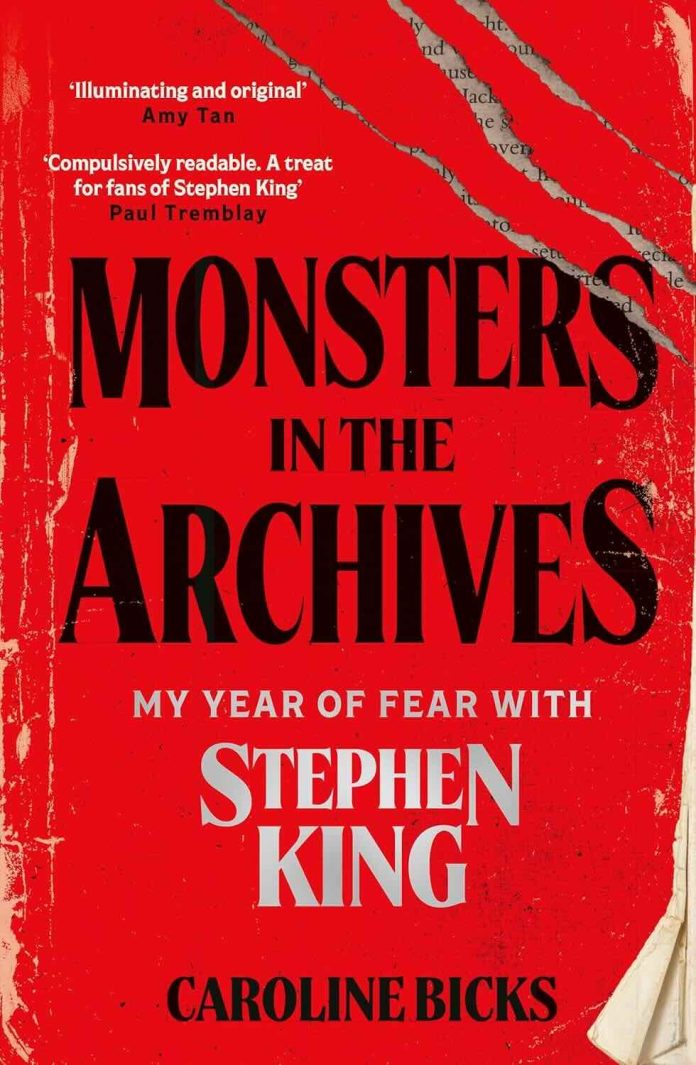
Caroline Bicks did not set out to be the first scholar granted extended access to Stephen King’s private archives. She was hired in 2017 as the inaugural Stephen E. King Chair in Literature at the University of Maine on the strength of her Shakespeare research. The King Chair carried his name, not his involvement. Four years later, the phone rang at her kitchen counter, and “Steve” was on the line. The yearlong archival project that grew out of that call became Monsters in the Archives by Caroline Bicks, a book that is somehow a literary master class, a King biography in miniature, and a personal memoir about a small, anxious child, all at once.
Her thesis is precise and worth stating up front. King’s lasting horror does not hinge on what he shows you. It hinges on the sound of a stutter, the shape of a toddler’s misspoken word, the difference between clatter and clittered. She reads his drafts the way a scholar reads a Shakespeare quarto, and she does it across five focused chapters that follow her actual reading order: Pet Sematary, The Shining, Night Shift, ‘Salem’s Lot, and Carrie.
What She Found in the Climate-Controlled Pool House
The archive itself sits inside a renovated indoor swimming pool behind the Kings’ Bangor Victorian. The pool tiles still line the walls. Julie, the longtime assistant, hands her thick folders and disappears behind a coded door. Bicks lays drafts side by side on a conference table and starts comparing.
The discoveries are the quiet engine of the book. Some are small, some matter quite a bit:
- King’s first version of Pet Sematary, the one he shelved for years because he found it too horrifying to publish, carried details he eventually cut. Bicks shows you what they were.
- The Shining was originally titled “The Shine” and was structured, deliberately, like a tragedy with rotating stage sets. Bicks asks King which Shakespearean play he had in mind; his answer rewards a careful reader.
- Carrie was originally set in suburban Massachusetts. Editor Bill Thompson moved her home to Maine. Bicks finds the memo.
- Carrie‘s first ending leaned on a 1957 creature feature. Bicks lays out why King and Thompson cut it, and what was gained.
Bicks does not parade any of this as a scoop. She uses these moments to show how King writes by ear, by sensory memory, by patient subtraction. The book reproduces facsimiles of his margin notes, including the legendary “Now I’m all bollixed up” and his courtly battles with copyeditors over commas, colons, and a dying toddler’s pronunciation of flying.
The Memoir Strand: An Anxious Girl Meets the Boogeyman
Running alongside the archival work is the second register of Monsters in the Archives by Caroline Bicks. Bicks grew up in a New York apartment building, terrified her mother would step into the elevator and never come back. She read The Wizard of Oz aloud at the kitchen counter to manage her fear. At twelve, she found Night Shift on a Maine library shelf and met the Boogeyman. Her hand carries a deep childhood scar from a shattered glass door, and she wears that scar through the book, returning to it whenever King’s monsters touch a similar nerve.
This is where readers will split. For anyone who likes their criticism cold and structural, the personal material can feel like it elbows in. Bicks circles back often to her own mother, her ghostly bedroom visitor, her habits of “alert anticipation and avoidance.” For other readers, this is the whole point. King’s stories work because they find what she calls our “secret room of fears,” and the only honest way to write about that is to open your own door first.
When she sits across a conference table from her boss-of-sorts and asks why he made Oz the Great and Terrible the guiding shadow of Pet Sematary, the exchange lands because we have followed her own Oz history for chapters by then.
The Shakespeare Throughline
Bicks is a Renaissance scholar by training, and she puts that training to genuine work. Her chapter on The Shining reads Jack Torrance against Hamlet and Wendy against Ophelia. Her Carrie chapter argues that King had stumbled, half by accident, onto the same model of adolescent female cognition Bicks has been chasing in Shakespeare’s girls for years: a “mental puberty” where imagination, memory, and rage sharpen into something formidable.
These parallels could easily turn into party tricks. They mostly do not, because she lets King’s edits do the arguing. When a single careted word shifts Wendy’s status from victim to Ophelia, the connection feels earned rather than imposed.
Where the Book Comes Up Short
Treating Monsters in the Archives by Caroline Bicks as flawless would do it no favors. There are real limitations:
- The five-book scope is deliberate but narrow. Readers hoping for The Stand, It, Misery, or the Dark Tower will need to look elsewhere.
- The hybrid form sometimes pulls in three directions at once. Pure King fans may want more close reading and less personal coloring; memoir readers may want fewer manuscript box numbers.
- A few coincidences (a Spelling Bee puzzle producing the word deadfall the same week, a housekeeper named Carrie) are leaned on a little hard.
- The Shakespeare strand is generous in some chapters and oddly thin in others, particularly the Night Shift chapter, which leans more on King’s old college newspaper columns than on a clear literary frame.
These are the price of the book’s particular ambition, and most readers will pay it without complaint.
The Voice of the Book
Bicks writes in clean, unfussy sentences with a faintly self-mocking warmth. She is comfortable being the embarrassed party in her own anecdotes, and that comfort gives the book a steady tone even when the material gets ghoulish. King, in the interview passages, sounds exactly the way fans hope he will: generous, sharp, mildly profane, allergic to his own legend.
Three things her prose does well:
- Sensory specificity, especially around sound. She catches the difference between rattly and congested, the shuh of a scared mother’s stutter, the click of a tomb door on rusty hinges.
- Restraint with the King quotations. They are short and well chosen rather than padded.
- A willingness to leave findings open. She offers two readings and lets the reader pick.
If You Liked This, Read Next
Strong companion reads, in rough order of nearness to Monsters in the Archives by Caroline Bicks:
- On Writing by Stephen King. The obvious pairing. Bicks’s book reads at times like an annotated gloss on it.
- Danse Macabre by Stephen King, his nonfiction study of horror, which Bicks cites often.
- Reading Lolita in Tehran by Azar Nafisi, for the same blend of close reading and personal life.
- Why Read Moby-Dick? by Nathaniel Philbrick, an affectionate single-author study with real archival texture.
- A Year in the Life of William Shakespeare: 1599 by James Shapiro, the scholar Bicks credits in her acknowledgments with pushing her to write the book.
- Shakespeare, Not Stirred by Caroline Bicks and Michelle Ephraim, her earlier and lighter foray into trade writing, for readers curious about her range.
This book is one of the 58 spooky books on our Halloween list.
Final Word
Monsters in the Archives by Caroline Bicks rewards slow reading with the relevant King novels nearby. It is not the definitive Stephen King biography, and it does not try to be. It is something rarer: a scholar’s working notebook, opened to general readers, that takes seriously the question of why a sentence King typed in a rented Hermon trailer in 1973 still keeps grown adults from sleeping with the closet door open.
For King obsessives, the book is essential. For readers who came up through Carrie and ‘Salem’s Lot and never quite shook them, it is a kind, unsettling reunion with the man behind the curtain.