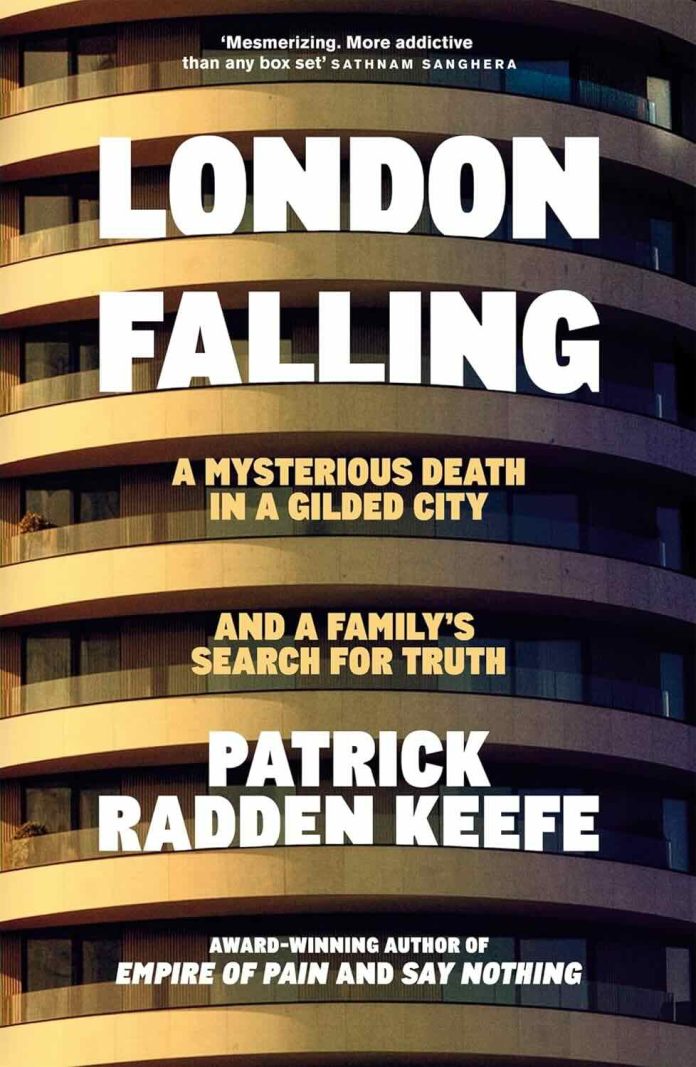
At 2:24 in the morning on November 29, 2019, a surveillance camera mounted on the headquarters of MI6 picked up a slender silhouette on the fifth-floor balcony of a luxury tower across the Thames. The figure paced from one end of the curved balcony to the other, walked back to the middle, and jumped. The boy on the balcony was nineteen. His name was Zac Brettler. He lived with his parents in a leafy pocket of Maida Vale. The people he was with that night knew him as someone else entirely.
That opening image is also the entire invitation of London Falling by Patrick Radden Keefe. Either you want to sit with the question it raises for the next four hundred pages, or you don’t. I did.
The Fall and the Fiction
Keefe writes this book on two timelines. On one, he follows Rachelle and Matthew Brettler in the days after the police knock, as they piece together a version of their son they had never met. On the other, he retraces the months before, when their quiet teenager had been moving through a London of private clubs in Mayfair, leashed whippets walked through Knightsbridge, and a Riverwalk flat borrowed from a man called Verinder Sharma, better known on the London street as Indian Dave.
Inside those rooms, Zac was not Zac. He was Zac Ismailov, son of a Russian oligarch, heir-apparent to a fortune that did not exist. He had built the fiction in painstaking detail: a forged bank statement showing £850,000, a Punkt phone bought at Harrods for its vague aura of encrypted menace, a finder’s fee story about selling an apartment at One Hyde Park to Roman Abramovich’s longtime deputy. The author is careful never to let the lie read as simple theatre. It is always also a cry.
A Family with Long Memories
What makes London Falling by Patrick Radden Keefe land so hard is the seriousness with which it treats the Brettlers. Rachelle is the daughter of Rabbi Hugo Gryn, a Holocaust survivor and beloved BBC broadcaster. Matthew’s father, Benny Brettler, came to England alone at thirteen on the last Kindertransport out of Germany. Zac was the second son of a family that understood, in its marrow, what it takes to keep a life going against long odds. Keefe is alert to the painful symmetry here: two grandfathers who lived under the shadow of a great historical lie, and a grandson who fabricates a small one of his own and cannot get out of it.
The book’s most uncomfortable question is not whodunnit. It is this: how interventionist should a parent be with a child who is drifting away? Rachelle and Matthew agonise over it in real time. Keefe does not answer the question for them, which is the honest thing to do.
London Is the Second Main Character
The city itself carries half the weight of the narrative. Keefe traces the post-Big Bang deregulation of 1986, the arrival of oil money, the slow oligarchisation of the property market, the 1983 Brink’s-Mat gold robbery whose laundered proceeds seeped into the redevelopment of the Docklands, and the expulsion of Ugandan Asians in 1972 that brought Akbar Shamji’s grandfather Abdul to England with a million dollars already tucked away in Swiss accounts.
These chapters could feel like detours. They don’t. They are the brickwork of the book’s argument, which is that a city that sells itself as a safety deposit box for anonymous capital will also, inevitably, grow a charisma-for-hire economy where a teenager with a made-up Russian father becomes a plausible prospect.
Where the Book Slows Down
No long work of reporting is all cream. A few things to flag for prospective readers:
- The middle section, particularly the ancestral histories of the Shamji and Sharma families, occasionally reads more like a New Yorker fact file than narrative. Keefe is too good a reporter to drop any thread he has pulled at.
- The coroner’s inquest chapters are procedurally excellent but the pacing slackens. You will feel the page count here.
- There is a structural choice to stay inside the Brettlers’ vantage point as facts surface in real time. It’s a brave call, but it occasionally withholds clarity a beat too long.
- The closing chapters reach for thematic grandeur via Mark Twain and the Gilded Age, and while the sign-off is beautiful, it can feel slightly tacked onto the intimate work that came before.
None of these is disqualifying. They are the price of a book that refuses easy answers.
The Scenes That Earn the Book
London Falling by Patrick Radden Keefe is at its strongest in the smaller moments. Rachelle standing at a mortuary window and being told not to touch her son because the autopsy has not yet happened. Matthew building a six-page, single-spaced chronology for detectives, complete with an abbreviation system for the central players, because grief can sometimes only survive inside a spreadsheet. A detective named Rory Wilkinson trying, with unexpected gentleness, to spare the Brettlers the full contents of their teenager’s iPad search history, aware that parents can read too much into a boy’s private Google searches. These passages are where Keefe earns the book.
His prose is restrained and specific. He lets images do the work. The Thames is always there, rising and falling twenty feet a day, carrying away, as Dickens once put it, “suicides and accidentally drowned bodies.” The repetition of water is not decorative. It is the book’s gravity.
Reading Keefe Against Himself
If London Falling by Patrick Radden Keefe is your first Keefe, his previous books reward a deeper trip into his catalogue:
- Say Nothing (2018), his best-known book, on the disappearance of Jean McConville during the Troubles in Northern Ireland.
- Empire of Pain (2021), on the Sackler family and the engineering of the opioid crisis.
- Rogues (2022), an essay collection pulled from his long-form work at The New Yorker.
- The Snakehead (2009), on the Chinatown smuggler Sister Ping and the global human-smuggling trade.
- Chatter (2005), his debut, on signals intelligence and the culture of surveillance.
This new book sits closer to Say Nothing than to Empire of Pain in temperament. It is intimate, confined to a few rooms and a few voices, and more interested in a family’s grief than in any single institutional villain.
If London Falling Leaves You Hungry
For readers who want to keep pulling at the threads this book opens, a short list worth your time:
- Butler to the World by Oliver Bullough, on Britain’s role as facilitator for the global rich.
- Putin’s People by Catherine Belton, the essential read on Russian money and Western institutions.
- McMafia by Misha Glenny, on the transnational shape of modern organised crime.
- Kleptopia by Tom Burgis, for the financial plumbing of laundered wealth in London and beyond.
- We Keep the Dead Close by Becky Cooper, another family-adjacent investigation into a death ruled one thing and suspected as another.
Closing Verdict
London Falling by Patrick Radden Keefe is a book about parents. It is about what grief looks like when it refuses to stop being useful. Rachelle keeps a recording device running through the worst weeks of her life because she knows she will not remember them clearly. Matthew devises spreadsheets no one asked for. Joe, the older brother, cannot now cycle through Pimlico without mapping a route away from Riverwalk. Keefe does not pretend to give this family the answers they came for. He gives them, and the reader, the closest thing a book can: the whole story, told carefully, with the lies weighed against the love, and a city that hid their boy held responsible, page by page, for its share.
Read it for the reporting. Stay for the parenting.