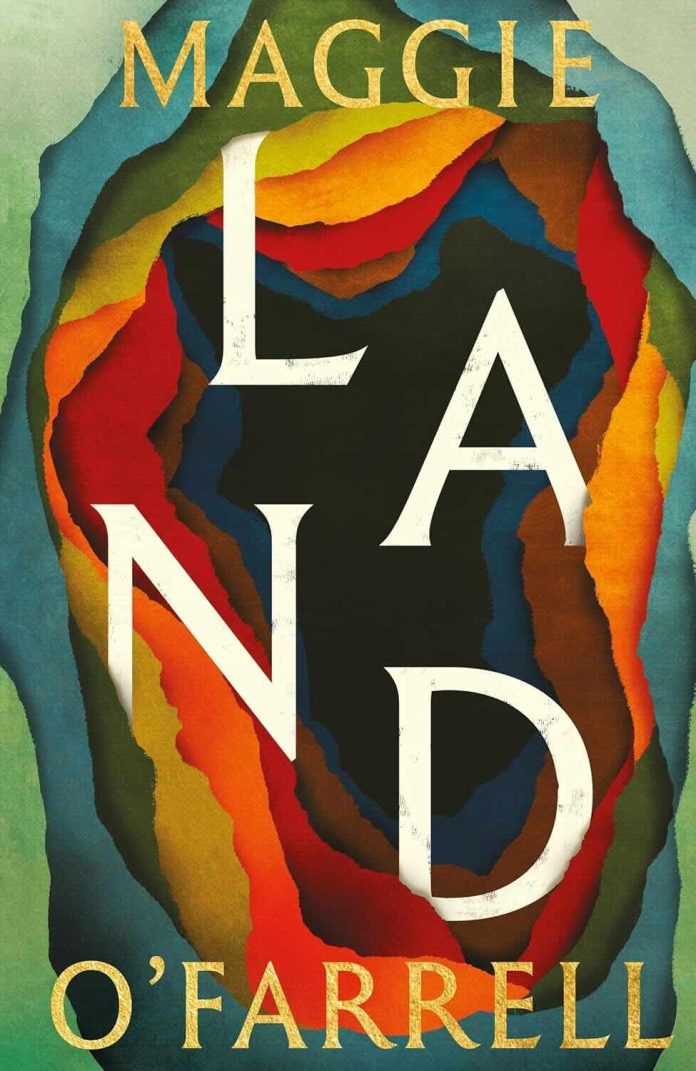
There is a moment near the start of the new novel where a ten-year-old boy stands on a windswept hillock holding a surveying chain in hands gone scarlet from cold, while his father waves at him from the other end of a measuring line. Liam can barely make out his father in the wet Atlantic mist. That image of a small child and a stubborn adult, separated by chain and weather and several centuries of grief, more or less tells you what Land by Maggie O’Farrell is going to do to you over the next four hundred pages.
A country still in mourning
The year is 1865. The Great Hunger is recent enough that the bones are still settling in the ditches and that everyone over the age of twenty has lost someone. Tomás, the map-maker, has been sent by the British Ordnance Survey to record a peninsula on the westernmost tip of Ireland. His task is technical, but his motive is private. He wants the maps to bear witness. And he wants the names of the dead villages, the unworked fields, the workhouse roads that lead nowhere, set down in ink so the ruin cannot be politely forgotten by Dublin or by London.
He has brought his reluctant son Liam, aged ten, as a chain-bearer. His wife Phina, his daughters Enda and Rose, and a watchful baby called Eugene wait at a cottage rented from the local viscount’s factor. There is a loyal dog called Bran. There is a widow with a spinning wheel who knows every cabin that emptied in the wintering. None of this should be unusual ground for the author of Hamnet, but what she does with it here is.
The hidden copse and the rule Tomás will not follow
The central engine of the book is a small one. Tomás goes looking for his son’s lost boot and instead finds a copse so old and so concealed that the previous sappers missed it altogether. Inside is a spring, a pool with mineral-green water, oak trunks no two men could span. He drinks from the source. Something in him moves and does not move back.
The question that follows him for the rest of the novel is, in his own words, whether the place should exist on the map or on the land. He knows that to record it is to condemn it: the viscount will have the trees felled within a week of the chart reaching the office. He also knows that not to record it goes against everything an Ordnance Survey assistant is paid to do. The novel never lets him resolve that argument easily.
The lives that overlap with his
What makes Land by Maggie O’Farrell more than a quiet meditation on cartography is how widely she opens out from this single hesitation. She slips back to a girl called Brith, who walked the same hillside thousands of years earlier with a hound at her side and a ring in her possession. She slips forward to a Liam who has crossed an ocean and is being judged by a panel of robed men in a country far from home. And she gives Phina a fierce inner life, makes Enda the fastest mind in the family, lets Rose and Eugene each carry a separate kind of silence.
The dog Bran gets his own consciousness, and rather than feeling twee, those passages read as the most uncomplicated love in the book. He sleeps near a swaddled baby and decides, on the spot, that this is his post in the world.
A prose that listens to the ground
O’Farrell has always written from inside the body. Here she writes from inside the place. The prose pays attention to the way moss creeps over a stone, the way a stream slips underground and reappears, the cold edge of a Gaelic word against an English one. She uses two languages with the kind of grace that does not call attention to itself. Anyone who has loved her sentence-level work in The Marriage Portrait or Instructions for a Heatwave will find the same restrained, sensory care here, only applied to soil instead of skin.
There are also Report Of Progress sections written in a deadpan civil-service voice, with the inner truth of what Tomás is actually doing tucked into parentheses underneath. That formal trick gives the book some of its best small comedy and most of its quiet heartbreak.
What the novel does brilliantly
- The Ordnance Survey premise feels both meticulously researched and lightly worn. You learn how a theodolite is levelled without ever feeling lectured at.
- Childhood is rendered with rare honesty. Liam at ten, Enda at almost twelve, Eugene as a watching infant, each gets the full weight of an internal weather system.
- The peninsula itself is given the attention usually reserved for a person. The cliffs, the cove, the boreens, the bog, all feel surveyed by someone who has stood there with wet feet.
- The grief sits in the right places. The famine is never sensationalised. It works the way real grief works, in absences rather than in scenes.
Where the book asks patience of you
Land by Maggie O’Farrell is not built for readers in a hurry. The prehistoric strand with Brith and her hound is haunting on its own terms but takes a while to align with the 1865 storyline, and some readers will lose patience before that pay-off arrives. The middle third, set on a remote island where the family fractures further, slows the forward push considerably. A few of the time-jumps, especially the late Dublin sections, feel as if they belong in their own short novel rather than tucked into the close of this one.
There is also the question of register. The book is written in a serious key throughout. Compared with the springy momentum of This Must Be the Place or even the cracked-open energy of Hamnet, this novel sometimes reads as a more solemn cousin. That suits its subject, but readers who came to O’Farrell for her dry domestic wit may miss it.
None of this undoes the book. It does, fairly, explain why the average reader response sits a notch below adoration.
Where it sits on her shelf
O’Farrell’s fiction has been moving steadily outward, from the contemporary interiors of After You’d Gone and My Lover’s Lover, through the historical psychology of The Hand That First Held Mine, into the early modern reaches of Hamnet and The Marriage Portrait. Land by Maggie O’Farrell is her first sustained look at Ireland on the page. She brings the same gift for staging a single decision inside a wider sweep of time, the same instinct for what a child notices that an adult does not.
Similar reads worth your shelf
- The Colony by Audrey Magee, for another peninsula, another outsider with instruments, another country reckoning with what survives
- Small Things Like These and Foster by Claire Keegan, for the same quiet Irish moral weather
- Days Without End and Old God’s Time by Sebastian Barry, for the lyric line and the wounded male protagonist
- This Is Happiness by Niall Williams, for Irish landscape and slow, patient sentences
- The Good People by Hannah Kent, for famine-adjacent folklore and the question of belief
- The Western Wind by Samantha Harvey, for another remote community and a slow, unsettling mystery
- Trespasses by Louise Kennedy, for sharply observed Irish prose with grief at its centre
Final word
The dedication thanks her great-great-grandfather, with the Irish blessing for eternal peace. By the end of the book, you understand why. Land by Maggie O’Farrell is a book about the work of remembering done on behalf of people who were not given the chance to remember themselves. It does not all land, and it asks something of you in the reading. The pages that do land are worth the asking.