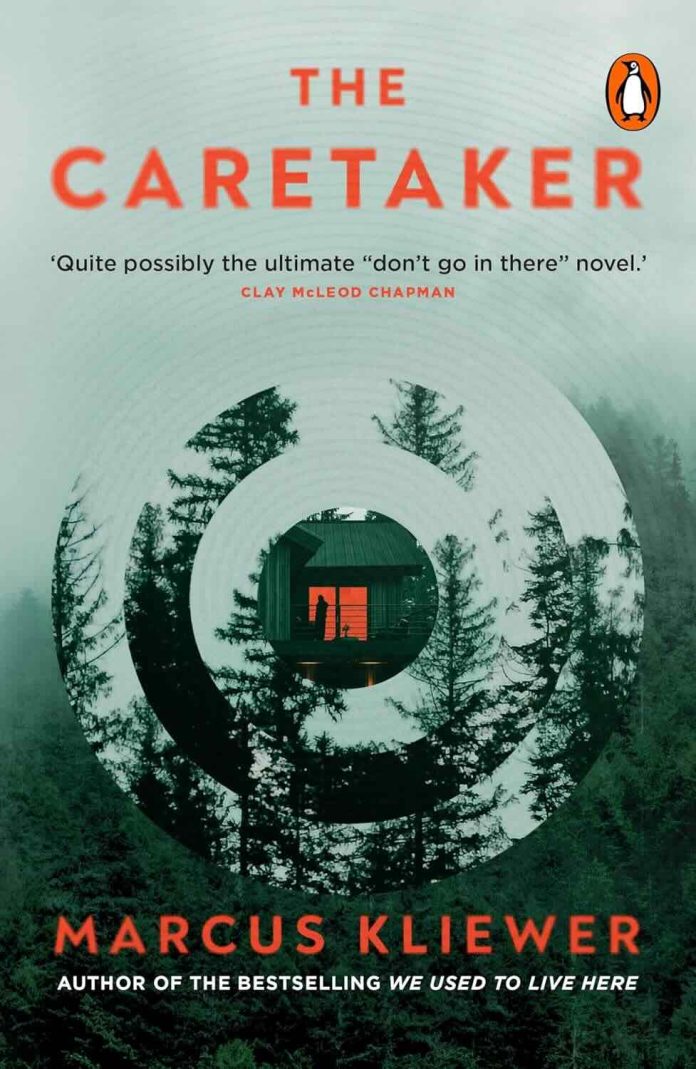
Some horror novels announce themselves with a scream. The Caretaker by Marcus Kliewer opens with a whimper in the Oregon woods, and somehow that is worse. An aging man named David follows muddy footprints off his front stoop at midnight, carrying a flashlight and the unshakable belief that humanity depends on him being very, very careful. By the time he meets what he calls a Visitor in a sloped clearing, you already know this book is not going to behave.
This is Kliewer’s sophomore novel, arriving after his debut We Used to Live Here, a Reddit creepypasta that Netflix scooped up before it had even been stretched into a full manuscript. The Caretaker carries over the analog-horror DNA of that first book. Lonely houses, cursed rules, protagonists too broke to walk away. What it trades in is suburban-family anxiety for something rawer and more claustrophobic. This time the house belongs to a stranger, and the person sleeping in it is utterly alone.
The Setup: A Job, a Sister, a Shaky Girl
Macy Mullins is twenty-something, carries a faded Pikachu backpack from middle school, and lives in a repurposed motel next to a musty bog that overlooks a tent city and the Oregon State Penitentiary. Her checking account has taught her the exact pixel location her balance occupies on the banking app, because covering it with her thumb is cheaper than therapy. Her younger sister Jemma needs a ninety-eight dollar asthma inhaler. Their father drove his pickup off a rain-slick road three years ago, and Macy has not cried once since.
Then comes the Craigslist ad: three days of work, competitive pay, and a spooky-quaint Oregon rancher at the end of a gravel drive. The widow who owns it, Grace Carnswel, offers nine thousand dollars. Macy, in her own words, sells out.
What the House Wants
Once Macy accepts the job, a VHS tape from Grace’s dead husband lays out the Rites. A partial tour of the rules, in no particular order:
- Keep the main-floor and second-floor lights off between 3 and 4 a.m.
- If a rabbit shows up within fifty feet of the house, lock every door to the outside.
- If a Visitor with pale blue eyes knocks three times between 6 p.m. and 6 a.m., hide.
- Pick up the phone when it rings, write down what the voice says, and obey.
- In case of failure, open the appropriately labeled envelope.
That is the book’s whole engine. A grieving young woman alone in a stranger’s house, following rules that sound like a prank until they very much do not. What the book pulls off, and it is legitimately unsettling in parts, is welding this rules-horror structure to the texture of clinical compulsion. Macy’s relief after turning off a lamp reads like a hit of dopamine. Her lock-checking spirals read like textbook OCD. The supernatural and the psychological get tangled on purpose, and Kliewer never condescends to either one.
Prose That Sounds Like Someone You’d Actually Know
Kliewer writes Macy in a first-person voice that sounds like the friend of yours who overexplains her own jokes and listens to deathcore on the bus. There is gallows humor on nearly every page. There are specific brand names (Costco, TJ Maxx, a podcast called Mind-Set Grind-Set hosted by a guy in a Tapout cap). There is a running bit where Macy imagines Jemma’s popcorn commentary during scary movies: “OUT! OUT! GET THE FUCK OUT!” It is funny, and when the scares hit, that levity buys them real weight.
The Oregon Coast wilderness earns its keep as a character. Trees get called introverts at a cocktail party. Rain straggles from branches like the sky is on the verge of bursting into tears. Nothing is overwritten. The book reads fast.
What Works
A few things The Caretaker by Marcus Kliewer does better than most horror novels on the shelf this year:
- The sibling relationship. Macy and Jemma’s text threads (“Are u dead?” / “Not yet.”) carry the emotional spine of the book. You care because they care about each other.
- Class-coded dread. Most haunted-house stories gloss over how a protagonist can afford to stay. This one opens with an eviction notice and never forgets where its hero came from.
- The analog-horror aesthetic. VHS tapes, rotary phones, muddy footprints in gravel, a Ford Ranger that may or may not be a dead man’s truck. Kliewer knows this stuff in his bones.
- Mental health as texture, not decoration. The novel opens with an author’s note on depression, OCD, grief, and suicide. That framing earns itself across the book.
Where It Stumbles
A four-star book is not a five-star book, and The Caretaker by Marcus Kliewer has its soft spots. The middle third loops through a pattern of Rite, failure, letter, Rite, failure, letter that starts to sag before the plot kicks back into gear. Readers coming off We Used to Live Here may find the formula a touch familiar, since both books trade on lonely houses and cryptic instructions written by absent men.
Secondary characters beyond Macy and Jemma are thinly sketched. That is a fair choice for a claustrophobic haunt, but it leaves the cast feeling sparse. And the ending leans into ambiguity in a way that will either gut you or frustrate you. I landed closer to gutted, though I understand the readers who wanted the knife to twist a few more degrees.
Who This Book Is For
You will like The Caretaker by Marcus Kliewer if:
- You read We Used to Live Here and wanted more from that analog-horror world.
- You spend your weekends deep in the r/NoSleep rabbit hole.
- You want a protagonist whose financial panic feels as specific as her supernatural one.
- You are fine with a horror novel that ends on a question mark rather than a period.
You may want to skip it if you prefer your haunted-house stories tied off cleanly, or if you bounce off horror that leans heavily on compulsion and intrusive-thought cycles.
If You Liked This, Try These
A short shelf of spiritually adjacent reads:
- We Used to Live Here by Marcus Kliewer (his debut, and essential if you liked this one).
- A Head Full of Ghosts by Paul Tremblay (mental health and the supernatural, tangled).
- The Grip of It by Jac Jemc (wrong house, wrong rules, creeping wrongness).
- Home Before Dark by Riley Sager (inherited-house horror, found documents).
- The Last House on Needless Street by Catriona Ward (unreliable perspective plus genuine dread).
- Mexican Gothic by Silvia Moreno-Garcia (atmospheric rot, stubborn woman, bad house).
- Nestlings by Nat Cassidy (economic desperation meets supernatural landlord).
Final Word
The Caretaker by Marcus Kliewer is not flawless, and it is not trying to be. It is a nervy, often very funny horror novel about a young woman who takes a job she cannot afford to quit, in a house that will not stop ringing. It earns its scares, it earns its grief, and it earns the reader’s patience even through a baggy middle. Worth your weekend, ideally in the rain.







