
 1
1 2
2 3
3 4
4There is a kind of love story that does not open with a meet-cute so much as a reckoning. Two people who already know what they once had, circling a shared history neither has fully survived, unsure whether returning to it is brave or simply hopeless. Unbound by Peyton Corinne is that story, and it commits to the full, uncomfortable weight of it with the lyrical precision of a writer who trusts her readers to stay.
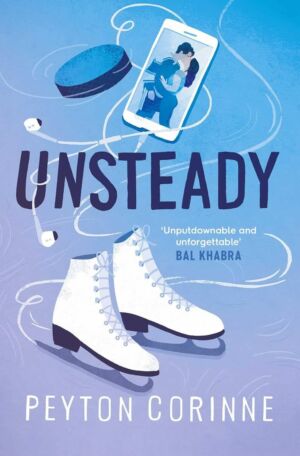
The third novel in Corinne’s Undone series, Unbound arrives after Unsteady (Rhys and Sadie’s story) and Unloved (Freddy and Ro’s story), dropping readers back into Waterfell University and the closely held world of the hockey house. The fourth and final installment, Undone, follows Toren Kane and Lily, a pair whose connection surfaces throughout the pages here with just enough tension to make their eventual story feel genuinely earned. Readers who have followed the series from the beginning will find the accumulated emotional world richer than ever. Those arriving here first will find a story that stands on its own, though certain moments carry extra weight with the prior context.
Built on Two Timelines
Unbound by Peyton Corinne unfolds in alternating chapters: THEN (freshman year, where everything began) and NOW (senior year, where the wreckage still smolders). The early chapters shimmer with the tentative, almost frightening hope of first love: two eighteen-year-olds who find each other in a half-empty locker room, then again in an Introduction to Poetry seminar, deciding slowly and carefully to let that mean something. The present-day chapters carry the bruise of years: the same two people, older and more defended, thrown back into proximity with no clean way to resolve what broke apart between them.
This structure is the novel’s most deliberate creative decision, and also its most demanding ask of the reader. The full explanation for why Bennett and Paloma’s relationship fractured unfolds across hundreds of pages, threading backward and forward with patient precision. Readers who prefer their revelations earlier will feel the accumulation. Those who surrender to the rhythm will find that the convergence lands with exactly the weight it has been building toward. Every THEN chapter quietly reframes a NOW moment. The architecture is far more purposeful than it appears at first.
Two Portraits, Built to Last
Unbound by Peyton Corinne succeeds most completely as a character study of two people whose damage is almost perfectly mirrored. Bennett Reiner is autistic and manages OCD with the help of a therapist he has seen since childhood, a system of careful routines, and Seven, a black Labrador therapy dog who functions throughout the novel as something close to an emotional compass. Corinne worked with a psychologist to build Bennett’s interiority, and the care is visible on every page.
His compulsions are not framed as flaws for a romantic partner to smooth over. His directness is not shorthand for social awkwardness. He is fully himself: meticulous, observant, quietly volcanic, and entirely worthy of the attention the novel gives him. Readers who share his neurology will likely recognize the texture of his inner life in ways that feel rare in the genre.
Paloma Blake is his counterpart in the most literal sense. She is warmth dressed in armor: a woman who has learned to pre-empt abandonment by becoming someone nobody could hold gently. Her backstory is serious, handled with care and significant content warnings that readers should take seriously before proceeding. What Corinne does with Paloma over the course of the novel is not comfortable, but it is honest in a way that rewards careful reading.
The specific love language these two share is poetry. They trade poems like letters, annotated and responded to, E. E. Cummings answered with Mary Oliver, free verse returned with structured sonnets. It could easily read as affectation. Instead it reads as necessity, because it makes precise character sense. These are two people for whom direct emotional speech is complicated. Of course they reached for poetry first.
Seven, quietly, may be the novel’s third most important character. His loyalty tracks both Bennett and Paloma’s emotional states with an accuracy the humans rarely match, and his presence communicates things neither lead can yet name aloud.
The Sea as Architecture
Running from the first page to the last, the central metaphor of ocean and shore never feels labored or ornamental. Paloma is the sea: restless, alive, occasionally dangerous, always moving. Bennett is the shore: constant, changed by every wave but never swept away. This is not a metaphor Corinne gestures toward and abandons. It structures the emotional logic of the entire novel, and by the time the final chapters arrive, it carries enough accumulated weight to be genuinely affecting rather than merely poetic.
Where the Novel Tests Patience
At its most ambitious, Unbound by Peyton Corinne is a sustained study in emotional tension. At its most demanding, the tension holds a beat or two past comfort. The midsection asks readers to sit with unresolved yearning across a significant page count, and the shape of what is coming becomes visible before the resolution finally arrives. Readers accustomed to faster-paced romance will feel this. Those drawn to literary-leaning, angsty new adult fiction in the vein of Corinne’s earlier Undone books will likely find it calibrated precisely to their preferences.
The novel’s secondary cast, particularly Rhys and Sadie from Unsteady and Freddy and Ro from Unloved, add genuine warmth to the Waterfell world. Their presence rewards series loyalty. Toren and Lily, seeded throughout with careful attention, make the turn toward Undone feel natural rather than obligatory.
What Peyton Corinne Does That Others Don’t
Corinne has built the Undone series on the premise that romance can hold serious emotional weight without sacrificing heat or hope. Unbound is the fullest expression of that commitment to date. It does not sanitize trauma or reduce neurodivergence to personality texture. It does not offer easy catharsis. What it offers instead is specificity: two people rendered with such precision that their reunion feels both inevitable and honestly earned.
If This Was the Book You Needed, Try These
- Icebreaker by Hannah Grace, for the hockey setting and that same slow-burning, bruised-by-history tension
- The Kiss Quotient by Helen Hoang, for an autistic protagonist written with comparable care and emotional intelligence
- People We Meet on Vacation by Emily Henry, for the dual timeline structure and the ache of revisiting a fractured relationship across years
- Reminders of Him by Colleen Hoover, for the same emotional weight and the sense of love as something that survives rather than dissolves
- Love Redesigned by Lauren Asher, for second-chance romance with a heroine who refuses to make healing easy on herself
- Pucking Around by Emily Rath, for readers who want to stay in the hockey romance world with similar emotional stakes
Unbound by Peyton Corinne does not want to be easy. It wants to be true. And for readers who can follow it there, it delivers something most sports romance does not attempt: a love story that looks directly at how much wreckage two people can carry, and insists that carrying it together is still worth the try. The shore does not stop being the shore because the sea is restless. That is the quiet promise at the center of this novel, and Corinne earns it on every page.