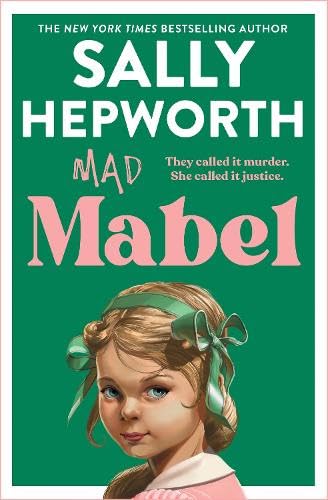
Elsie Mabel Fitzpatrick is eighty-one, six feet tall, grows prize-winning roses, and finds a photocopy of a decades-old newspaper article shoved under her door by a neighbour who would very much like to see her gone. She also happens to have been convicted, aged fifteen, of murder. In Mad Mabel by Sally Hepworth, we meet this cantankerous former Mad Mabel on the very afternoon a new, nosy little girl called Persephone decides they are now best friends. Across the cobblestones, an elderly neighbour turns up dead. And across town, a true-crime podcasting duo is about to convince Elsie that after sixty-six years of silence, it might finally be time for her to speak.
Sally Hepworth has made a career out of writing women who look ordinary on the front porch and feel like storm systems on the page. Readers who loved The Soulmate, Darling Girls, The Mother-in-Law, and The Good Sister will recognise the shape here: a suburban setting, a domestic drama with teeth, short chapters that dare you to put the book down. What feels different this time is the voice. Elsie is older, sharper, and considerably less inclined to be liked than any of Hepworth’s previous narrators.
Two timelines that mostly work, and occasionally don’t
The novel splits itself between Now (2025) and Then (the late 1950s). In the present, Elsie lives out her last stretch of life on a cobbled Melbourne lane full of busybodies, a belligerent chihuahua called Nugget, a litigious neighbour named Joan, a good-hearted Greek widower called Peter, and the precocious Persephone, who treats Elsie’s porch like her own personal interview studio. In the past, a lonely, too-tall girl called Mabel Waller grows up inside a cold mansion, taunted at Mass, blamed by her father for her baby sister’s death, and eventually thrust into a long hospital stay after a bicycle accident.
This back-and-forth structure works beautifully when it lets the past chapters explain something you have been puzzling over in the present. It works less beautifully when the Now chapters stall for a stretch while we wait for the next Then chapter to land. Read in long sittings, you feel the seams. In shorter gulps, you barely notice them.
What the dual timeline does well:
- Lets the reader meet Mabel at fifteen and Elsie at eighty-one as if they were two entirely separate women, only to watch them collapse into one by the final third.
- Uses Anne of Green Gables as a quiet motif for the bosom-friend idea that powers the whole novel.
- Delivers the book’s most emotionally honest scenes inside the historical chapters, where Hepworth’s restraint is at its sharpest.
- Staggers the reveals so that even readers who see the biggest turn coming still feel the smaller emotional ones land.
The voice is the whole reason you’ll stay
The strongest reason to pick up Mad Mabel by Sally Hepworth is Elsie herself. She calls people “dipshit” far more often than “dear,” refers to the postman as a walking name-typo, and processes her grief through a steady drip of dark one-liners. Her internal monologue reads like the grandmother most of us secretly wish we had, the kind who would happily tell a concerned paramedic to mind his own business. Hepworth gives Elsie’s sentences a dry, faintly Australian snap that feels closer to a friend reading aloud than a thriller narrator performing for an audience.
Persephone, the seven-year-old interloper, is the novel’s most unexpected gift. She is loud and audacious and occasionally grating, which is precisely the point. The slow, reluctant warming between the two of them is what gives the plot its heartbeat. Watching an angry old woman who has spent a lifetime being called mad discover she might have one more person worth protecting is, genuinely, the most affecting thread in the book.
Where the novel loses its footing
For all its warmth and wit, this is not a flawless book, and an honest review of Mad Mabel by Sally Hepworth needs to say so. A few things that did not fully land:
- Too many deaths at too close a distance. Mabel’s early life is punctuated with a string of losses and suspicious incidents, and while that is part of the point, after the fourth body the shock value begins to soften into routine.
- The present-day mystery is the weaker half. What happened to the elderly neighbour is thinly plotted compared to the historical arc, and the resolution leans too hard on coincidence.
- A couple of subplots resolve a shade too neatly. Without giving anything away, at least one late reveal involving a long-standing Kenny Lane neighbour feels engineered rather than earned.
- Tonal whiplash. In a book that touches on child abuse, grooming, domestic violence, and suicide, the chirpy one-liners can misfire in the wrong scene.
None of this ruins the experience. It does, however, explain why many readers who adored Darling Girls are likely to enjoy this one without quite worshipping it.
A final turn worth arriving at honestly
The ending rewards attention. There is a reveal in the final pages involving one of the recurring characters that quietly reframes large chunks of what you have just read, and Hepworth has the discipline not to shout about it. She lets you sit with it, and then she cuts away. It is the kind of last beat that tends to surface in a book club three weeks after the fact, when someone finally works up the nerve to ask, “Wait, did you notice…?” For a novel that spends so much time talking about female friendship, the closing pages are a generous, slightly melancholy argument for the idea that the people who save us are rarely the ones we expect.
Who this book is actually for
Mad Mabel by Sally Hepworth will suit:
- Long-time Hepworth readers, especially fans of The Mother-in-Law, The Good Sister, and Darling Girls.
- Anyone who loved Richard Osman’s Thursday Murder Club for its elderly, chaotic leads.
- Readers who liked Fredrik Backman’s A Man Called Ove and enjoy grumpy protagonists with secret softness.
- Fans of character-first Australian and British mysteries that lean harder on interiority than on forensics.
If you prefer tightly plotted procedurals or relentless page-turner thrillers with a shock on every third page, this is probably not the book for you.
If you liked this, try these
- The Thursday Murder Club by Richard Osman, for elderly sleuths and sharp comic timing.
- A Man Called Ove by Fredrik Backman, for the curmudgeon-with-a-past template.
- The Dry by Jane Harper, for another strong Australian voice in the crime space.
- Big Little Lies by Liane Moriarty, for suburban secrets and a female-friendship backbone.
- The Appeal by Janice Hallett, for a similarly playful mystery structure.
- Still Life by Sarah Winman, for a gentler take on decades-long bonds.
The verdict
Sally Hepworth has written a book that is funnier than it has any right to be, sadder than it lets on, and more interested in friendship than in solving a crime. For most of its pages, Mad Mabel by Sally Hepworth earns the high expectations readers arrive with, and when it stumbles, it stumbles politely. It is a good choice for a long weekend, a plane ride, or a book club willing to argue about whether an eighty-one-year-old with a high body count counts as a hero or a cautionary tale. Either way, Elsie Mabel Fitzpatrick is a woman worth meeting.