The Pastures of Heaven by John Steinbeck opens with a Spanish corporal chasing runaway Indians over a ridge, sees the valley below, takes off his steel helmet and calls it the green pastures of heaven. He intends to return and live there peacefully. Instead he contracts smallpox, and when his face begins to come away his friends lock him in a barn until he dies.
That is the first page of The Pastures of Heaven by John Steinbeck, and the joke it sets up runs for two hundred more. The valley really is beautiful. Nobody in it ever gets the quiet life they came for.
How The Pastures of Heaven Works
The Pastures of Heaven by John Steinbeck runs to twelve chapters, each centred on one family, connected by place rather than plot. The form is the short story cycle, and this is an unusually disciplined example of it.
The connective device is the Munroe family. Bert Munroe buys the derelict Battle farm, which the valley considers cursed, and moves in with his wife and children. He is a decent, friendly, entirely unremarkable man. Over the following chapters, a Munroe appears somewhere near the edge of each story and something is destroyed.
The point is that they never intend it. Bert’s son makes an idle remark at school and a boy’s life collapses. Mrs Munroe offers a well-meant piece of advice. A Munroe mentions something to a neighbour in passing. Each time, the family moves on with no idea what has happened, and the reader watches the mechanism from outside.
What works
- The structure is genuinely elegant. Each story stands alone and the cumulative effect is far larger than any one of them.
- Tularecito is unforgettable. No character in The Pastures of Heaven by John Steinbeck is harder to shake. A foundling of enormous strength and no speech who can draw anything from memory, and whom the valley cannot accommodate.
- Junius Maltby is the best story in the book. A man who reads by the stream while his wife and children die of fever, and who is later destroyed by charity rather than neglect.
- The prose is already recognisable. Two years before Tortilla Flat, the valley writing is confident and exact.
Where The Pastures of Heaven Gives Ground
- The pattern becomes visible. Once you spot that a Munroe will appear and something will break, several chapters lose their suspense.
- Some stories are much better than others. Maltby and Tularecito are superb; one or two of the middle chapters are anecdotes with an ending bolted on.
- The women are handled unevenly. Molly Morgan and Helen Van Deventer get real interiors; others exist to be ruined.
- The curse framing is left half-developed. The book raises the idea that the Battle farm is haunted and then quietly abandons it, which is probably deliberate and still feels unresolved.
The Munroes Are the Mechanism of The Pastures of Heaven
It is worth being exact about how the damage travels, because the book is careful and most summaries are not.
Bert Munroe’s son repeats a piece of schoolyard gossip and a teacher acts on it. Mrs Munroe pays a charitable call and leaves a parcel of clothes. A Munroe mentions, in passing and to the wrong listener, something a neighbour said in confidence. In every case the Munroe involved is being sociable by the standards of any ordinary small community.
What makes it work is the population they have moved among. Nearly everyone in this valley is concealing something: a parentage, a condition, a failure, a private arrangement that functions only while nobody examines it. A family of cheerful, curious, well-meaning newcomers is the one thing such a place cannot survive.
Steinbeck never states this. He arranges twelve demonstrations and leaves The Pastures of Heaven by John Steinbeck to be read by somebody paying attention.
Read it if
- You want the architecture, which is better than anything he had attempted before.
- You like linked stories where the connections are consequences rather than reappearances, which is what The Pastures of Heaven by John Steinbeck does better than most.
- You are interested in how fast he improved; this is two years after the first novel.
Skip it if
- You need a protagonist to follow.
- Repeated structural patterns irritate you once spotted.
- You want the political writing of the following decade.
The Trick The Pastures of Heaven Plays at the End
The last pages of The Pastures of Heaven by John Steinbeck leave the valley altogether. A sightseeing bus stops at the top of the ridge and the passengers look down at the farms with the evening air lying blue over them.
Each of them says some version of the same thing. A man could keep a cow down there and a few pigs. A man could raise enough to eat. One passenger says he could think down there, make something whole out of the trailing ends of his life. The driver, who makes this stop every day, says he always likes to look at it and imagine how quiet and easy a man could live.
They are describing exactly what the Spanish corporal wanted on page one, and the reader has just spent two hundred pages watching the valley refuse it to everybody who tried. Nobody on the bus is told. The driver kicks the starter and they go.
Read these next
- Cannery Row by John Steinbeck. The other book built from vignettes about one small place, thirteen years later and far warmer.
- A Literary Analysis of East of Eden by John Steinbeck. The full-length version of the same idea about land and inheritance.
- The Red Pony by John Steinbeck. Linked stories again, on a smaller scale and with one consciousness at the centre.
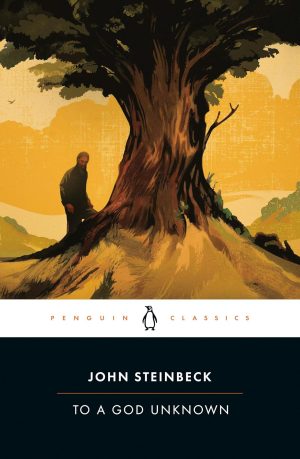
- To a God Unknown by John Steinbeck. Written around the same period, and the proof of how differently he could handle a valley.
Do You Need the Earlier Book?
No. This followed Cup of Gold and has nothing whatever in common with it. The pirate novel was a historical romance written by someone trying to sound like other people; this is the first book in which the Salinas country, the plain declarative sentences and the interest in people who have quietly arranged their lives around a secret all arrive at once.
If you are working through the bibliography in order, this is the point at which it becomes worth doing.
Content notes
The Pastures of Heaven by John Steinbeck contains child death, maternal death in childbirth, the committal of a disabled young man, and a suicide.
What Stays With You
Not the curse, which the book mostly drops. What stays is the structure of the harm.
Every disaster in The Pastures of Heaven by John Steinbeck is triggered by somebody being neighbourly. A boy’s talent is noticed and reported to the authorities. A reclusive family is offered clothes and respectability. A remark is passed along in good faith. The Munroes are not a curse and never become one; they are simply ordinary sociable people in a valley full of others who have arranged their lives around not being noticed.
That is a far more disturbing proposition than a haunted farm, and Steinbeck, at thirty, was already clear-eyed enough not to spell it out.