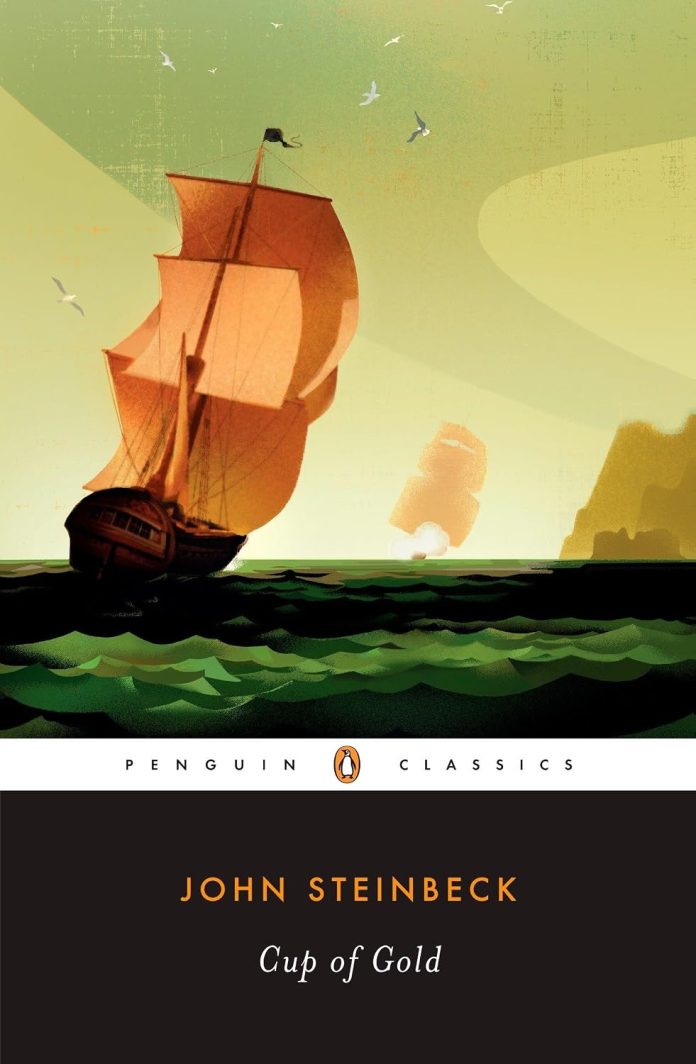
The boy at the start of Cup of Gold by John Steinbeck is sent up a crag by his father to hear what old Merlin has to say before he sails. Merlin looks at him and gives the verdict plainly: he will be a great man because he has never grown up, and the ones who stay children get what they chase and find it worthless the moment it is in their hands.
Everything that happens afterwards is in that conversation. The trouble is that it occurs on page thirty, and the remaining two hundred and forty pages do very little that the old man has not already given away.
Where Cup of Gold by John Steinbeck Sits in the Backlist
This was the first book, published in August 1929, two months before the Wall Street Crash. It sold around fifteen hundred copies and the publisher went under.
Reading it now, the striking thing is how little of it survives into the writer he became. The subject is a seventeenth-century Caribbean pirate. The register is high romance, full of inversions and invocations. There is no Salinas Valley, no working people, no interest in how anybody earns a living. A reader coming to it from The Grapes of Wrath will not recognise a single habit of the prose.
Three years later The Pastures of Heaven arrived and sounded like him. Whatever happened between the two, it was decisive.
What the Story Actually Is
Henry Morgan leaves Wales, is sold into indentured service in Barbados, serves his term, acquires a ship and then a fleet, and becomes the most successful buccaneer in the Caribbean. The real Henry Morgan did most of this.
What Cup of Gold by John Steinbeck adds is the quest. Across the Main, sailors whisper about a woman in Panama called La Santa Roja, the Red Saint, whom nobody has actually seen. Every man in the islands has drunk to her and dreamed of her. She becomes, as the book puts it, the quest of every man’s heart.
So Morgan takes Panama, the city the buccaneers call the Cup of Gold, in order to find her. He does find her. She turns out to be an intelligent, unimpressed woman who sees him clearly and tells him so, and he discovers he does not want her at all once she is standing in front of him.
What works
- The Merlin scene is excellent and would not be out of place in his mature work.
- Dafydd is the best thing in the book. The farm boy who went to sea years earlier and comes home grey, hardened, rich and cold, warning everyone and convincing nobody. He appears for four pages and haunts the rest.
- The central idea is sound. A man who gets exactly what he wanted and finds it empty is a real subject, and Steinbeck returned to versions of it for forty years.
- The sack of Panama is well staged, and the one sequence where the prose stops posing and simply reports.
Where Cup of Gold Gives Ground
- The writing is badly overdressed. Archaic constructions, portentous repetitions and a great deal of weather doing emotional work. He was twenty-seven and it shows on every page.
- The women are not people. Elizabeth exists to be left behind, and La Santa Roja exists to disappoint, which is a thin job for the character the whole plot is built around.
- The structure sags in the middle. A long stretch of raids and voyages with no development, because the thesis of Cup of Gold by John Steinbeck cannot advance until Panama.
- The colonial material is handled without much thought. Enslaved people and Indigenous Caribbean populations appear as scenery, and the novel’s interest in them extends about as far as atmosphere.
The Prose Is the Real Difficulty With Cup of Gold
The structural complaints above are fixable things, the sort of fault a second book usually corrects. What makes the novel hard going is at sentence level, and it is worth being specific rather than just calling it purple.
Three habits run through it. Nouns arrive with a decorative adjective whether they need one or not. Sentences are inverted for gravity, so that an ordinary statement about a ship or a field is given the word order of scripture. And the weather is constantly asked to do the work the characters are not given to do, so that a man’s disappointment is reported via the colour of the evening rather than anything he says or notices.
The reason this matters is that Cup of Gold by John Steinbeck is not a badly plotted adventure story. The plot is fine. The trouble is that a reader cannot get close to anybody through that much upholstery, and the central argument of the novel, which is about the private difference between wanting and having, needs proximity to land at all.
You can see him diagnose it himself. The sack of Panama is the one extended passage where the ornament drops away and the book simply reports what happens, in order, to whom. It is the best sustained writing in the novel, and it reads like the man who turned up three years later.
Read it if
- You are working through Cup of Gold by John Steinbeck and the rest of the bibliography in order and want to see the starting point.
- You like historical adventure and are forgiving about period prose.
- You are curious how a major writer sounds before he finds his subject.
Skip it if
- You came for the Steinbeck of the California books; he is not in here.
- Ornate early-twentieth-century romance prose is a chore for you.
- You want women who function as characters.
Do You Need Anything Before Cup of Gold by John Steinbeck?
There is nothing before it. This is the first, and it is also the one you can most comfortably skip. Nothing in The Pastures of Heaven, Of Mice and Men or anything later depends on having read it, and the usual advice to start an author at the beginning is actively unhelpful here.
There is a case for reading it out of sequence altogether. Save Cup of Gold by John Steinbeck until you already know what the mature prose sounds like, and the distance between the two becomes the whole interest of the exercise. Read cold, it is simply a slow pirate novel from 1929. And read last, it is evidence.
Read these next
- A Literary Analysis of East of Eden by John Steinbeck. The late novel that finally manages what this one attempts, taking one family across sixty years and treating the result as an ethical case.
- A Literary Analysis of Of Mice and Men by John Steinbeck. The opposite lesson, learned eight years later. A hundred pages, no ornament, same subject.
- A Literary Analysis of The Grapes of Wrath by John Steinbeck. Proof of what the ten years after the pirate novel were for.
- The Timshel Debate. On the one word he spent his career circling, and the Merlin warning is an early draft of it.
The Verdict
Cup of Gold by John Steinbeck is the weakest book he published, and worth knowing about rather than reading.
What stays is the shape of the disappointment. Morgan takes the richest city in the Americas, finds the woman every buccaneer in the Caribbean has dreamed about, and feels nothing. He dies years later, respectable and knighted, watching the figures around his bed vanish when he looks at them directly, asking after a father who is already dead and a magician he half invented.
That ending is better than the book around it. Cup of Gold by John Steinbeck understood its own argument perfectly well at twenty-seven. It simply had not yet learned how to put it in the mouths of people who sound like anybody you have met.