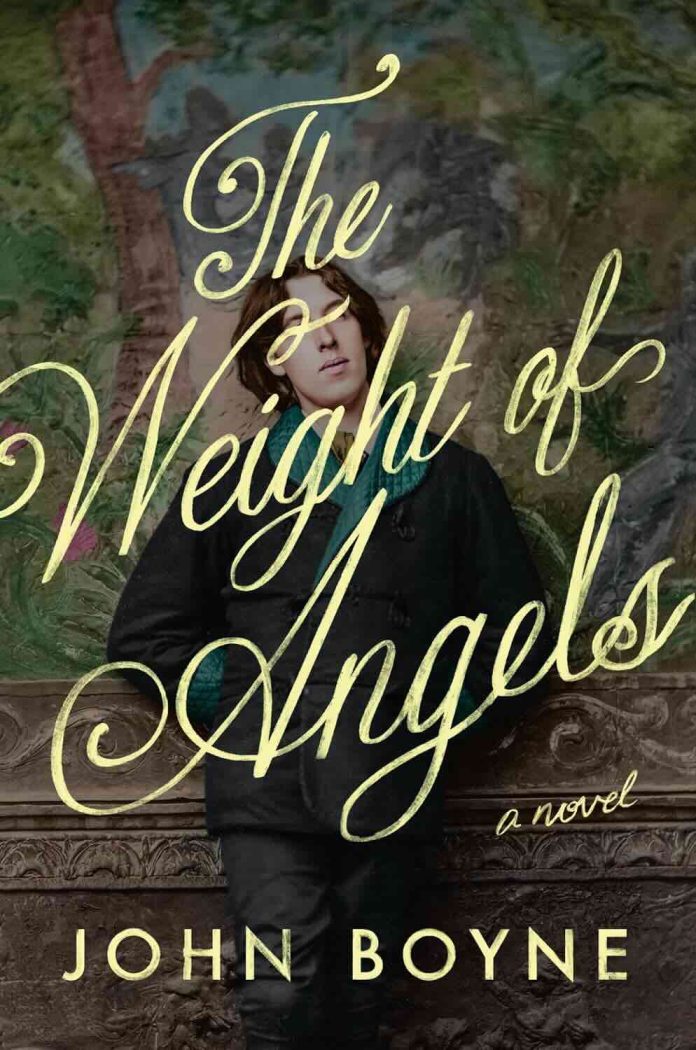
February 1895, the Albemarle Club. Three friends have told Oscar Wilde to sue the Marquess of Queensberry, his solicitor has privately advised him not to, and Lord Alfred Douglas is screaming at him across the table to destroy his father in open court. Wilde tears the offending calling card into four pieces, balls the scraps up, and flicks them into the melting ice of a champagne bucket. He will not sue. Bosie tells him their friendship is finished and walks out. The Weight of Angels by John Boyne runs five hundred and seventy pages on from that flick of a thumb, and Wilde lives to be ninety-eight.
Where The Weight of Angels Sits
Three shelves claim it at once, and that is the first thing worth knowing.
It is biographical fiction, catalogued by the Library of Congress under Wilde and under contemporaries of Wilde, which is accurate: the book is as interested in who was in the room as in who was speaking. It is alternate history, formally, with a single clean branch point in the prologue. And it is a John Boyne novel, which means a long life told in dated set pieces, a protagonist in flight from one catastrophic act, and a willingness to put real people on the page and let them behave badly.
What The Weight of Angels by John Boyne does not do is read like the Wilde industry. There is no gloating, no biography smuggled in as dialogue, and no reverence. Wilde here is vain, lazy, snobbish, funny, a hopeless judge of beautiful men and frequently a coward, and the novel is clear that the last of those is what matters.
The Swap, and What It Buys
The counterfactual is elegant because it invents nothing. It moves one man out of the dock and another into it.
Within a year Bosie is on trial himself, discovered with two boys in a hotel room, prosecuted by Edward Carson, undone by one joke too many. Two years’ hard labour. He becomes a number on a landing. From his cell he sends Wilde a letter that is the best thing in the book, a reverse of the famous one, in shouting capitals, cursing Wilde’s descendants and insisting that he was the real poet all along. He dies in a Paris hotel at thirty with Wilde holding his hand, and in the desk drawer afterwards Wilde finds a manuscript titled The Ballad of Reading Gaol, by Lord Alfred Douglas.
That is the whole trick of The Weight of Angels by John Boyne, and it is a good one. Wilde then spends twenty years trying to get a dead boy’s poem published, which hands Boyne his best running device: an alternate literary century in which Shaw collects every prize first, Eliot runs the Ballad in his new magazine, and Wilde keeps forgetting the title of Bram Stoker’s vampire novel.
The Man Who Makes Oscar Happy
The counterfactual is the hook. Augustus Boone is the reason to read on.
Gus is invented, a Peckham schoolteacher who mistakes Wilde for a waiter in a hotel bar in 1906 and then shares a Berkeley Square house with him for seventeen years. He is not a reader, not clever, not beautiful, not interested in the theatre, and he is the only person in nearly a century who makes Wilde content. The cost is immediate and very funny: contentment stops him writing. Yeats tells him to set the man aside for the sake of his art.
He does worse than that. In 1917 he takes up with a nineteen-year-old actor of no talent whatsoever, keeps him in a part against every director’s judgement, and when the thing breaks open, The Weight of Angels by John Boyne becomes a novel about consequence rather than wit. Gus is arrested in a raided house, pleads guilty, and is given thirty months. The line about what a rope costs in Wandsworth is the cruellest in the batch, and it arrives in two sentences of dialogue with a guard.
The Weight of Angels and Its Receiving Line
The guest list in The Weight of Angels by John Boyne is enormous, and for roughly two hundred pages it is the book.
- Kipling, in a playscript scene grieving a son alongside Wilde, and the best of them.
- Emmeline Pankhurst, in a Claridge’s row about a slashed Velázquez, winning the argument twice.
- Magnus Hirschfeld, whose institute has just been burned, which is where the novel stops being a comedy.
- Virginia and Leonard Woolf, who are a sketch act.
- E. M. Forster, who publishes the novel he actually suppressed, is ruined for it, and reinvents himself writing detective fiction under a woman’s name. The most enjoyable invention here.
- Churchill, Chamberlain, Gielgud, Olivier, Katharine Hepburn, Selznick, Chaplin, Noël Coward, Thelma Furness, Wallis Simpson, Edward VIII, Mickey Rooney, Agatha Christie, and four coronations’ worth of royals.
Where The Weight of Angels Gives Ground
- It is far too long. The book stalls twice, between 1902 and the war and again in Hollywood, and both stretches read as anthologies of good scenes rather than chapters of a novel.
- The alteration alters nothing. Wilde gets fifty-two extra years and a Nobel, and nothing outside his own address book moves: same wars, same abdication, same everything. For a formal alternate history that is a strange abdication of its own.
- The political ending is a wish, not an argument. One speech, a comfortable majority, no public campaign, no committee stage, fifteen years ahead of the real thing. Boyne has earned the feeling and skipped the politics entirely.
- The wit runs on a timer. Roughly an epigram a page for five hundred pages. The mangled Dracula gag is funny eleven times and audible machinery by the twentieth.
Read It If, Skip It If
Read it if:
- A counterfactual that reshuffles a literary canon appeals more than one that reshuffles a war.
- You want the love story. It is the strongest writing in The Weight of Angels by John Boyne and makes the length survivable.
- You can take an author who refuses to let his protagonist off. The Paris lunch where a real novelist defends his own practice at length, with a child at the table, and Wilde backs him, is the bravest scene here.
Skip it if:
- Famous-person cameos make you itch. There are forty of them.
- You need alternate history to be rigorous. This one is a character study wearing the genre’s coat.
Content Notes
A suicide by hanging, with the body described. Imprisonment with hard labour, and a prisoner’s account of being raped in his cell with the guards’ connivance. Child prostitution, including a sixteen-year-old in a borstal, birched and used nightly, who says he is not drawn to men at all. A Black teenager beaten by guards and inmates until he takes his own life. A sustained on-page defence of paedophilia by a real historical novelist, with a fourteen-year-old present, which the protagonist answers by agreeing. A son killed at Festubert. Period slurs for gay men in great quantity. Nazi book burnings and a Gestapo death list. The 1918 influenza pandemic. Cancer. Alcohol on nearly every page.
Read These Next
Five of ours for readers who finish The Weight of Angels by John Boyne.
- The Boy In The Striped Pyjamas by John Boyne is the one everyone has read, and the fairest measure of the distance travelled.
- The Disappearers by Marlon James for men criminalised, then vanished, for who they loved.
- A Dangerous Bargain by Erin Cotter if the queer historical thread is what you came for.
- Typewriter Beach by Meg Waite Clayton if the Hollywood stretch is what you want more of.
- Ten most famous authors worth reading once for the real shelf behind all the gossip.
The Verdict
What stays is a title and an instruction. Wilde produces the phrase himself, late, in a Stockholm restaurant on the eve of a prize ceremony: the sensation of being suffocated beneath the weight of angels, with no way of knowing whether those same creatures will carry him to his reward or watch him punished. He follows it with advice to a young man he loves, which amounts to holding your own angels close and never betraying them.
He has already failed at that, and will fail again. The Weight of Angels by John Boyne is a long book about a man who was given a voice and spent sixty years declining to use it, and about what it costs him to find it at ninety-four. Skim the parties. Do not skim the schoolteacher.







