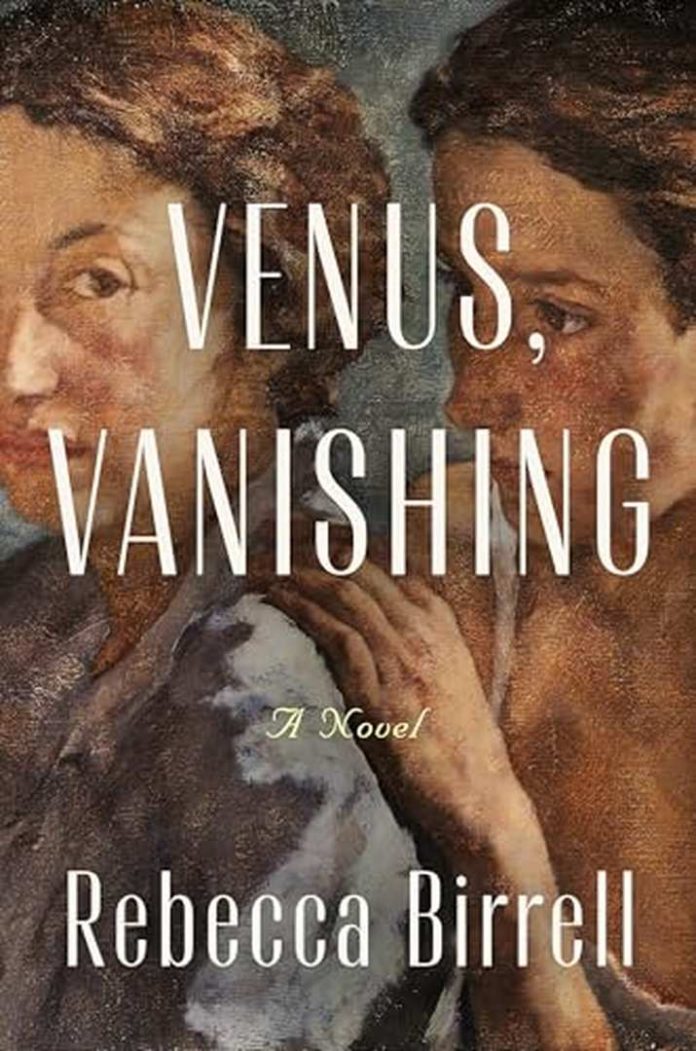






The exhibition is for women artists only, and Hannah has sent in a nude portrait of her own mother, a seamstress bent by decades at the machine. She has never shown a painting in public before. On opening night her friend Saul steers her through the crowd with a tight grip on her elbow, and she soon sees why. The picture hung beside hers is a farm scene with a hook-nosed crone lurking at its edge, coveting the milk pails, and next to it her mother suddenly looks like a type rather than a person. Then her richest customer sweeps in, dismisses the caricature in a voice meant for the whole room, and buys the portrait before the evening is out. Venus, Vanishing by Rebecca Birrell is the story of that sale, and of everything Hannah agrees to in the relief of it.
The Seamstress Who Wanted to Look
Hannah has fled her parents’ tailoring shop in the Scheunenviertel and an arranged match with a widower, and she rents a room in Schöneberg under the name Schmidt. She mends by day, haunts the Kaiser Friedrich Museum in the mornings, and draws everything. The first half of the book is a portrait of an artist made almost entirely out of looking: the women she fits for skirts, the dancers she sketches in a bar for women, and Saul, the curator with badly hemmed trousers she follows through the galleries until he finally turns round.
Birrell, a curator herself, is superb on how a painter learns. Saul poses for Hannah in his darned socks because life drawing is what art schools teach and she has only books. A painting of Diana hunting in the museum becomes the private image of her desire. The morning after their first afternoon together, he posts her half a postcard. These are lovers who argue in reproductions, and the novel makes that both funny and moving.
Saul has another lover, a musician called Joe, and Hannah soon has one too: Charlotte, a dancer she sketches night after night at a hidden club off Friedrichstrasse until the dancer walks over and asks why. Venus, Vanishing by Rebecca Birrell treats this arrangement without scandal or apology. Hannah describes her life as a diptych, two painted panels hinged together, and the book is honest that the hinge creaks. Charlotte is jealous of Elke, Saul is wary of her, and both are right long before Hannah will admit it.
The relationship at the centre, though, is with Elke Grese, the patron. She pays Hannah a monthly stipend, sits for her nude, and slowly makes herself the only person whose verdict matters. The sittings in her cream dressing room are the sensual core of the book, written with a seamstress’s eye for silk, seams and skin. They are also a study in power, because Elke decides when the door opens and when it shuts. When Hannah’s work starts to circulate in ways she never agreed to, the title stops being decorative.
A City Turning, One Room at a Time
Against that private story runs the public one, and here Venus, Vanishing by Rebecca Birrell is at its most chilling. History arrives through domestic objects. A Nazi newspaper turns up in the apartment and is used to mop spilled champagne. The voice on the wireless grows louder every morning. Elke’s husband Kurt, a war-damaged culture official, invites Hannah to lunch and quizzes her on modern art, and she survives by pretending to despise everything she loves. It is a superb scene of nerves, conducted entirely over boiled potatoes and pink meat.
What makes this thread work is that Hannah keeps looking away. She notices the headline over her landlady’s shoulder and turns her mind to the tassels on a chaise longue she still has to paint. Her brother tells her about neighbours beaten in the street, and she sends money rather than visit. Venus, Vanishing by Rebecca Birrell understands that denial is not stupidity, and it makes the reader complicit in Hannah’s wish that the next sitting could last a little longer.
The second half widens into the persecution itself, and the restraint pays off. The book burnings of 1933 reach Hannah secondhand, as a drunk friend’s story. A leafleting campaign, cycled across the city at night, is the most exhilarating sequence in the novel. And a late chapter in which Hannah takes in washing and mends the clothes of Jewish clients who are vanishing one by one is the quietest and best thing Birrell writes.
Where Venus, Vanishing Gives Ground
- Hannah waits too long. Her devotion to Elke is the point, but the middle stretch circles: she returns, is rebuffed, lies to Saul and returns again, and the repetition dulls the tension rather than tightening it.
- The history lesson never stops. Almost every scene is anchored to a real painting. Often that is a pleasure, but Saul’s monologues on proportion and angels can read like a seminar, and the list of artworks at the back runs to dozens of entries.
- A late change of view. One chapter abruptly hands the narration to another character and delivers a great deal of sexual and personal backstory in a single sitting. It is bold, and it is also lurid.
- The final section leans on coincidence. Without spoiling it, the last part of Venus, Vanishing by Rebecca Birrell resolves more threads than it has earned, through chance meetings and convenient letters.
Read These Next
If Venus, Vanishing by Rebecca Birrell sent you looking for more art, secrecy and borrowed names, start here.
- Perspective by Laurent Binet, for a painting secretly altered and a scandal about who painted what.
- Girl with a Pearl Earring by Tracy Chevalier, for the charged gaze between a working girl and the painter’s household.
- The Seven Husbands of Evelyn Hugo by Taylor Jenkins Reid, for a woman who loves women and trades her name for a career.
- Goodbye to Berlin by Christopher Isherwood, the classic view of the same clubs and lodging houses as the party closes in.
About Rebecca Birrell
Rebecca Birrell is an art historian and curator, and Venus, Vanishing by Rebecca Birrell is her first novel. Before it she spent years with the paintings themselves, and you can feel that expertise on every page. Picador published it in the UK on 16 July 2026, and Henry Holt’s American edition is out now, released on 27 October 2026.
- Former Curator of 19th and 20th Century Paintings and Drawings at the Fitzwilliam Museum in Cambridge.
- Earlier curatorial posts at the Charleston Trust, the British Museum’s Department of Prints and Drawings and the Jewish Museum.
- Her nonfiction debut, This Dark Country, was shortlisted for the PEN Hessell-Tiltman Prize.
- The novel’s epigraph comes from Charlotte Salomon, the German-Jewish painter murdered at Auschwitz in 1943, one of the real artists who shaped Hannah.
What Stays With You
This is a debut with a curator’s eyes and a novelist’s nerve. It sags where its heroine stalls, and it explains its paintings more often than it needs to. But Venus, Vanishing by Rebecca Birrell makes the loss of a single woman’s name feel like the loss of a whole world, and it finds hope where most novels of the period find only an ending.
Read it slowly, with a book of reproductions open beside you, and look for the painter hidden in every frame.