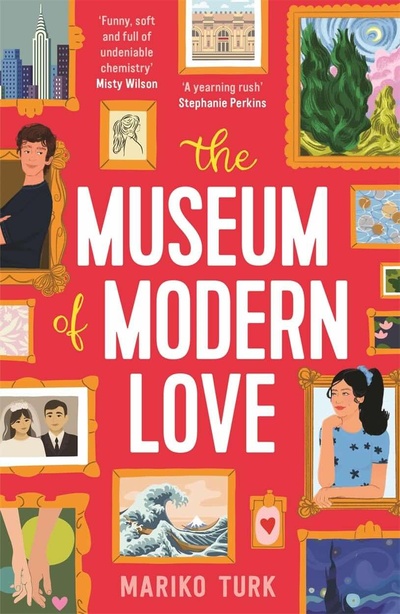






On the last evening of a three-week internship, seventeen-year-old Miki Kawamura stands on the granite steps of the Metropolitan Museum of Art while her best friend Auden dances badly down toward her and hands over a small gift box. Inside is a scrunchie printed with The Starry Night, chosen because the museum shop had nothing with her favourite Van Gogh cypresses on it. She ties up her hair with it and cannot get out a single word of what she came to say. She has a plan for that. Miki and Auden have permission to stay inside the building overnight to film social media videos for a new exhibit, and she intends to walk him through the galleries until the art does the confessing for her. Within the hour, her supervisor has pulled Auden onto a lighting job and handed Miki a substitute: a curator’s nephew in a wrinkled band T-shirt. He is Lou McSweeney, the boy she spent last summer arguing with and kissing. The Museum of Modern Love by Mariko Turk begins as a confession plot and quickly becomes something better: a test of whether the person you planned for is the person you actually talk to.
A Rehearsal With the Wrong Boy
The route Miki has mapped is not her own. It retraces the night in 1965 when her grandparents, two strangers accidentally locked inside the museum, fell in love among the paintings, a story later made famous in a magazine photo-essay that Lou’s late grandfather wrote. Lou guesses the scheme in about four minutes, tells her it has no chance, and offers to play Auden for a practice run. That premise does a lot of work. Every stop on the tour becomes a scene played twice, once as rehearsal and once, in Miki’s head, for the boy who is not there, and the gap between the two performances is where the novel finds its comedy and its ache.
The first rehearsal is the best scene in The Museum of Modern Love by Mariko Turk. In the Paris Salon gallery, in front of Pierre-Auguste Cot’s Springtime, Miki takes Lou’s hand and delivers her speech to Auden. Lou listens, then points out that the lovers’ swing is not tied to any branch; the ropes simply vanish out of frame. That is his whole philosophy of romance in one observation, and Miki’s furious defence of the painting is hers. Turk lets them both be partly right, which is rarer in YA romance than it should be.
Lou is the real achievement of The Museum of Modern Love by Mariko Turk. On the surface he is a type, the sardonic boy with the resting bored face and a tin of sour sweets in his pocket. Turk gives the type a reason. He has watched what all-consuming passion did to his older brother, Gray, a gifted musician whose conservatory years left him unable to play, and he has decided that caring hard is how people get hurt. The novel reveals this slowly and through behaviour rather than confession: a boy who sits hypnotised for eighteen seconds in front of a Noguchi fountain, who knows details about Auden that Miki only mentioned once, who keeps renaming their night after whatever is going wrong. By the halfway point, every rehearsal has started to feel like the real thing, and both of them know it.
Madison, Miki’s best friend back in Florida, arrives by FaceTime with a romance-personality index of her own invention, under which Miki is a Type A Romantic Retriever: elaborate plans, endless fetch, no forward motion. It is a running joke that also happens to be the most accurate diagnosis anyone offers.
What The Museum of Modern Love Believes About Repair
The second thread is quieter and it is what lifts the book. Miki wants to be a conservator, and the reason is a sculpture. In 2002 the pedestal under Tullio Lombardo’s Adam collapsed and the marble shattered into hundreds of pieces; it took twelve years of work to put him back together. To a twelve-year-old girl reading about it, that rebuild proved something could be un-broken. That anecdote is her heroine’s whole emotional logic.
Miki’s parents divorced the summer before high school, when her mother took a job in Florida and her father one in California, and they told her calmly that love sometimes fades. She said she was fine. She has been saying it ever since, and her faith in grand gestures is partly a refusal to accept their version of how love ends. The Museum of Modern Love by Mariko Turk is at its most perceptive when it pits Miki’s belief in conservation, the idea that anything precious can be preserved by enough care, against Lou’s suspicion that some things should be allowed to change shape. Neither of them wins outright. The novel’s resolution of that argument is generous, specific and unexpectedly moving, and it widens the definition of a love story well beyond the two teenagers at its centre.
The building itself is drawn with an insider’s precision. The Museum of Modern Love by Mariko Turk knows which wing sits where, what the air temperature is, and how a conservator removes fly droppings from an antique valentine.
Where The Museum of Modern Love Gives Ground
- The interruptions run on a schedule. Almost every near-kiss is broken by a phone alert, a supervisor or a guard. The device works the first few times and starts to show its gears by the sixth.
- The final act talks its themes through. Two blow-ups arrive back to back, and in their wake three different characters sit Miki down and explain what the night has meant. The ideas are good; hearing them stated is less satisfying than watching them emerge.
- Security is improbably relaxed. Two teenagers wander off the approved route, break minor rules for hours and suffer almost nothing for it. Forgivable in a romantic comedy, but it lowers the stakes.
- Distance is waved away. A book this alert to how relationships fray treats the miles between its couple as a detail for later.
Read These Next
The Museum of Modern Love by Mariko Turk is no relation to Heather Rose’s 2016 adult novel of the same name, so search carefully. Turk’s debut, The Other Side of Perfect, was a YALSA Best Fiction for Young Adults pick, and her second YA novel, I’ll Be Waiting for You, won the Colorado Book Award. Then try:
- Better than the Movies by Lynn Painter, for a heroine with a romantic master plan and the irritating neighbour recruited to help her execute it.
- The Summer I Turned Pretty by Jenny Han, for a girl torn between the boy she has always wanted and the one who keeps surprising her.
- Nick and Norah’s Infinite Playlist by Rachel Cohn and David Levithan, for two near-strangers, one New York night and a romance that happens in transit.
The Last Word
What sets this book apart from other one-night romances is that it understands its own premise. A plan copied from somebody else’s love story is a costume, and Turk spends the whole night peeling it off her heroine, gallery by gallery, until only the conversation is left. The interruptions are mechanical and the ending over-tidies, but the banter is sharp and the family history underneath gives it weight.
The Museum of Modern Love by Mariko Turk is a valentine to a building, and a warning about loving anything only as it was. Bring someone who argues back.