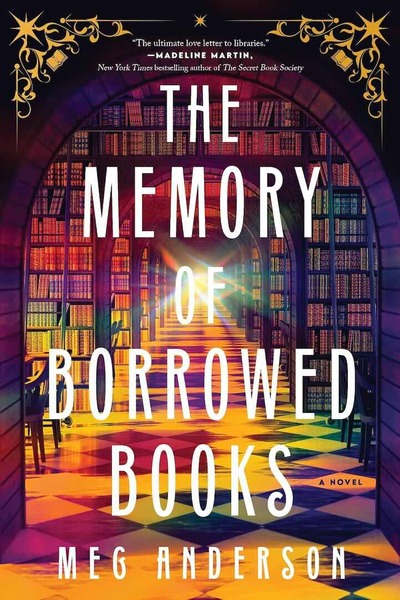
The door is set into the wood paneling at the back of the archives, beside the portrait of the town’s founder, and Claire Ashford has worked at Foxhollow Library long enough to know it was not there last week. Behind it is a room that goes on farther than the building allows, shelves climbing into a ceiling full of stars, every spine stamped with a title that reads like something whispered at three in the morning. She opens one and is standing in a stranger’s yellow kitchen, watching a couple make toast. She opens another and another. Then she slips three of them into her tote and drives home, telling herself it is not theft, because books are made to be borrowed. The Memory of Borrowed Books by Meg Anderson is built on that small, guilty decision, and on what it costs her to keep reading.
The library is on borrowed time too. The board wants it gone by the new year, a developer wants condos and a café where the stacks stand, and Claire, who has not slept properly since childhood, has a handful of months to make anyone care. Meanwhile there is Julian Thomas, the quiet artist who sits in the back corner every day drawing the same fog-wrapped bridge, and Eddie, the friend he has not spoken to in fifteen years, who keeps turning up between the shelves with a grin and no straight answers. The save-the-library plot is the frame. The story is the bridge.
Memory, Grief and Borrowed Books
Anderson’s central idea is simple and well handled. The room is the building’s memory: every book holds a moment someone left behind inside these walls, and the room opens for whoever needs it, which for now means Claire. When she reads, she stands inside the moment as an invisible witness, unable to touch anything, while the scene stutters and jumps forward like a film reel slipping its sprockets. She can take books home, and they still work. That is the whole rulebook of The Memory of Borrowed Books by Meg Anderson, and Anderson never cheats on it, which is rarer in magical realism than it should be.
The pleasure of the first half is in the strangers. A regular who borrows gardening books turns up in one volume on her knees among salt-burned roses, keeping a notebook of bloom dates. A quiet man Claire passes every week by the public computers appears years younger, hiding in a half-finished room off the back corridor with a rain-swollen law textbook. A teenage boy eats his lunch alone in the school library with a Foxhollow bookmark poking out of his bag. None of them is dramatic. Together they make the novel’s real argument for libraries far better than any speech: these are the people a demolition crew would never see.
The best chapter in The Memory of Borrowed Books by Meg Anderson goes back almost two centuries. Claire falls into the house that became the library, where a grieving founder lends his own books to a girl in a shawl, then to her neighbours, then to anyone who knocks, tucking handwritten notes inside the covers to waive a widower’s fine or to send a book to a child who will not speak. It is a quietly moving origin story, and the moment the novel’s sentiment feels fully earned.
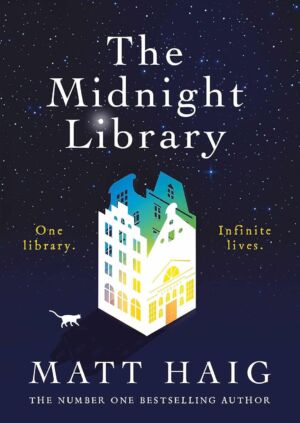
There are lighter touches. Grace, Claire’s long-serving colleague, runs a story hour by convincing a rug full of toddlers that a fox might hear them breathing. And when Julian finally applies for a library card, the first book he picks off the shelf is The Midnight Library, a wink Anderson keeps light.
The Boys on the Bridge
The thread that lifts the book is the one Claire opens without permission: Julian’s own memories. Through them we meet Julian as a teenager, sketching in tall grass, in love with a girl called Quinn who is clearly bound for somewhere bigger, and Eddie, the friend who makes every room laugh. Anderson stages these scenes in basements and at gas stations and bonfires, and in each one she gives Eddie a small, telling gesture when nobody is looking: a bottle cap squeezed too hard, a smile that drops the second the joke lands. By the time we see his own home, with a drunk father down the hall and a sick mother he feeds by hand, the cheerfulness has become one of the saddest performances in recent fiction.
Eddie in the present is the novel’s most interesting presence: charming, evasive, forever telling Claire she is nearly there. Julian is harder to love in his adult form. He is gentle, wounded and tactful, and almost entirely defined by what happened fifteen years ago, so the young man in the memories is more vivid than the one at Claire’s dinner table. The romance between them is slow and kind and mostly consists of hands brushing over handed-off wine glasses. It works as comfort rather than heat.
When the bridge finally gives up its secret, The Memory of Borrowed Books by Meg Anderson handles it with real care. The scene is frank about despair and generous about who is to blame, and it is the reason this book will be pressed on friends.
Where The Memory of Borrowed Books Gives Ground
- The central secret is visible from a long way off. Anderson signposts it so steadily that experienced readers will be a hundred pages ahead of Claire, which drains some tension from the reveal.
- The middle runs on a loop. Open a book, fall into a memory, wake up gasping, go to work, get teased at the circulation desk. For several chapters the pattern resets instead of building.
- The opposition is cardboard. David the developer is all hair gel and condo talk, and his change of heart arrives as a single public sentence.
- The physical shorthand repeats. Cheeks flush scarlet, pulses trip and fingers graze on nearly every other page, until the tells stop meaning anything.
Content Notes and Heat Level
What The Memory of Borrowed Books by Meg Anderson carries, briefly. A teenager’s suicidal crisis on a bridge, and a death, shown in remembered scenes. Parental alcoholism and physical abuse. A parent’s chronic illness. A child’s death from cancer, recounted. A mother’s death, in the past. Insomnia, compulsive rituals and a panic attack. Frequent social drinking. Heat level: closed door, a handful of kisses.
Read These Next
Meg Anderson writes from Indiana, and this debut from Sourcebooks Landmark is the third novel she wrote and the first to find a publisher. She has said the boy eating lunch in the library came from her own school days, and her next novel stays in the same bookish world, this time among Little Free Libraries. If The Memory of Borrowed Books by Meg Anderson worked for you, try these.
- The Midnight Library by Matt Haig, the book Julian borrows, for a library whose shelves hold the lives a woman did not live.
- Before the Coffee Gets Cold by Toshikazu Kawaguchi for a single magical room with strict rules about revisiting the past.
- The Lost Bookshop by Evie Woods for a shop that appears to the people who need it, and three lives it pulls together.
- The Astral Library by Kate Quinn for books that choose their readers and a sanctuary worth defending.
The Last Word
Anderson is better at grief than at municipal politics, and better at the past than the present, and the novel knows where its strength lies. The board meetings and slogans are the scaffolding; the reason to read The Memory of Borrowed Books by Meg Anderson is a founder’s handwritten note in a returned book, and two boys outside a gas station who never said what they meant.
Borrow it. Then go and renew your library card.