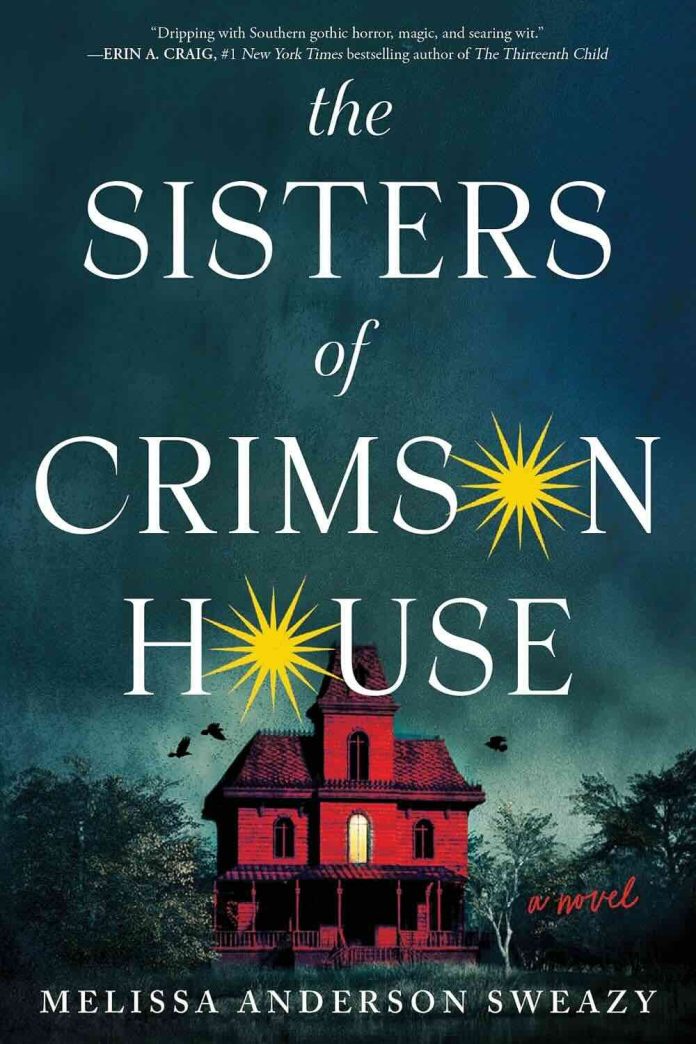
Most haunted-house novels begin with an arrival: somebody inherits, somebody buys, somebody takes the caretaking job against advice. The Sisters of Crimson House by Melissa Anderson Sweazy begins with somebody who has been inside eight years and cannot afford to leave. Charley Bryde is twenty-two, her grandmother three months dead, the third-storey turret under a blue plastic tarp she keeps forgetting to secure, and the city has just wrapped the porch in caution tape because those stairs will eventually kill a guest. The ghosts are not the problem. The ghosts are the revenue.
That position is what separates The Sisters of Crimson House by Melissa Anderson Sweazy from the fifty other Southern gothics published this autumn. The Bryde women have been Memphis royalty for four generations: each born with a Seeker’s Star scarred into her palm, each with a different gift, each putting on an annual Halloween demonstration the city’s wealthy paid serious money to attend. Charley is the only Bryde born with a blank hand. She reads tarot in a hotel bar, cold-reads well enough that nobody asks, and runs a ghost-tour outfit with two friends to service a mansion that eats every dollar it generates.
The Sisters of Crimson House Is Really a Book About Money
Sweazy’s best decision is to treat the supernatural as a line of business with a cash-flow problem. Tickets are fifty dollars. Twenty sell, then two hundred, and the difference is one catastrophic morning-television appearance and a post on a social network that will be dead within the decade. Wine comes cheap via a bartender at the Peabody. A local anchor gets a comped seat because she used to be a client. There are not enough chairs for the audience, and the fire marshal is a running joke with genuine teeth.
None of this is played for quirk; it is the pressure of the plot. A haunted house that has to pay for itself behaves differently from one that merely broods, and in The Sisters of Crimson House by Melissa Anderson Sweazy every choice Charley makes is legible as a business decision taken by someone with no other options. When her sister comes home after eight years abroad, Charley’s first coherent thought is that the great Miranda Bryde is the only Bryde who can reliably sell a ticket.
Inside Crimson House, Melissa Anderson Sweazy Keeps the Lights On
The neighbours are the other pressure. Howard and Peyton Lovell live next door in a gleaming Victorian stuffed with china and prop books whose price tags are still on the spines, and Howard chairs a nonprofit founded, in his own words, to save the street from people like her. Their offer is generous. Their tone is a warm hand on the arm and the suggestion that Charley is being saved from herself. It is a precise satire of preservation as a polite method of removal, and Sweazy is good enough not to make them monsters: they are people who believe a work of art should not be left with a child.
Then there is the escalation engine of The Sisters of Crimson House by Melissa Anderson Sweazy, which is genuinely elegant. Lines begin appearing on Charley’s palm, one at a time, cut into the skin and bleeding. Each new line switches on another woman’s gift: first the dead who have always walked these halls become visible, then she can do what her sister does, then what her grandmother did, then something nobody in the family ever managed. The mark she has grieved her whole life is assembling itself, and every instalment costs blood. A clean structure for a horror novel: a progress bar you do not want filled.
The Sisters of Crimson House Earns Its Best Scene on Live Television
One sequence justifies the book. Charley and her sister go on a local morning show to plug the revived Halloween event, opposite a co-host who has decided they are frauds and possibly Satanists. Mid-interview a new line opens on her palm and she can hear exactly what he is thinking about her. What she does with that, on air, is funny and ugly and entirely in character, and it sells out the show.
The other pleasure of The Sisters of Crimson House by Melissa Anderson Sweazy is the deck. Charley reads with her mother’s cards, and at one point they stop behaving: the Tower is Crimson House with lightning striking the turret, the Death card has acquired a rider with her sister’s hair. Then she looks again and they are ordinary cards, and the skeptic across the table saw nothing. Sweazy is very good at the horror of being the only witness.
Where Melissa Anderson Sweazy Gives Ground
Four things keep The Sisters of Crimson House by Melissa Anderson Sweazy from the top of the pile.
- The romance and the plot run on one engine. Every line on Charley’s palm appears when Sy Prescott, the skeptic chasing a hundred-thousand-dollar prize for disproving her family, touches her hand. The book has to keep manufacturing contact, so the attraction reads as mechanism rather than feeling. His shift from believing her family destroyed his to kissing her in her grandmother’s study takes two scenes.
- One chapter carries the entire mythology. Late on, an aunt sits Charley down and explains the entity, the day of her birth, why her sister was made its keeper, and why the outcome was fixed. Everything before has been better at showing than telling, so the seminar feels like a different book.
- The middle sags on eviction logistics. Letters, the neighbourhood council, offer, counter-offer, the same argument on the same lawn.
- The climax reaches for a gun. After three hundred pages of restraint, the resolution arrives as a gunshot, and the aftermath of who fired it is settled a year later in two paragraphs of mutual agreement not to press charges.
Read It If, Skip It If
The Sisters of Crimson House by Melissa Anderson Sweazy knows precisely who it is for.
Read it if:
- You want a haunted house with a ledger, and a heroine whose supernatural crisis is also a small-business crisis.
- Sisters who love and resent each other in equal measure is your engine.
- You like a gothic that is funny on purpose.
Skip it if:
- You need mythology delivered in pieces, not in one conversation.
- Slow-burn attraction between antagonists is a hard no.
- A first half of tours, letters and family history will lose you.
Content Notes
An elderly woman murdered in a bath, her hand mutilated. Strangulation. A stabbing in front of an audience. A gunshot wound causing permanent paralysis. A woman pushed into a bonfire. The poisoning of an innocent. A body weighted and sunk in a river. A skull concealed in a wall. A child struck by a car. Drowning. Parental death and long grief. Repeated possession. Drink-driving. A care-system childhood, and child neglect. Frequent profanity.
Read These Next
Five of ours for anyone who finishes this at two in the morning.
- Mexican Gothic by Silvia Moreno-Garcia for the other great novel about a house with opinions.
- Dark Sisters by Kristi DeMeester if the sibling half gripped you.
- House of Splinters by Laura Purcell for decay, inheritance and a building that will not let go.
- The Entirely True Story of the Fantastical Mesmerist Nora Grey by Kathleen Kaufman on making a living from the dead.
- Unveiling the 10 Best Horror and Mystery Books You Can’t Miss for the wider field.
What Stays With You
The grandmother’s gift was psychometry, the claimed ability to hold an object and read the life that passed through it, and Sweazy uses it better than the showier powers in the family. When Charley inherits it, the visions arrive as full-body occupancy: inside someone else’s fear, at someone else’s window, watching a car roll down a driveway with its lights off. Sweazy, a Memphis screenwriter, films these rather than describing them, and they are the most frightening pages here.
What stays is not the entity, a woman in black with a sword who does her job. What stays is the arithmetic. Charley spends the novel begging for the mark that proves she belongs to her family, and the book is honest enough to let her have it and then present the bill. The Sisters of Crimson House by Melissa Anderson Sweazy has a saggy middle and one chapter of pure explanation, and it is still the sharpest haunted-house debut of the season, because it knows the scariest thing about an inheritance is what came attached.