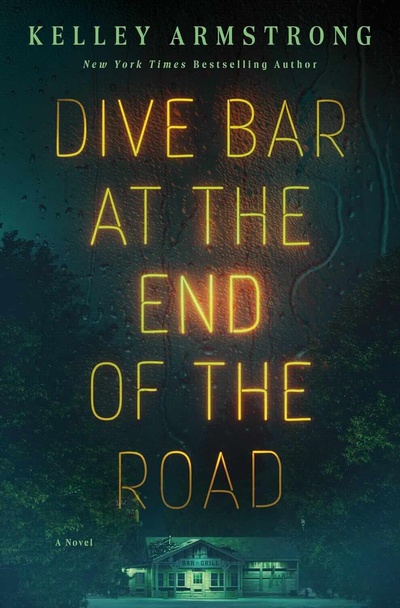
The car clock says 11:56, which is impossible, because Ellie left Chicago at seven and has covered maybe fifteen miles since a GPS detour pushed her off the interstate. Then it says 11:59. Then a middle-aged woman is standing in the headlights, the brakes go to the floor, and the car hits something. When Ellie staggers out into the rain, the thing she hit is a hardwood trunk lying across the road, and there is no woman anywhere. A light swells behind her and swallows the scene. That is the first move of Dive Bar at the End of the Road by Kelley Armstrong, and every chapter after it is the same trap closing on someone new.
How It Works
The premise is a pileup in slow motion. Ellie’s car is the first to hit the fallen tree. A paramedic named Henry, heading for a fishing weekend, rear-ends her. An engaged couple, Noemi and Caleb, arrive next, then an elderly professor driving in his pyjamas, then a salesman in a new Jaguar. Nobody has a signal. There is no landline. The only shelter is a ramshackle roadside bar a short walk away, kept by a cheerful young bartender, with one silent customer at the counter. The sky above it has turned a swirling red, and nobody can agree on what time it is.
The rules arrive in a clean escalating order, and Armstrong is careful to let the characters discover each one rather than announce it:
- Hazard lights left blinking on the wrecks switch themselves off the moment anyone walks away.
- The forest moves people around. Step a few paces off the road and the road is suddenly behind you, or gone.
- What waits in the trees is specific to whoever goes in. Each driver meets a private nightmare, dressed in the details of their own past.
- The road does not lead anywhere. Ride away from the pileup and you come back to it from the rear.
None of this is explained early, and that restraint is the smartest decision in Dive Bar at the End of the Road by Kelley Armstrong. The first half plays as a mystery, with the reader assembling the rules from clues. Henry and Ellie agree to stay within fifty paces of each other at all times, and both know the limit is meaningless before they say it out loud. That little exchange is the book’s tone in miniature.
What the Bar at the End of the Road Is Really Serving
Structurally, this is a closed-circle horror novel with a rotating spotlight. Ellie narrates in the first person and the present tense; Henry, the couple, the professor and the salesman each get chapters in close third person, also present tense, usually timed to the moment they arrive or the moment the forest comes for them. It is a sturdy design. Every new point of view enlarges the ensemble and quietly tests the pattern the reader has started to suspect.
What the machine is actually for is guilt. Ellie has spent twenty-five years believing she owes the world something for surviving a campus shooting at ten, which is about as clear a case of survivor guilt as genre fiction gets. Henry carries a patient he lost in his first week on the job. Everyone who crashes into the tree is stalled at some hinge in their life, and Dive Bar at the End of the Road by Kelley Armstrong is interested in what happens when those hinges are forced.
What works
The strengths of Dive Bar at the End of the Road by Kelley Armstrong sit mostly in its voices and its timing.
- Ellie’s voice. Wry, self-mocking, therapy-literate, and funny under pressure. She keeps the book readable when the gore spikes, and her arc away from needing to be remarkable is genuinely earned.
- The fears are personal, not generic. Each monster is built from one character’s history, so the scares double as backstory. The professor’s chapters, told from inside a man who half suspects his own mind, are the most harrowing in the book.
- The salesman as foil. Raymond is loud, transactional and self-deluding, and his chapters let the reader see the threat from outside while the bar argues about whether to believe him.
- Armstrong’s pacing. Short paragraphs, chapter-ending hooks and a final stretch that runs almost minute by minute. The last eighty pages are close to impossible to put down, and the quiet scenes between attacks are short enough to work as breaths rather than stalls.
Where Dive Bar at the End of the Road Gives Ground
Four problems keep Dive Bar at the End of the Road by Kelley Armstrong from the top shelf of the genre.
- The rationalising loops. Characters keep wandering back into the trees after deciding not to, and several scenes restage the argument about whether any of this is real.
- Backstory on arrival. Each new narrator opens with a block of history before the horror resumes, which stalls momentum in the first half.
- The explanation comes as a speech. When the reasons finally surface, they are delivered by the antagonist in one long sitting rather than uncovered by the cast, and the cosmology gets fiddly.
- Raymond never changes key. Useful as a foil, he stays a single sour note from his first scene to his last, and the late logic bends to let the plot reach its ending.
Content Notes for a Night on the Road with Kelley Armstrong
Plain list, because Dive Bar at the End of the Road by Kelley Armstrong does not hold back, and some of its worst moments arrive without warning:
- Graphic gore: dismemberment, a person eaten alive, eyes and limbs lost.
- A school shooting remembered from a child’s point of view.
- Death of a child (in backstory), drunk driving and its aftermath.
- Teenage stalking and a home invasion, with sexual violence threatened.
- Racist and homophobic abuse, dementia, passive suicidal thoughts.
- Heavy profanity. No sex scenes; the central relationship is a slow, tender partnership.
Read It If / Skip It If
Read it if you like rule-driven horror where the reader learns the system alongside the characters; if you want a heroine whose humour survives the worst night of her life; if horror that turns trauma into monsters works for you.
Skip it if long backstory passages pull you out of a thriller; if you need a supernatural system that never bends; if graphic body horror is a hard limit.
Read These Next
Armstrong has written more than fifty novels across mystery, fantasy and horror, from the Otherworld books to the Rockton thrillers and the time-slip mysteries of A Rip Through Time. For readers who finish Dive Bar at the End of the Road by Kelley Armstrong and want more, start here:
- The Haunting of Paynes Hollow by Kelley Armstrong, her previous standalone, for an isolated house and a heroine fighting her own history.
- I’ll Be Waiting by Kelley Armstrong, for her earlier ghost story built on grief and a sealed location.
- The Final Girl Support Group by Grady Hendrix, for trope-aware horror about survivors who cannot stop surviving.
- No Exit by Taylor Adams, for strangers stranded at a roadside stop in a storm with a threat among them.
- The Cabin at the End of the World by Paul Tremblay, if the moral question at the centre is what grips you.
What Stays With You
The monsters are borrowed from the shelf, and Armstrong knows it; half her cast names the films they come from. What is not borrowed is the way she ties each one to a specific regret, so that the scariest thing in the forest is always a memory. Dive Bar at the End of the Road by Kelley Armstrong is a fast, mean, surprisingly tender horror novel that wobbles when it explains itself and steadies whenever it sits with two frightened people holding hands in the dark. The last pages loop back to the first in a way that feels both inevitable and earned.
The bar is the hook. The drive home is what lingers.

