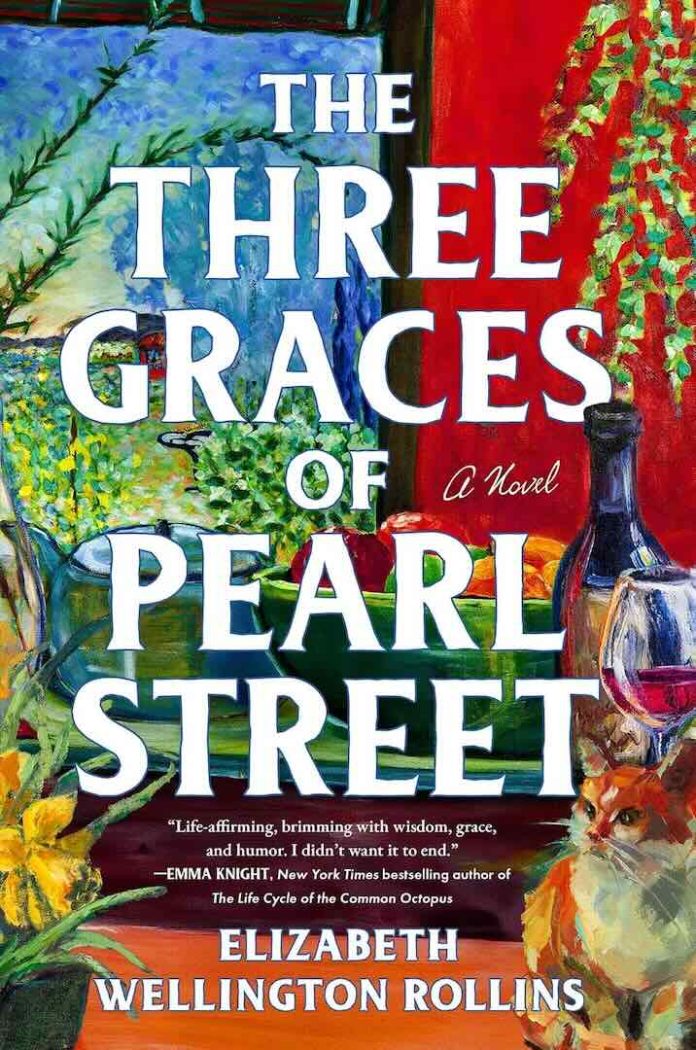
A ninety-six-year-old woman lays the Christmas Eve table, hears that her granddaughter has turned vegan, and sets a can of cat food in front of her on good china. The granddaughter throws it at a life-size plaster baby Jesus and leaves swearing she will not come back until there is a funeral. That is the first real scene in The Three Graces of Pearl Street by Elizabeth Wellington Rollins, and it tells you what the next three hundred pages are made of: an Italian American family in Westchester conducting its entire moral life through food, and a matriarch who would rather be rude than be thanked.
Three Women, One Name
The structure is the book’s cleverest decision and the easiest to describe. Every chapter is headed with a name, and the name is always the same name.
- Graziella, four foot two and ninety-six, widow of a postman, briefly a novice nun, litter picker, feral cat wrangler, and the only person on the street everybody obeys.
- Grace, around sixty, her daughter, a psychology professor at Columbia, in the middle of a menopause nobody will discuss and a marriage her husband has just announced he is leaving.
- Ella, twenty-seven, her granddaughter, type 1 diabetic, lately of a Brooklyn warehouse commune, and convinced she failed out of MIT two weeks before graduating.
A prologue in The Three Graces of Pearl Street by Elizabeth Wellington Rollins explains the repetition. In 1900 a ten-year-old named Maria Tuttoilmondo sails from Rome with a six-toed black kitten hidden in her coat, having passed a marble statue of the three Graces every morning of her childhood, and names her daughter after it. Her surname translates roughly as the whole world, which the novel saves and then spends beautifully.
The House That Holds Them
Within forty pages Rollins has engineered all three back into one two-family house: Ella jobless after an extraordinary set piece in which she finds radioactive material in a Times Square discount store, Grace homeless after her pipes disintegrate and her country club declines to keep a woman.
The address does a great deal of work in The Three Graces of Pearl Street by Elizabeth Wellington Rollins. Pearl Street is ten blocks of working-class houses and old industrial buildings in Mamaroneck, ringed by wealthy suburbs the way a moat rings a keep. Fazzio’s for meat, Norma’s for pizza, St. Joseph’s for everything else. Four generations have lived in the same rooms, and the furniture is load-bearing in both senses: the bread oven the great-grandfather built, the rocking chair, the pine table, the measuring mug used for broth at every birth and death since the First World War.
What The Three Graces of Pearl Street Is Actually About
The surprise is that this is a novel about money, and specifically about anonymous money.
Graziella taught herself to trade. The sum is large enough that stating it would spoil the chapter, and she has spent twenty-six years giving it away anonymously, mostly through the parish and mostly in cash. The Three Graces of Pearl Street by Elizabeth Wellington Rollins withholds the scale of this until very late, then releases it as a flood of letters from strangers:
- Houses bought outright for dozens of families, because she refused to be anybody’s landlord.
- Mould remediated, boilers replaced, wiring made safe, the tradesmen paid directly.
- A full-time English tutor endowed at the public library.
- A feral cat programme, and roughly ten thousand animals through the local shelter.
- Winter coats bought in bulk out of season and stacked in the cellar by size, for whichever child turns up cold.
Withholding it is also how it would really happen: nobody finds out what the quiet neighbour was doing until the quiet neighbour stops. Set against her is a cardinal who wants seventeen per cent off the top of any parish endowment.
Where The Three Graces of Pearl Street Earns Its Length
The last hundred pages are the reason to read The Three Graces of Pearl Street by Elizabeth Wellington Rollins. Rollins hands the dying woman her own chapters and refuses to make the experience tasteful: hearing sharpening instead of fading, Italian returning as the first language, a sensation of floating out into water and having to set one foot deliberately back on land to reach the people in the room.
The set piece everyone will talk about is a recipe. Ella breaks down because she never learned to cook the Feast of the Seven Fishes, so her grandmother spends five hours and three mugs of broth dictating the whole thing in Italian, with Grace translating and Ella recording on her phone: which day to order the salt cod, how long to soak it, two separate trips to the fishmonger, how to tell whether a fishmonger can be trusted at all. Everyone in the room understands that when the recipe ends, so does she. It is the most moving thing I have read this year, and it works because four hundred pages of chicken cutlets and emergency lasagne have taught you to read food as speech.
Where The Three Graces of Pearl Street Gives Ground
- The first half is slack. The radioactive material plot is a tremendous hook and then an orphan. It makes Ella briefly famous and permanently unemployable, then is dropped.
- A modelling agent arrives, and evaporates. Introduced with fanfare because of the insulin pump in Ella’s news photographs, revisited once, abandoned.
- The money is asserted, never shown. A self-taught retail trader compounding a postal widow’s savings into eight figures, then landing another fortune on one satellite telecoms flotation, is the only improbable thing in the book, and the only thing it declines to explain. It will tell you to the cent what a funeral costs.
- Everything lands. Columbia telephones with an unasked-for promotion. The graduate place comes through. The perfect hire is a cousin by marriage. A piazza in Rome produces exactly the right stranger. The grief in The Three Graces of Pearl Street by Elizabeth Wellington Rollins is earned to the last ounce; the plot around it is far too obliging.
Read It If, Skip It If
The Three Graces of Pearl Street by Elizabeth Wellington Rollins runs long, and the length is unevenly distributed.
Read it if:
- You want a grandmother who is specific rather than saintly: rude on principle, allergic to gratitude, and a polio survivor who never mentioned it to her own daughter.
- You will forgive a slow opening for a devastating close.
- A late coming-out written with no crisis machinery at all appeals. Grace’s story is the fairest thing here.
Skip it if:
- Local sainthood makes you itch. The accumulated good deeds are enormous, and the book half knows it.
- You need a plot that resists its characters.
Content Notes
An elderly woman’s death at home, at length and in detail, including her own refusal of hospice and her arrangements made by telephone. Bereavement throughout, and a second maternal death recalled as a fight to the end. Type 1 diabetes with hypoglycaemic episodes on the page. Childhood polio. Infidelity and the collapse of a long marriage. Institutional misogyny, in a club and in a church. Radioactive exposure and quarantine. Domestic abuse recalled in a letter. Food insecurity. Mild sex.
Read These Next
Five of ours for readers who finish The Three Graces of Pearl Street by Elizabeth Wellington Rollins.
- One Italian Summer by Rebecca Serle for a daughter grieving her mother with Italy as the destination.
- When We Were Widows by Annette Chavez Macias for three generations of women in one family, all mourning.
- Family Lore by Elizabeth Acevedo for a multigenerational household that organises itself around a death it can see coming.
- Mother-Daughter Murder Night by Nina Simon for three generations forced under one roof against their preferences.
- A Family Matter by Claire Lynch if Grace’s half of the novel is the half you want more of.
The Last Word
What stays is not the fortune. It is the measuring mug.
Rollins builds the whole inheritance out of objects too small to put in a will: the broth recipe, the seed packets labelled years in advance, the lasagnas in the cellar freezer with a note taped on saying you will be all right as long as you eat. The Three Graces of Pearl Street by Elizabeth Wellington Rollins argues that this is what actually passes down a family, and that the money was only ever a tool for doing more of it. Read the first half with patience. The second half will not need any.







