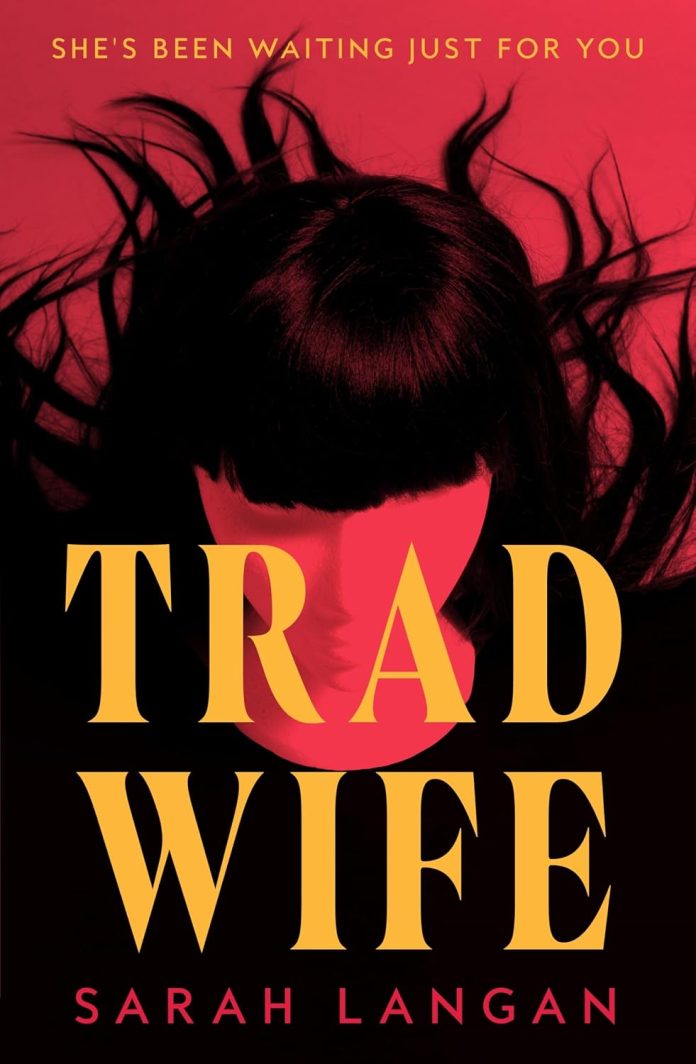
Jenny Kaplan watches the video twice. The first time she cries, because a pregnant farm wife has dropped a plate of hand-fried tacos, cut her hand open, picked herself up off the floor and fed her family anyway. The second time she runs it at half speed, and hears it: the small, dry click of a tongue, a half-beat before the dog charges. The accident was choreographed. Trad Wife by Sarah Langan opens with a woman who injures herself on camera because the numbers go up when she bleeds, and the comments beneath it all say the same thing. I feel seen.
What Trad Wife Is Really About
There is a children’s picture book that runs through this novel like a nerve. It is a real one, about all the different things that can be a house: a nest for a wasp, a stomach for a pancake. Jenny read it aloud to her little sister a hundred times in an apartment where nobody else was cooking dinner.
She is thirty-two when the book opens, and she has nothing. Her mother is dead. Her fiancé had a psychotic break, moved out with a rented truck, and took not only the furniture but thirty years of her diaries. And her apartment echoes. She writes one essay about all of it, goes viral, and is fired six months later because a loose affiliation of anonymous men decide she should not have a job.
So when she drives to Black Swan Farm and stands in a warm doorway with children hugging her knees and artwork taped to every wall, the thought she has is the one the picture book put in her. Trad Wife by Sarah Langan is not a book about whether traditional wifehood is good or bad. It is a book about what a person will walk into, and keep walking into, to stop being alone.
The Sound That Runs the Farm
Mia Wright opens every video by clapping her hands once. It reads, at first, as the chirpy throat-clearing of any lifestyle channel.
Langan spends two hundred pages letting you get used to it. The clap opens a cooking segment. The clap gets seven children out of bed. And the clap ends an argument. By the time the novel explains what the sound actually is, you have already watched it happen two dozen times, and every one of those earlier instances turns over in your memory like a stone with something underneath. It is the cleanest piece of long-range construction in the batch, and the third act is named after it.
The same patience is at work on Jenny’s body. She wakes dry. Her lips split. Her hair comes out on the pillow in lengths she knots up and hides in her suitcase, and a walk-in doctor thirty miles away gives her a perfectly reasonable explanation involving night terrors and a ring. The horror in Trad Wife by Sarah Langan is almost entirely administered through plausible deniability, and plausible deniability is also the book’s subject.
Where Sarah Langan Won’t Let You Laugh
This is the choice that makes the novel work, and it is worth knowing before you start.
A satirist would have had an easy week with the material in Trad Wife by Sarah Langan: the baby-talk, the vinegar sprays, the scripture quoted to sell lip balm. Langan declines. The women inside the phenomenon are treated as people who are lonely and short of money and have correctly identified that nobody has ever told them their work counts. The horror comes from the machine that notices that and bills them for it.
Her own closing note is explicit that this is not satire but horror, and the structure backs her up. She hands the folklore over to interstitial documents rather than to characters: a gleefully unreliable 1976 newspaper feature, a page of colonial scholarship whose footnote quietly reveals a murder pattern, a 1692 oral history in dialect. There is also a redlined newspaper column in which a man edits a woman’s account of her own abortion into its opposite, and it does more damage in four hundred words than most novels manage in a chapter.
Where Trad Wife Gives Ground
- The middle act is monotonous on purpose, and it is still monotonous. Seven numbered days of milking, laundry, homeschool and three meals is the right structural answer for Trad Wife by Sarah Langan, a book about domestic work as a trap. It is also a hundred pages in which the plot moves by inches, and readers waiting for acceleration will stall around Day Four.
- The cosmology arrives in one enormous speech. Late on, a character sits down and explains the curse, the rules, the previous hosts and the whole mechanism in a single long monologue. It is well written. It is still ten pages of someone narrating the novel to its own protagonist.
- The borrowed mythology is decoration. Robert W. Chambers is quoted directly and The King in Yellow supplies the two suns and the black stars, and none of it changes a single mechanism. It buys atmosphere at the cost of the book’s own specificity.
- One character’s arc is left as a promise. A teenage girl who sees more clearly than anyone ends the novel announcing an intention rather than carrying one out, which reads like a hook in a book that otherwise commits completely.
Content Notes
Long, and earned by the book. Trad Wife by Sarah Langan contains self-harm performed for an audience, repeatedly and in detail. A mother injuring her own small children for content, including a toddler tripped on camera and a baby who gets lye in his eye. A teenager’s asthma dismissed as psychosomatic by the men who should treat it, taken as far as cyanosis. A graphic sequence in which a fifteen-month-old traps a finger and an adult improvises with a kitchen knife. Abortion, described directly, including the procedure and the protesters, and later weaponised against the narrator. Pregnancy and birth under compulsion, and sex that is not consented to, elided but unmistakable. Loss of bodily autonomy as the central horror. Psychosis, involuntary commitment, and electroconvulsive therapy referred to obliquely. Suicidal ideation, one remembered attempt, and two deaths. Organised online harassment including threats and distressing images. Animal suffering and death in quantity. Frostbite, hunger, assault by several adults, and the physical restraint of a grown woman. Religion used as an instrument throughout. A business model that eats its participants’ savings.
Read These Next
Five of ours for readers who finish Trad Wife by Sarah Langan.
- Follow Me by Elizabeth Rose Quinn is the closest neighbour: the same platform, the same rot, a different genre.
- Dark Sisters by Kristi DeMeester for domestic horror that trusts its women to be frightening.
- Goddess Complex by Sanjena Sathian if the pressure to reproduce is the thread you want pulled.
- When Devils Sing by Xan Kaur for a small town with something owed to it.
- Psychological thrillers that play with your head for the wider shelf.
The Last Word
What stays is not the farm or the folklore. It is the picture book, and what the novel does to it. Every few chapters the refrain comes back slightly altered, and each version is a smaller, worse container than the last. A nest. A memory. A camera. A face.
Trad Wife by Sarah Langan is too long in its middle and too talkative in its final explanations, and it is still the best thing she has written, because it understands that the trap is not an ideology. The trap is wanting somewhere to belong badly enough to stop checking what is already living there. Read it with the lights on, and do not clap along.







