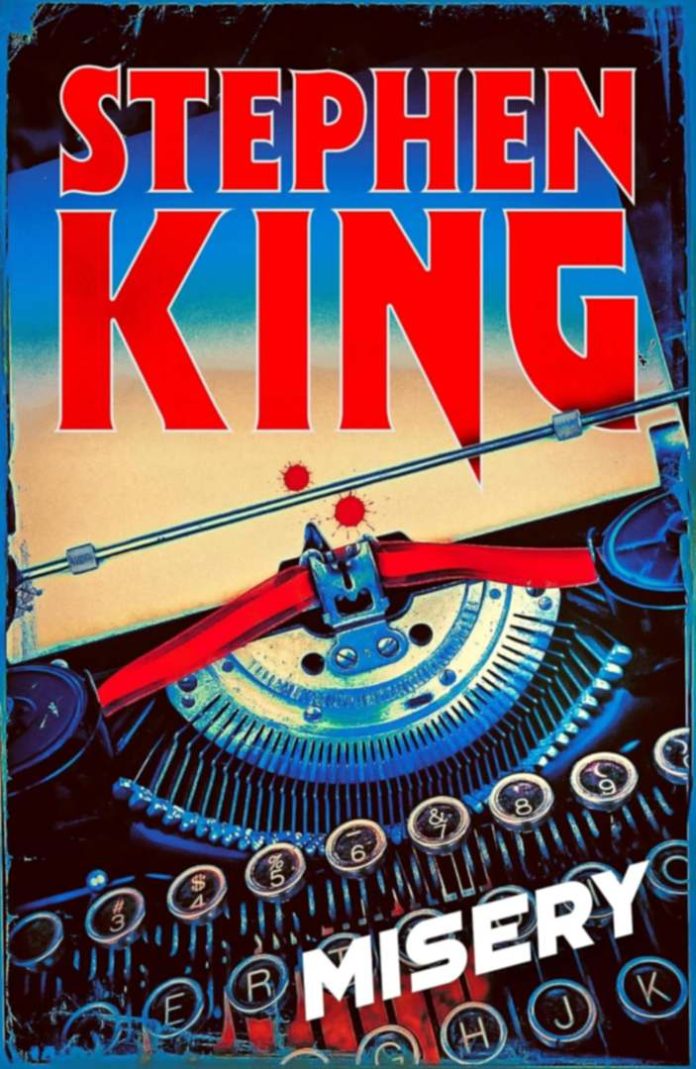




The barbecue grill is wheeled into the sickroom like an altar. Paul Sheldon, two weeks out of a car wreck in the Colorado mountains, legs splinted with sawn-off crutches, has not had a painkiller in hours. His nurse sets the only copy of his new novel on her lap, two years of work about a car thief from Spanish Harlem, and offers him a box of matches. He can have his capsules when he burns it, she explains, and he must do it of his own free will. Misery by Stephen King has worse scenes to come, much worse, but none that states its argument so plainly: a writer forced, page by page, to destroy the book he believes in for the reader who only wants the other kind.
The Captor Holds the Painkillers
Annie Wilkes found Paul upside down in a snowbank, recognised his face from his driving licence, and took him home instead of to a hospital. She had read every one of his eight novels, the four Victorian romances about Misery Chastain several times each. When he finally croaks a question about where he is, he already knows what she is going to say, and says it first: “I know. You’re my number-one fan.” King turns the most flattering sentence a writer can hear into a threat in the first ten pages.
What makes the captivity work is that it runs on need rather than locks. Annie keeps a cache of codeine-based Novril, and she brings it every six hours. Paul thinks of his pain as two rotted pilings on the beach he visited as a boy, the capsules as the tide that covers them, and Annie as the moon that pulls the tide in. The image recurs for three hundred pages and never feels like a device, because his dependence deepens exactly as his legs heal. By the midpoint he could manage on aspirin. He keeps taking the pills anyway.
That is the horror of the early chapters of Misery by Stephen King: not that Annie is violent, though she is, but that Paul learns to be grateful. He drinks dirty water from a floor bucket to get his medication. He lies to her about his father’s advice and is astonished how easily the lie comes. When she leaves him alone for fifty-one hours, he counts them in ink on his own arm.
The escape sequences are some of the most nerve-shredding King has written. With nothing but a fallen bobby-pin, a lock-picking lesson remembered from his car-thief research and a wheelchair two inches too wide for the doorway, Paul makes it out of his room to the downstairs bathroom and the parlour telephone. It is a journey of perhaps forty feet, and it reads like a polar expedition.
The Book Stephen King Makes Paul Write
The counter-thread is the book Annie makes him write. She buys him an ancient Royal office typewriter with a missing n, sets it on a board across his wheelchair and announces that he will bring Misery back from the dead. Paul’s first chapter cheats, and she knows it. His second is good, and here the novel finds its real subject: Paul as Scheherazade, keeping himself alive by making his captor need the next instalment.
Misery by Stephen King prints long passages of Misery’s Return, Paul’s Victorian melodrama of a heroine buried alive, and the device is cleverer than it first appears. Annie fills in the missing letters by hand. As the months pass the Royal loses more keys, and the excerpts arrive with gaps the reader has to fill in, so the manuscript falls apart on the page as Paul’s body does. Meanwhile the pastiche improves. Paul, who has sneered at his own genre for a decade, discovers he is writing the best book of his career for an audience of one.
That double vision is what lifts Misery by Stephen King above every other captivity thriller. It is a punishing horror novel and also a frank, funny and generous account of how fiction gets made, down to the subconscious “guys in the sweatshop” sending up flares when a plot is stuck.
Where Stephen King Gives Ground
- The middle pauses for an essay. Directly after the book’s most notorious scene, Paul spends a long stretch reflecting on memory, compulsive reading and a superfan from his past. It is thematically rich and it stalls the momentum just when the dread is highest.
- The book-within-the-book has a dated streak. Misery’s Return includes an African guide written in heavy minstrel dialect, and Annie uses a racial slur about him. King frames it as pulp convention, but it reads badly now.
- A late misdirection. One of the final chapters of Misery by Stephen King plays a trick on the reader that some will find one turn too many.
Read These Next
For more Halloween classics, our Halloween reading guide has the full shelf. These sit closest to Misery by Stephen King:
- The Shining by Stephen King for another writer snowbound in the Colorado mountains, and the drink that King later admitted was hiding inside it.
- The Plot by Jean Hanff Korelitz for a novelist, a stolen story and a reader who will not let him off the hook.
- The Collector by John Fowles, the 1963 captivity novel King quotes in an epigraph and that Paul suspects Annie owns.
- Gerald’s Game by Stephen King, his later novel of one person trapped in one room, fighting pain and her own mind.
About Stephen King and Some Misery Trivia
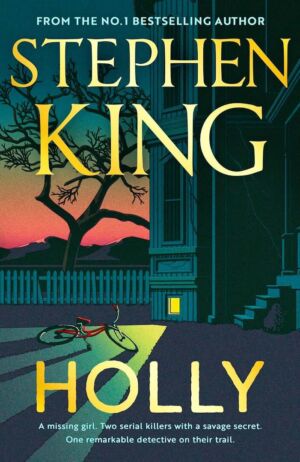
Stephen King was born in Portland, Maine, in September 1947, and by 1987 he was one of the best-selling novelists in the world and, by his own later account, deep in alcohol and cocaine dependency. He has said that Paul Sheldon’s chain to his fans was partly his own, and in On Writing he explains how this book grew from a situation rather than a plot. He has never stopped writing about captivity; Holly, with its prisoners in a tidy suburban basement, is a recent example. Misery by Stephen King came out from Viking on 8 June 1987.
- Annie arrived in a dream on a flight to London. King scribbled the idea on an airline cocktail napkin.
- At Brown’s Hotel the concierge let him write at a desk that had belonged to Rudyard Kipling. He filled sixteen pages of a steno pad.
- He expected a novella of about 30,000 words, and planned for Annie to bind Paul’s book in his own skin. Paul proved more resourceful than that, and the book ran almost four times as long.
- It was meant to appear under his pseudonym Richard Bachman until that cover was blown.
- It shared the first Bram Stoker Award for best novel with Robert McCammon’s Swan Song, and was a World Fantasy Award finalist the next year.
- Rob Reiner’s 1990 film won Kathy Bates the Oscar for Best Actress, still the only Academy Award for a film of a King novel.
The Verdict
King has written bigger books, but none tighter. Misery by Stephen King takes one room, one bed, one typewriter and two people, and builds from them a study of dependency, fandom and the stubborn, almost shameful need to finish a story. Annie Wilkes is the most convincing captor in his fiction because she is never only a monster; she is also, maddeningly, a good editor.
Paul begins the novel unable to save a single page of the book he loved. He ends it having written the one that saved him.