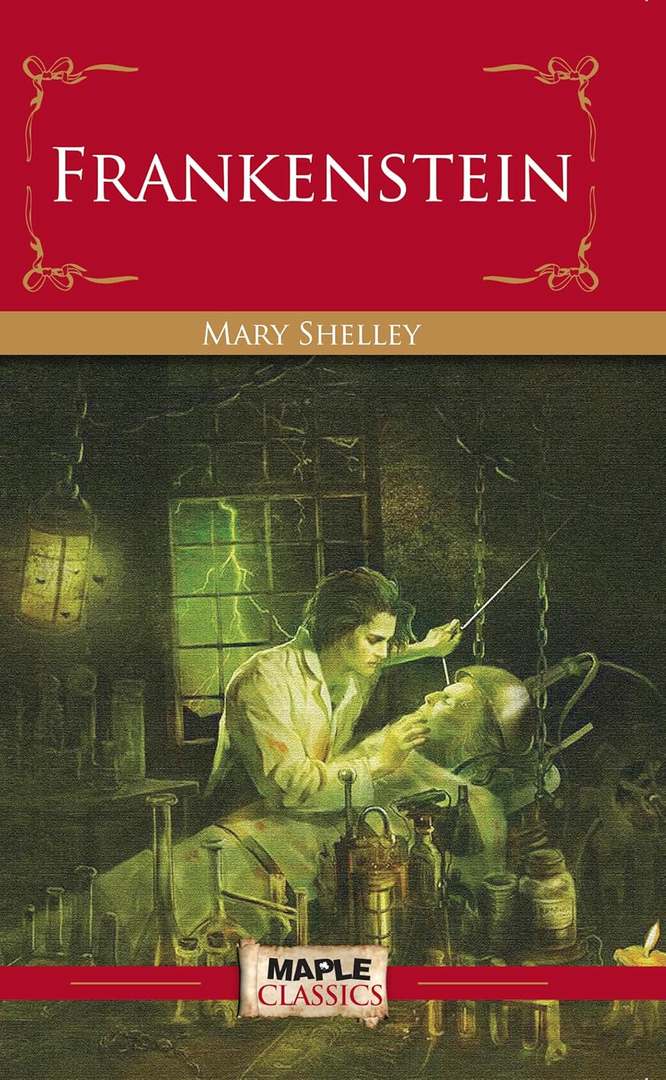



A ship is locked in Arctic ice, fog all around, and the crew are idling at the rail when they see a sledge pulled by dogs racing north across the frozen plain. The driver is shaped like a man but far too large for one. They follow him with their telescopes until he vanishes. The next morning a second sledge drifts towards them on a broken floe, carrying an emaciated European and a single surviving dog, and the stranger refuses to come aboard until he is told which way the ship is heading. That is how Frankenstein by Mary Shelley begins: not in a laboratory but at the far edge of the map, with the monster already glimpsed and his maker half dead in pursuit.
How It Works: Three Voices, One Sheet of Ice
Frankenstein by Mary Shelley is built like a set of nested boxes. The outer box is a run of letters from Robert Walton, an ambitious, lonely English explorer, to his sister Margaret at home. Inside them sits the confession of the man he rescues, Victor Frankenstein, which Walton writes down each night. Inside that, at the very centre, Victor repeats the story the creature told him on a glacier above Chamonix. Each narrator hands the microphone inward, and then the boxes close again in reverse order.
The rules of the world are stated plainly. Victor is a Genevan student at Ingolstadt who abandons the old alchemists after watching lightning blast an oak to splinters, then finds a way to give life to dead matter. The book never explains how. Readers expecting the crackle of galvanism and a laboratory full of sparks will find one dry paragraph on a rainy November night, because Victor deliberately keeps the secret from Walton. The edition read here follows the revised 1831 text, the version most paperbacks reprint, with Shelley’s own introduction describing the waking dream that started it.
The Monster Is the Argument
What the frame actually does is put the creature’s testimony on trial inside his accuser’s story. By the time he speaks, in the long middle section, we have heard Victor call him a fiend, a daemon and a wretch for ten chapters. Then the accused gets the floor, and he is the most articulate person in Frankenstein by Mary Shelley. On the ice of the Mer de Glace he tells his maker, “I ought to be thy Adam,” and the line lands as a legal charge rather than a plea.
The build-up to that meeting is pure gothic obsession. Victor spends two years in a top-floor workroom reached by a gallery and staircase, gathering bones from charnel-houses and materials from the dissecting room, letting the summer harvest pass unseen and ignoring his father’s letters. He chose a giant frame because small parts were fiddly to work with. The pragmatism is chilling.
What Mary Shelley Gets Right
- The confrontation on the glacier. Victor climbs alone through rain to the sea of ice, the creature bounds across the crevasses towards him, and two pages later the moral weight of the book has tipped. It is one of the great reversals in English fiction.
- Victor’s silence. When an innocent servant stands trial for a crime he knows she did not commit, Victor groans in a corner and says nothing. Shelley makes his cowardice the real horror, and it is far worse than anything stitched together in his attic.
- The sublime weather. Thunderstorms over Lake Geneva, avalanches in the Arve valley, fog over the pack ice. The landscape is never decoration. It mirrors Victor’s moods and then dwarfs them.
- The mirror in the frame. Walton is Victor in miniature, a self-taught overreacher willing to risk his crew for glory. The outer story quietly asks whether he will learn the lesson in time, which gives Frankenstein by Mary Shelley a suspense that has nothing to do with the creature at all.
Where It Gives Ground
- The opening is slow. Walton’s first letters are expository, and Victor’s first two chapters are a long, idealised family history in which nobody does anything wrong.
- The middle wanders. A later tour through the Rhine valley, Oxford, the Lake District and Edinburgh reads like a travel diary and stalls the dread just when it should tighten.
- Coincidence carries too much. Old friends arrive at exactly the right street corner, and a drifting boat washes up on precisely the shore where trouble is waiting. A modern reader will notice every one.
- The women are saints, not people. Victor’s mother, his fiancée Elizabeth and the family servant are all luminous, patient and good. Elizabeth is handed to the boy as “a pretty present” in the first chapter, and the novel never gives her much more agency than that.
Read These Next
If Frankenstein by Mary Shelley is the start of an October reading list, our guide to more Halloween classics has the rest of the shelf. For modern descendants of the creature, try these:
- Never Let Me Go by Kazuo Ishiguro, for made people who ask what they are owed by the society that made them.
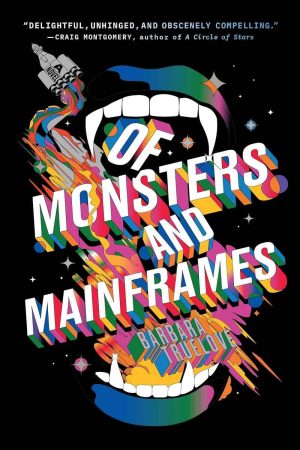
- Of Monsters and Mainframes by Barbara Truelove, for a space-horror Dracula retelling narrated by a ship’s computer that is starting to wonder whether it is alive.
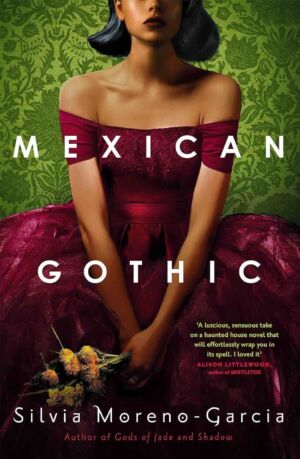
- Mexican Gothic by Silvia Moreno-Garcia, for a gothic in which a scientific obsession with life and death rots an entire family.
- Poor Things by Alasdair Gray, for a comic, Glaswegian reworking in which the made woman finally gets to tell her own story.
About Mary Shelley, Plus Some Frankenstein Trivia
Mary Wollstonecraft Godwin was born in Somers Town, London, on 30 August 1797, the daughter of the feminist philosopher Mary Wollstonecraft, who died days after the birth, and the radical writer William Godwin. At sixteen she ran away to the Continent with the married poet Percy Bysshe Shelley. She went on to write several more novels, including the apocalyptic The Last Man (1826) and the historical Valperga, and died in London on 1 February 1851.
- It was published anonymously on 1 January 1818 by the small London firm of Lackington, Hughes, Harding, Mavor and Jones, in three volumes and a run of only 500 copies.
- Reviews split. Walter Scott admired it in Blackwood’s but doubted how the creature learns language, while the Quarterly Review dismissed it as absurd.
- A London stage version, Presumption, was a hit in 1823; Shelley saw it, and the second edition that year finally carried her name.
- The flat head, neck bolts and electrical jolt come from the 1931 Universal film with Boris Karloff. The book contains none of them, and the creature has no name.
- The novelist Brian Aldiss argued that Frankenstein by Mary Shelley is the first true work of science fiction, because its hero chooses experiment over magic.
What Stays With You
Not the monster you expected. What stays is a creature who learned to speak and then had nobody to speak to, and a maker who spent his whole life running from the one conversation that mattered. Frankenstein by Mary Shelley is slower than its legend and more grown-up, and its question about what we owe the things we make has only become more urgent.
The villagers had torches. The real failure happened in an attic, the night a young man looked at what he had made and went back to bed.