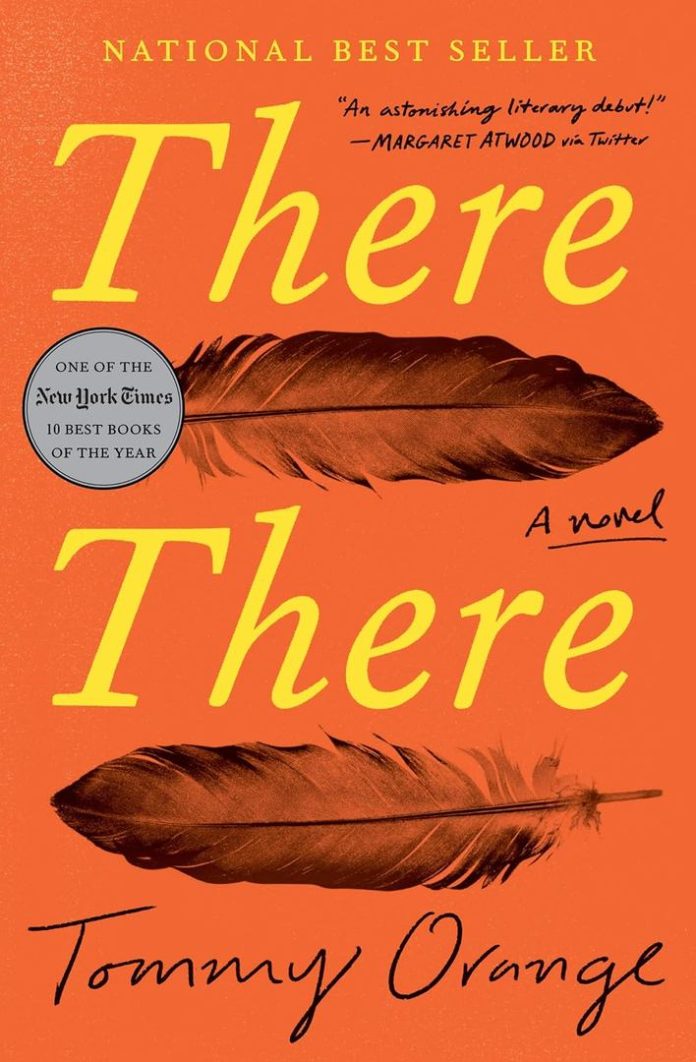


Before a single character speaks, the book shows you a drawing: the headdressed profile from the old Indian Head test pattern, broadcast to American televisions after the late shows ended, sitting just above a bull’s-eye. Then it walks you back to 1621, to the meal colonists shared with Massasoit and ninety of his men, and calls it what it was: a meal sealing a land deal, not a thanksgiving. A few paragraphs later comes 1637, when a colony declared a day of thanksgiving after burning a Pequot village during its Green Corn Dance. There There by Tommy Orange starts there, with the holiday Americans eat together every November, and asks you to keep that history in your mouth while you meet twelve people who are simply trying to get through a Saturday in Oakland.
A Prologue That Sets the Table
The opening essay is the most quoted part of the novel for good reason. It is short, furious and organised like an argument: heads on spikes and in jars, heads on pennies and nickels, Hollywood’s rolling heads, and finally the move to cities under federal relocation policy in the 1950s, which was meant to finish the work of erasure and instead produced a new kind of Native life. Orange insists that the city made his people new rather than lost, and every chapter that follows is evidence for that claim.
What makes the prologue more than a lecture is that it is also a key. Images from it return in the story proper: screens and reflections, heads and faces, bullets that travel across centuries before they land. By the end you realise the essay was the novel’s table of contents written in another language.
It also changes how the book reads as a holiday choice. Plenty of novels use Thanksgiving as a backdrop for family rows over the turkey. There There by Tommy Orange contains no holiday dinner at all, yet it may be the most useful book to have finished before one, because it hands you the version of the story that the school pageant left out and then shows you the descendants of that history living ordinary, complicated, very modern lives.
Twelve Voices, One Drum
The second thread is the cast, and it is where There There by Tommy Orange earns its reputation. Each chapter belongs to one person, and Orange changes his instrument for each. Edwin Black, a thirty-something with a master’s degree in Native literature and four years lost to the internet, narrates in a wry first person full of forum threads and constipation, and his attempt to find his father by messaging strangers from his mother’s Facebook account is both mortifying and very funny. Thomas Frank, a janitor who drinks, gets a chapter in the second person, which turns his self-loathing into something close to a song.
Orvil Red Feather, fourteen, has learned to dance from YouTube videos and wears regalia that does not fit. With his brothers Loother and Lony he scrapes coins out of fountains to afford Indian tacos, and their banter is some of the warmest writing in the book. Blue, the powwow’s organiser, gets a tense, nerve-shredding escape from an abusive husband through an Oklahoma bus station. Octavio’s chapter, built around a grandmother who cures curses with badger fur, has the cadence of a family legend told late at night.
Between the parts sits an Interlude in the first person plural, a choral essay on what it means to be counted as Indian. Its litany of fractions ends with a phrase that sums up the absurdity of the arithmetic: “Undoable math. Insignificant remainders.” Few novels manage to be this angry and this playful on the same page.
All of these lives are converging on the Big Oakland Powwow at the Coliseum, where a robbery is being planned. You know from early on that something will go wrong. The suspense in There There by Tommy Orange is not whether, but who, and the final chapters arrive in short bursts, voice after voice, with a momentum the slower first half does not prepare you for.
Where There There Gives Ground
- Too many voices for the space. Twelve narrators in around three hundred pages means some never get room. Calvin’s second chapter is barely a scene, and the two men who travel everywhere as a pair stay interchangeable.
- The coincidences show their stitching. The web that ties the cast together is satisfying, but a few of the links depend on chance meetings that the book explains away rather than earns.
- The foreshadowing is heavy. The Interlude and a short future-tense chapter announce the shape of the climax so plainly that some tension drains out before the powwow begins.
- Two chapters run on monologue. Long stretches of family backstory are delivered as speeches, which slows the middle of There There by Tommy Orange just as it should be tightening.
Read These Next
- Wandering Stars by Tommy Orange, the follow-up that reaches back to Sand Creek and forward past the powwow. Read it second.
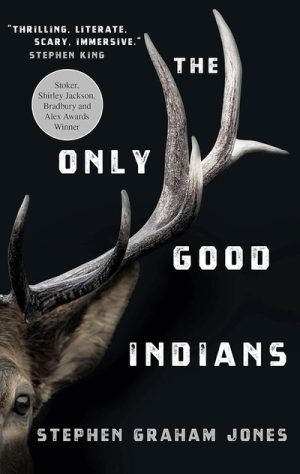
- The Only Good Indians by Stephen Graham Jones for another contemporary Native novel where the past refuses to stay buried, in horror rather than realism.
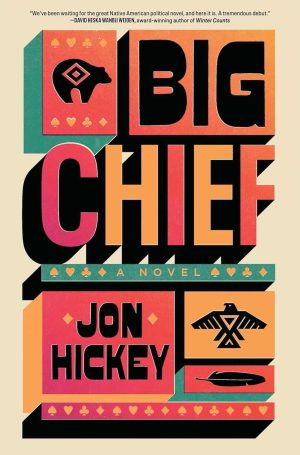
- Big Chief by Jon Hickey for community, politics and identity on a reservation, told with sharp humour.
- A Visit from the Goon Squad by Jennifer Egan, if what hooked you was the relay of voices and chapters that each change form.
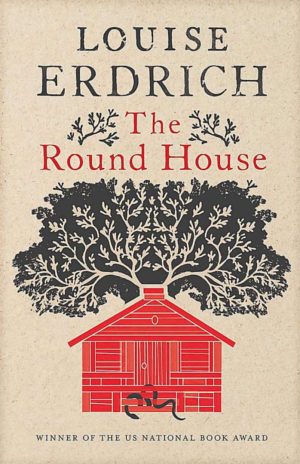
- The Round House by Louise Erdrich, an Ojibwe family’s story of crime and justice on a reservation, and a natural next step after this one.
About Tommy Orange
Orange grew up in Oakland, and the idea for his debut came out of a job recording oral histories in a digital storytelling booth at the city’s Native American Health Center. Listening to urban Native people tell stories nobody else was collecting convinced him those stories needed a novel of their own. There There by Tommy Orange became one of the most decorated debuts of its year, and he returned to the same families in Wandering Stars.
- Born in Oakland on January 19, 1982; an enrolled member of the Cheyenne and Arapaho Tribes of Oklahoma.
- Earned his MFA at the Institute of American Indian Arts in Santa Fe, where he now teaches.
- The novel was a finalist for the 2019 Pulitzer Prize for Fiction and won the PEN/Hemingway Award, the American Book Award and the National Book Critics Circle’s John Leonard Prize.
- It also took the Center for Fiction First Novel Prize and the Anisfield-Wolf Book Award for Fiction.
- Wandering Stars was longlisted for the 2024 Booker Prize.
What Stays With You
The flaws are real: a crowded cast, a climax announced too early, a few links that rely on luck. They barely dent the achievement. There There by Tommy Orange is a debut with the confidence of a late novel, a book that hands the microphone to people who rarely get it and lets each of them sound like nobody else.
Read the prologue again after the last chapter. It is a different essay the second time.