 1
1 2
2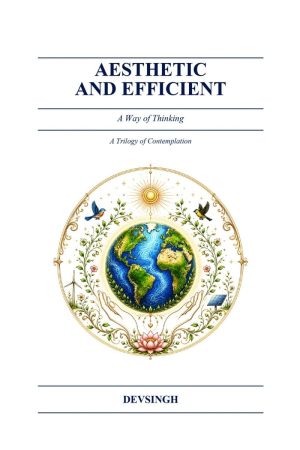 3
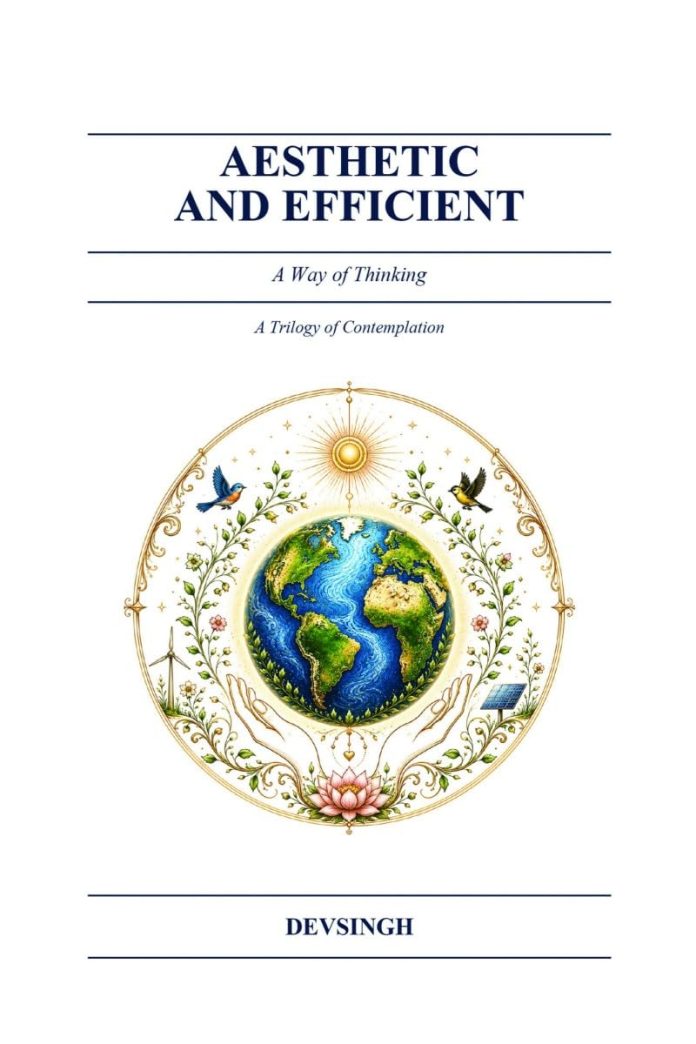
3Most books about design begin in a studio. This one begins beside a chipped cup you have stopped noticing, a chair you once moved three feet to the left, and a door handle worn pale by every hand that reached for it before yours. Aesthetic and Efficient: A Way of Thinking by Devsingh Balan opens with a claim so quiet you almost miss its ambition: you already know good design when you feel it, and nobody had to teach you. The rest of the book spends forty chapters and seven movements proving that claim, patiently, from termite mounds to temple stone to the software running underneath your day.
This is the closing volume of A Trilogy of Contemplation, following Journey to Infinity Within and The Inward Quest. The first book turned attention inward, toward the self. The second carried that attention into leadership and the rooms where people meet. This third book completes the arc by aiming the same stillness at the physical world: what we make, what we keep, what we throw away, and what all of it says about how clearly we are seeing. For how the three volumes work together, see our analysis of A Trilogy of Contemplation as a whole.
What the Book Is About
One Question Wearing Two Names
The central argument of Aesthetic and Efficient: A Way of Thinking by Devsingh Balan is that beauty and usefulness were never separate questions. A jaali screen that cools a room for two hundred years without electricity is beautiful because it is efficient, and efficient because someone looked long enough to see what the stone, the sun, and the wind already wanted to do. The book returns to this fusion again and again, in a leaf banking sugar against the night, in a bullet train nose borrowed from a diving bird, in a spacecraft computer deciding, three minutes from the moon, what actually mattered.
The Seven Movements
The book is arranged like music rather than a syllabus, and the structure rewards reading in order:
- Learning to See asks why children notice everything and adults stop, and what it would take to reopen that attention.
- The Living Planet reads Earth as one interconnected system, the same pattern repeating at the scale of a body, a garden, a river, a city, and a world.
- Those Who Already Knew gathers builders, potters, engineers, and artists who never accepted the divide between form and function.
- The Scale of What We Waste counts the cost of forgetting, from uneaten harvests to a clothing mountain visible from space.
- The Four Questions distills everything into a portable tool for daily life.
- Becoming the Maker hands authority back to the reader, arguing the design instinct was never reserved for the credentialed.
- Close joins all three books of the trilogy into one house with three rooms.
Four appendices then change register deliberately, testing the book’s felt claims against research on fractal fluency, processing fluency, systems thinking, and design theory, with sources credited chapter by chapter.
The Writing Style: Parables Without Names
Balan makes an unusual and quietly brilliant choice throughout. Nearly every figure in the main chapters goes unnamed. An architect in Kerala who asked of every design choice, is it necessary. A programmer who taught a machine to let go. A scholar who went looking for beauty in ordinary workshops. Only in the final appendix do the names arrive, and by then each story has already done its work as a parable. The effect is that you meet ideas before reputations, which is exactly the kind of seeing the book is teaching.
The prose itself practices what it preaches. Sentences carry their weight the way the book says a good tool should, nothing extra, nothing missing. Chapters end not with summaries but with direct questions to the reader: what would you build differently, if you knew you would never see it finished? These questions accumulate quietly until the book stops feeling like something you are reading and starts feeling like something reading you back.
The Four Questions: A Tool You Take With You
The most practical gift of Aesthetic and Efficient: A Way of Thinking by Devsingh Balan is a set of four questions to ask of anything you make, buy, or keep:
- What was this before it became what it is now?
- Where does this end once its use is finished?
- Can it come back in some form, rather than simply ending?
- Who is this really for, a real person or a gap that needed filling?
What makes these questions land is that the book has already shown you dozens of objects answering them, from a clay pot that knows its way back to earth, to a plastic bottle built for a straight line instead of a circle. By the time the questions are named, you recognize them as ones you have been half asking your whole life.
Standout Strengths
A few qualities set this book apart from the crowded shelf of design and sustainability writing:
- Rooted in Indian making traditions while remaining genuinely global, moving between Kerala courtyards, Chola temples, Japanese repair aesthetics, and Apollo era software with equal ease
- Evidence held honestly, including moments where the book corrects a popular story rather than repeating a tidy version of it
- A structure that mirrors its argument, subtracting rather than adding, the way the rock cut temple in its pages was carved
- Zero preaching, replacing guilt with attention, which turns out to be far more persuasive
Who Should Read This Book
Readers of the first two trilogy volumes will find the most complete experience here, though the book stands fully on its own. It will reward anyone drawn to slow, contemplative nonfiction, designers and architects curious about vernacular wisdom, sustainability minded readers tired of statistics without soul, and anyone who has ever rearranged a room until it finally felt right and wondered what that feeling actually was.
Similar Books Worth Exploring
If Aesthetic and Efficient: A Way of Thinking by Devsingh Balan speaks to you, these sit comfortably on the same shelf:
- A Pattern Language by Christopher Alexander
- The Nature and Aesthetics of Design by David Pye
- Thinking in Systems by Donella Meadows
- Biomimicry by Janine Benyus
- The Beauty of Everyday Things by Soetsu Yanagi
- Cradle to Cradle by William McDonough and Michael Braungart
- In Praise of Shadows by Junichiro Tanizaki
Final Thoughts
Some books argue. This one notices, and lets the noticing do the arguing. Aesthetic and Efficient: A Way of Thinking by Devsingh Balan closes a trilogy about attention by proving that the same stillness practiced alone, then carried into rooms full of people, was always meant to reach the shelf, the workshop, and the bin. You finish it holding ordinary objects a second longer than you used to, hearing the questions the book has planted, and understanding that this small hesitation is precisely the way of thinking the title promised. For readers seeking philosophy that lives in the hands as much as the head, this is a rare and generous book, and a worthy end to one continuous inquiry into seeing clearly.