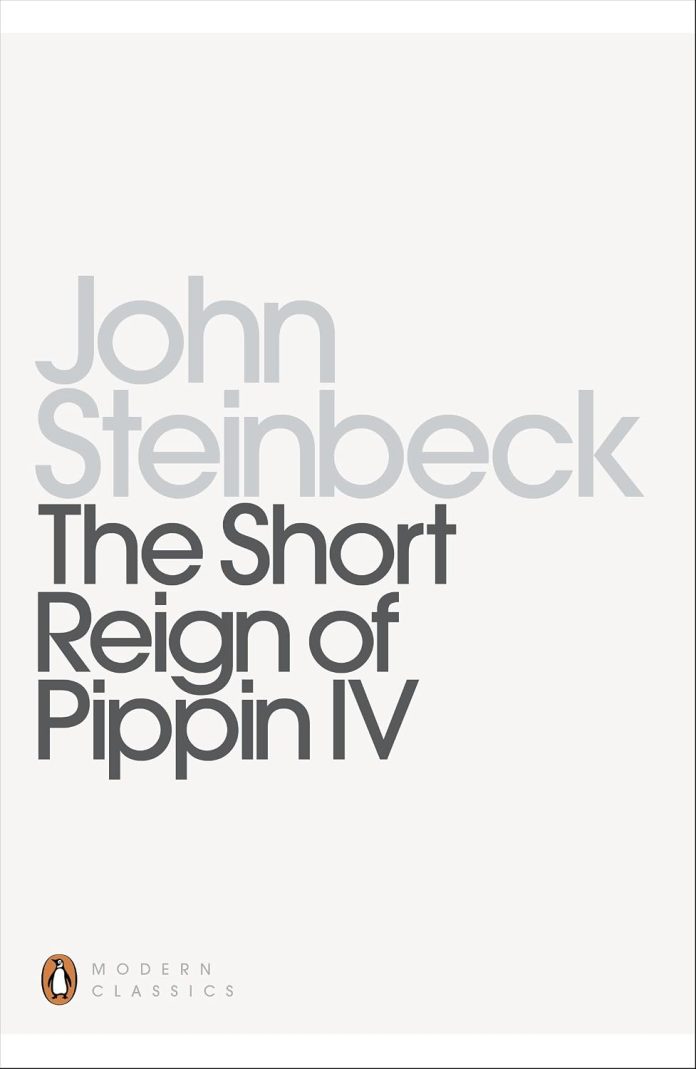
The Short Reign of Pippin IV by John Steinbeck opens with a man sleeping through his own proclamation.
Pippin Héristal is an amateur astronomer of fifty-four with an eight-inch refractor on the roof, living in a converted coach house on a small income from vineyard slopes near Auxerre. On the night France restores the monarchy and hands it to him, he goes to bed. He learns of it at half past two in the morning, when the anti-aircraft batteries fire a royal salute over Paris. The salute kills five people and wounds thirty-two, every one of whom afterwards gives loyal statements to the press from a hospital bed.
How The Short Reign of Pippin IV Begins
Published in 1957, The Short Reign of Pippin IV by John Steinbeck is his only political satire.
The premise is that the Fourth Republic runs out of arithmetic. A government falls over a question about Monaco and no combination of parties can replace it. The outgoing premier is a psycho-botanist whose real work concerns pain in plants, known in his field for a paper on the symptoms of hysteria in red clover; he leaves the national crisis early, on a telegram reporting that his sow has farrowed.
What the deadlock produces is a king. Pippin is chosen because his descent from the Carolingian line is documented and because he is harmless. His family name points back to Pepin of Herstal, and his uncle, a picture dealer on the Rue de Seine, is called Charles Martel.
The Question Running Under The Short Reign of Pippin IV
Halfway through, the king takes to a motor scooter in a corduroy jacket and crash helmet to find out what is actually wrong with his country. It is the best decision in The Short Reign of Pippin IV by John Steinbeck, because it produces the scene the whole fable is built to reach.
At Gambais he is beaten and thrown into a moat defending an old man who salvages garden statuary, and ends up drying his clothes over the man’s stove. He asks, roundabout, what he thinks of the king.
The old man says there are not rightly any kings any more. Kings are like the big lizards, big as a house. They ran out. He gropes for the word and Pippin supplies it: extinct. A king now is a play game for children, like Father Christmas, something you stop believing in once you are old enough. Pressed on how he would know a real one, he works through the possibilities, discards them all, and arrives at the only test available: you would be fairly sure he was a king “if they’d take him out and guillotine him.”
Pippin takes down his wet clothes and goes. “A man can’t stand being extinct,” he says. Perhaps he will do it badly, but he will do it.
What works
- The reasoning of the parties is the sharpest writing here. Twelve of them, from the Conservative Radicals through the Christian Atheists and Christian Christians to four flavours of Communist, each supporting a monarchy for a private reason that would ruin the others. The Communists back it because you cannot revolt against anarchy, and a throne gives you something to aim at.
- The uncle is the best character in the book. Found packing his gallery into crates, he explains that a pawn moves only forward while a king moves any way he likes, and says he has always hated martyrs. A martyr, Pippin answers, trades something he has for something he wants, and he himself is not ambitious.
- Sister Hyacinthe. A nun formerly of the Folies Bergère, and the only person who tells the king the truth to his face. At the end she brings him one of her habits, calls it the time-honoured disguise, and sees no reason for either hemlock or the cross.
- The ending refuses every available exit. Offered a car, the Channel and a career in the chicken business, the king declines because running would make him important enough to kill. Then he relieves the last sentry at Versailles with a fortnight’s furlough written on a kiosk notepad and signed Commander-in-Chief of All Armed Forces.
Where the Fable Thins
- It is very short and the middle sags. The Short Reign of Pippin IV by John Steinbeck runs about forty thousand words, and a long stretch of court business is funny by accumulation rather than design.
- Marie and Clotilde are devices. The wife runs a kingdom as she ran a household and never develops past the joke; the daughter is a magazine cutting of a precocious Parisian girl, and the jokes around her have dated badly.
- Nobody in The Short Reign of Pippin IV by John Steinbeck talks like a person. They talk like positions, pleasantly, which is legitimate in a fable and still a cost.
The Scene That Turns Pippin IV by John Steinbeck
The climax of The Short Reign of Pippin IV by John Steinbeck is a man reading a document badly. Argued by committee into a rented Grand Marshal’s uniform pinned up the back with safety pins, he delivers his address in the flat voice of a mathematician reading his own small handwriting.
He orders taxes kept low and collected from everybody, wages keyed to profits, prices protected, housing built, government shrunk, pensions and health insurance established, the great estates broken up. To the three words of the motto he adds a fourth, so that France shall stand for liberty, equality, fraternity and opportunity.
Then he waits for applause and nothing comes. He had braced for uproar, and the silence defeats him, so he loses his temper and tells them he begged not to be king, that they wanted a patsy, and that what they have is either a king or an enormous joke.
He turns to leave and a page is standing on his cape. It tears off, the safety pins are revealed, and the chamber discovers it can convert shock and guilt into laughter. By midnight he is deposed.
Where The Short Reign of Pippin IV Sits in the Backlist
The Short Reign of Pippin IV by John Steinbeck came out of a Paris winter. He had lived in the city in 1954, writing a weekly column for Le Figaro called One American in Paris, and the novel grew out of that stay. Viking published in New York in April 1957, jacket by the children’s illustrator William Pène du Bois, and Heinemann followed in London.
The notices were tepid. Kirkus thought his own readers would be let down and anyone hunting new flavours would find it insufficiently tart. The jacket invited comparison with Voltaire and Twain’s Connecticut Yankee, which is asking a good deal. It has been his least characteristic book ever since, defended at intervals as a dry run for The Winter of Our Discontent. There has never been a film or a stage version.
Read these next
- Tortilla Flat by John Steinbeck. The other fable, better dialogue.
- Cannery Row by John Steinbeck. The light Steinbeck at full strength.
- A Literary Analysis of The Grapes of Wrath by John Steinbeck. The same anger, delivered straight.
- The Timshel Debate. On choosing, which is the only thing Pippin ever does.
What Stays With You
The old man in the shack, and the test he reaches by elimination.
Everything good in The Short Reign of Pippin IV by John Steinbeck comes out of that exchange. A king is something people have stopped believing in, so the only proof of one is that somebody thought him dangerous enough to kill. Pippin hears this, understands the office he holds is empty by design, and decides to fill it anyway. He is not brave and says so. He wants his house, his wife and his telescope.
What he gets is not the guillotine. It is laughter, which is worse, plus a Republic proclaimed overnight and a coalition government that lasted until the third of February.
So the scooter runs dry in the Bois de Boulogne and he walks. A gendarme checks his card, mentions the looting and accepts a packet of Lucky Strikes. The concierge grumbles about the hour and wants to discuss a mayoral election in Lunéville. And Pippin Héristal crosses his own courtyard, takes off the crash helmet, brushes back his hair with his fingers, and puts his finger on the bell of his own front door.