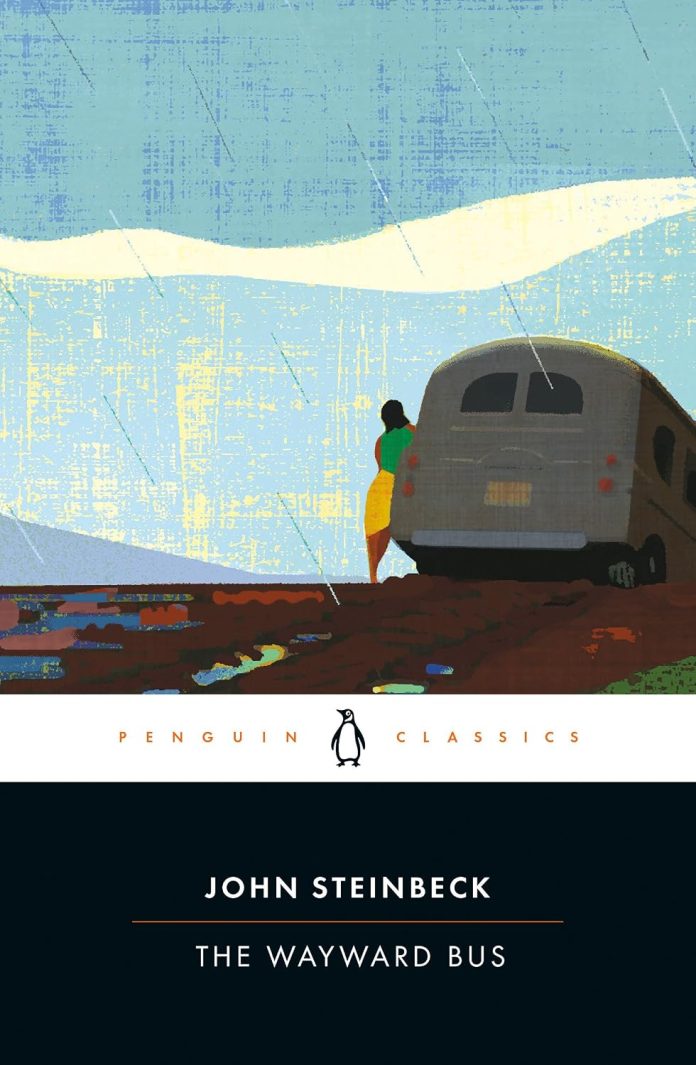
The bus in The Wayward Bus by John Steinbeck has the word “Sweetheart” lettered on both bumpers. Under the new paint you can still just read what a previous owner put there, which was the great power of Jesus in Spanish. Hanging from the windshield are a baby’s shoe for protection, a tiny boxing glove for strength, and a plastic kewpie doll in a sarong for everything else. On the dashboard, in her own small shrine, stands a metal Virgin of Guadalupe.
That is the vehicle. It will travel forty-nine miles in the course of the novel and it will not arrive. Everything The Wayward Bus by John Steinbeck wants to say is loaded onto it before a single passenger climbs aboard.
How The Wayward Bus Is Built
Twenty-two chapters, ten significant characters, one day. Juan Chicoy runs a lunchroom, garage and bus franchise at a California crossroads called Rebel Corners, and holds the franchise for the only public conveyance on to San Juan de la Cruz. A rear axle has broken, the passengers have spent the night in other people’s beds, and it has started to rain.
Steinbeck told an interviewer that The Wayward Bus by John Steinbeck contained an indefinite number of echoes of Chaucer and Boccaccio, and the architecture bears him out. Chapters peel off to follow whoever is most interesting at that moment, including people who never return. Chapter seven belongs entirely to a Greyhound driver named Louie, who delivers one passenger to the Corners and drives out of the novel for good.
The effect is that no one is a protagonist and no one is safe. The narration enters a head, reports what is actually in there rather than what the person says, and moves on.
What works
- The method of The Wayward Bus by John Steinbeck is ruthless and applied to everybody. Nobody gets a private self the narration agrees to respect.
- Camille Oaks is one of his best characters. A woman whose entire problem is that men cannot leave her alone, who wants a house and children and a staircase to come down, and who knows precisely why she will not get them.
- Ernest Horton, the novelty salesman, is the moral centre and the book never says so. A decorated veteran selling artificial crushed toes and a shot glass shaped like a lavatory, who is the only person on board who names a confidence trick when he is shown one.
- The ending refuses to resolve. Lights appear ahead, somebody says that is the town, and that is all.
Where The Wayward Bus Gives Ground
- The allegory is signposted. A place called Rebel Corners, a destination named for a mystic, the word REPENT painted in failing letters across a cliff the passengers shelter under. Scholars have spent decades matching characters to the seven deadly sins, which tells you how legible the scheme is.
- The sexual bookkeeping is relentless. Nearly everybody arrives via an inventory of their appetites, and by the tenth such arrival the technique has begun to flatten the people it was meant to expose.
- Two women are written with real attention and two are written as conditions. Camille and Norma are alive. Bernice Pritchard is a diagnosis with a handbag.
- It is not funny, and The Wayward Bus by John Steinbeck needs to be. The comic writer who produced Tortilla Flat and Cannery Row is almost entirely absent, and the bleakness has nothing to push against.
The Chapter That Proves the Book
If you read one chapter of The Wayward Bus by John Steinbeck closely, read the eleventh.
The bus leaves and Alice Chicoy is alone for the first time in a long while. She hangs the Closed sign, latches the door, drops every blind, washes the counter properly, and then gets out a bottle of bourbon and a glass and begins to drink, playing both customer and waitress, speaking both parts aloud.
It goes where you expect and then somewhere better. She fixes her face carefully between drinks to prove a point to a husband who is not there. Memories she has no defence against arrive unasked, including her mother paralysed in a white bed with one hand that could still rise. By the end she is on the floor behind her own counter among the spilled cornflakes, having spent the last of her strength trying to kill a single bluebottle fly.
The fly survives her. The last line of the chapter gives it the wine.
That is the whole novel in miniature, and it is as good as anything in the famous books.
Read it if
- You want The Wayward Bus by John Steinbeck for the formal ambition, attempted in the gap between the two books everybody has read.
- You like ensemble novels where the author declines to pick a side.
- You are interested in 1947 America as it was actually being written about: returning soldiers, commercialised everything, and a general suspicion that honesty and thrift had stopped paying.
Skip it if
- You need somebody in a novel to admire.
- The relentless sexual appraisal of every character will wear you down, and it is fair to say it will.
- You came for the warmth of the Monterey books.
Where The Wayward Bus by John Steinbeck Sits in the Backlist
The Wayward Bus by John Steinbeck arrived on 15 February 1947, his first long novel in the eight years since The Grapes of Wrath and his last before East of Eden. The commercial scale was extraordinary: a first printing of 750,000 copies, a Book-of-the-Month Club selection, and advance orders approaching a million before anyone had read it.
The notices then split down the middle and stayed split. One reviewer in the New York Times read it as a modern Everyman parable. A Catholic weekly called it a dreary and meaningless bus ride. Steinbeck, writing to a friend, said the arguments were good for the book.
He had struck the idea in Mexico in 1945 while finishing The Pearl, first imagining something picaresque, a Don Quixote of Mexico, and then watched it grow past a hundred thousand words. In 1957 Twentieth Century Fox adapted it as a film with Jayne Mansfield and Joan Collins, turning the novel into roughly the product it had been satirising. He had nothing to do with it.
Content notes
Contains a scene of sexual assault within a marriage, an assault on a teenage girl, a character suffering a stroke, suicidal planning, heavy drinking, and period language about race and sex that the narration does not challenge.
Read these next
- A Literary Analysis of East of Eden by John Steinbeck. The next long novel, five years later, and the one where the moral machinery finally has room to turn.
- A Literary Analysis of The Grapes of Wrath by John Steinbeck. The book this one had to follow, and the reason the pressure on it was absurd.
- A Literary Analysis of The Pearl by John Steinbeck. Written in the same stretch, in Mexico, while the bus was still just an idea.
- East of Eden: What Netflix Changed From Steinbeck’s Novel. On what adaptation does to him, which is a question this novel answered badly in 1957.
Worth Your Shelf
Yes, with the understanding that it will not be a pleasant week.
What makes The Wayward Bus by John Steinbeck hold up is a line Camille gives Norma near the end, after the girl has defended her honour with her fists against an accusation that happens to be accurate. Everybody, she says, is a tramp some time or other, and the worst ones are those who call it something else.
That is the book’s actual thesis, and it is why the novel is colder than anything else he wrote. There are no migrants here to be wronged by somebody else, no bank, no drought, no system to blame. There are only ten people who each want something they will not name out loud, stuck on a hill in the rain, and a driver who spends the afternoon trying to work out whether he is allowed to walk away from them.
He goes back. The novel does not tell you it was the right choice.