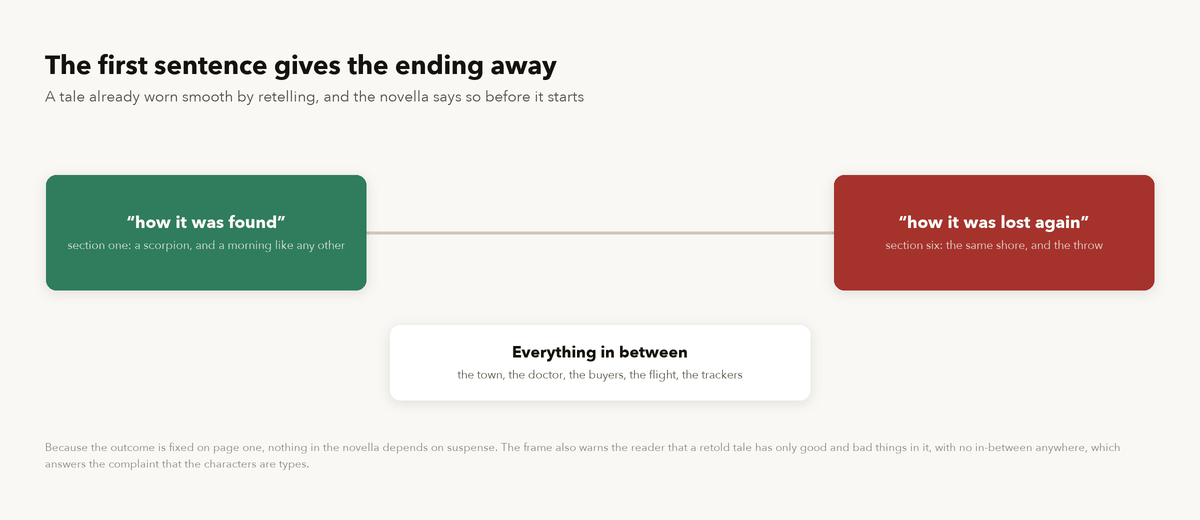
The Pearl (1947) by John Steinbeck opens by telling you how it finishes. In the town, the narrator says, they tell the story of the great pearl, how it was found and how it was lost again. Before a character has moved, the outcome is fixed. Everything Steinbeck does in the following ninety pages is shaped by that decision, and reading the book as a thriller about whether Kino gets rich misses the form entirely. This analysis discusses the whole novella, including the ending.
How The Pearl by John Steinbeck Tells You What Kind of Story It Is
The opening paragraph does three separate jobs in about a hundred words.
It establishes that this is a retold tale rather than an event, something worn smooth by repetition in a particular town. It warns you about the consequences of that retelling: because the story has been told so often, there are only good and bad things, black and white things, and “no in-between anywhere”. And it offers a licence, saying that if this story is a parable then everyone takes his own meaning from it.
That is an unusually honest set of instructions. Steinbeck is telling the reader in advance that the characters will be simplified, that the moral oppositions will be stark, and that this is deliberate rather than a failure of craft. Complaints that Kino is a type rather than a person are answered on page one, though whether the answer satisfies is another matter.
The Songs Are the Narration
Kino hears music. Steinbeck’s note is that his people once made songs and stopped, so the old songs remain but no new ones are added, and what Kino carries in his head is personal rather than communal.
This is the novella’s most interesting technical device. There is no interior monologue in The Pearl by John Steinbeck, and Kino is not a reflective man. The songs do the work that thought would normally do.
The Song of the Family is the baseline: safety, warmth, the sound of Juana at the fire pit and the baby in his hanging box. The Song of Evil arrives with the scorpion and returns whenever something threatens. And the Song of the Pearl That Might Be starts in the canoe, and once the pearl is found it begins to drown out the family music. By the final pages the pearl’s music has become distorted and insane.
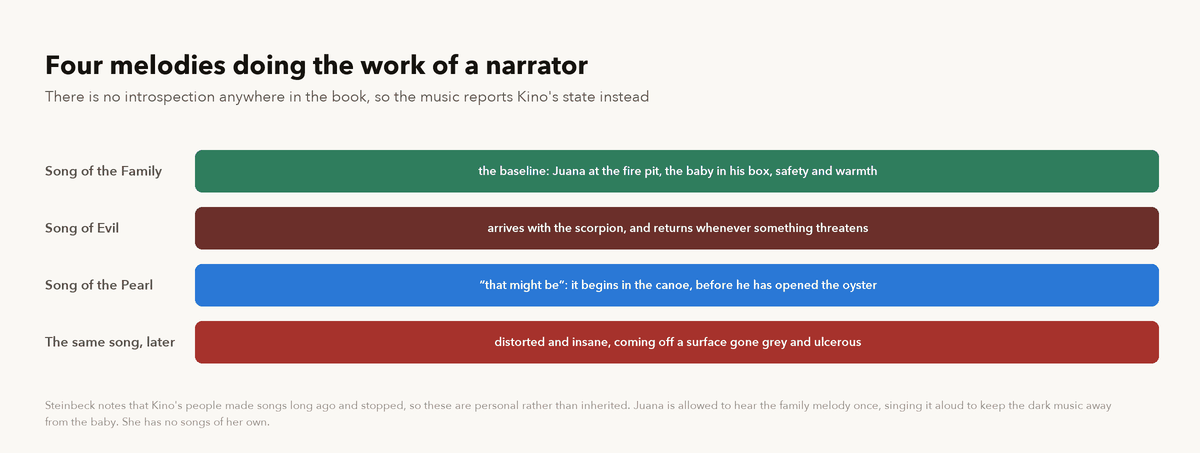
Because the reader is told which song is playing, Kino’s inner state is always legible without a single sentence of introspection. It is closer to how a film score works than to how novels usually operate, and it is why the book can be so short. Steinbeck was writing with a film in mind at the time, which may explain the instinct, but the device does something prose-specific too: it lets him report a man’s emotional state without ever claiming to know what the man is thinking, which suits a narrator retelling a story he heard in a town.
The Pearl Is Built in Six Symmetrical Parts
The novella is divided into six numbered sections, and they mirror each other across the middle.
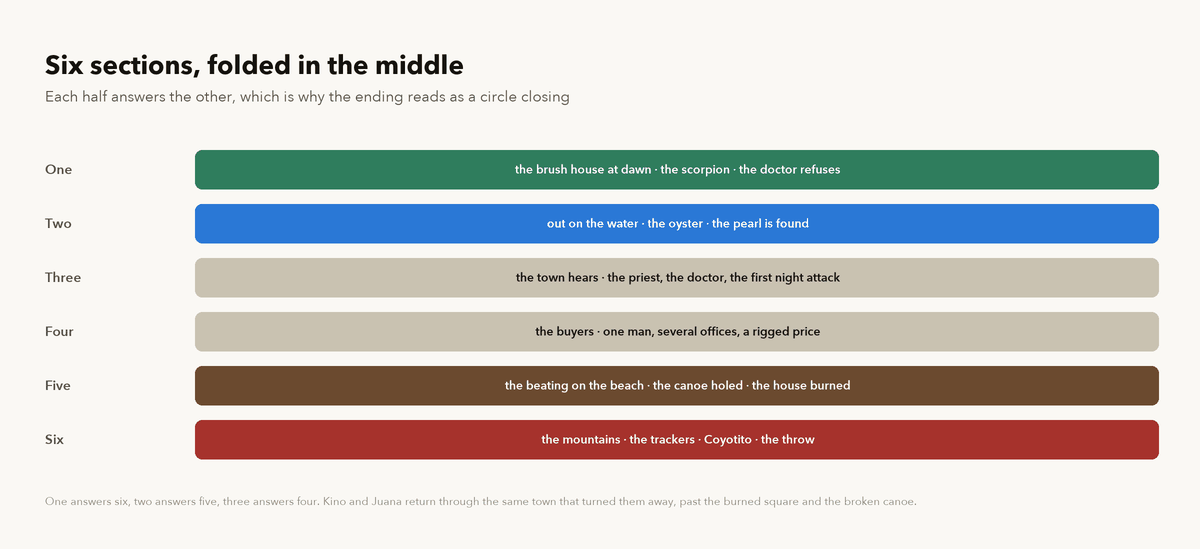
Section one is a morning of ordinary domestic routine, broken by the scorpion. Section six is the return, and the restoration of nothing. And section two takes Kino out to sea to find the pearl; section five sends him out of town to lose everything. The two middle sections handle the town’s reaction and the attempt to sell.
The symmetry is what makes the ending feel like a circle closing rather than a plot resolving. Kino and Juana walk back through the same stone and plaster town they were turned away from, past the burned square where their house stood and the canoe somebody holed, and the neighbours stand back and let them pass. Juan Tomás raises a hand in greeting and does not complete it.
The Scorpion Is the Novella in Miniature
The opening threat arrives four pages in and functions as a compressed model of everything that follows.
A scorpion comes down the rope that holds the baby’s box. Kino and Juana both see it. Both are within arm’s reach. Juana whispers a charm and then, under her breath, an actual prayer. Kino moves slowly, hands out, and the scorpion stings Coyotito anyway, at the exact moment he grabs for it.
Three things are established in that half page. The family is attentive and competent, and it makes no difference. Juana responds with ritual and Kino with his hands, which is the division between them for the rest of the book. And the harm lands on the child, who is the one person with no capacity to act at all.
Steinbeck then has Kino crush the scorpion into the dirt long after it is dead, beating the floor with his fist. The gesture is useless and he keeps making it, which is a fair summary of what he does with the pearl.
What Kino Actually Wants
It is worth being precise about this, because The Pearl John Steinbeck is often summarised as a story about greed and it is not quite.
Kino’s plans for the money are specific and modest, and he states them in front of the neighbours: he and Juana will be married in the church; they will have new clothes; he will buy a rifle; and Coyotito will go to school. The last one is the real ambition, and he explains why. If his son can read, the family will no longer have to take other people’s word for what documents say, which is the exact mechanism by which they are kept poor.
That is not avarice. It is a man identifying the lever that would free his family and reaching for it. The tragedy of the novella is not that Kino wanted too much; it is that the society around him has no route by which a fisherman may convert a windfall into a future, and every institution he approaches is organised to prevent it.
The Canoe Is the Real Catastrophe
Among the losses in The Pearl by John Steinbeck, one is structurally more important than the death it leads to, and it is easy to read past.
Kino’s canoe came from his grandfather by way of his father. It is described as the one thing of value he owns, the only bulwark against starvation, and the single piece of property that has been handed down. He maintains it with a hard shell of plaster, and the novella treats it with a seriousness it gives to nothing else Kino possesses.
When he goes to leave town, somebody has driven a hole through the bottom of it. Steinbeck writes the reaction plainly: killing the canoe is an evil beyond understanding, because a boat does not have sons.
Look at what that does to the plot. Before the canoe is holed, Kino has options. He can fish, he can feed his family, he can wait for a better offer or sell the pearl in the capital. Afterwards he has no way to work and no way to leave by water, which is why the flight goes overland into the mountains where the trackers can follow. Every event in the last third of the book is made possible by a hole in a boat.
It also makes the economic argument concrete in a way the pearl itself cannot. The pearl is potential wealth that nobody will convert. The canoe is actual, working capital, inherited across three generations, and it is destroyed in a night by people who want what Kino has found. The novella’s point is not that wealth corrupts. It is that a poor man who acquires something valuable will be stripped of what he already had.
Historical and Social Context
Steinbeck heard the story in 1940, during the Gulf of California expedition he made with the marine biologist Ed Ricketts, and recorded it in The Log from the Sea of Cortez as a local anecdote about an Indian boy who found a great pearl and eventually threw it back. John Steinbeck wrote the novella in 1944 and 1945, published it in a magazine as The Pearl of the World in 1945, and issued it as a book in 1947 alongside a film made in Mexico.
The setting is La Paz, in Baja California, and the social arrangement the book describes is colonial in structure. There are brush houses on one side and a town of stone and plaster on the other. The doctor who refuses to treat an Indian baby for a scorpion sting, and who arrives promptly once there is a pearl, is European and thinks of Paris. The priest’s first thought on hearing the news concerns repairs to the church.
Published two years after the end of the war, by a writer who had just come back from reporting it, the book’s bleakness about institutions is not accidental.
Style: Folk Tale Cadence
The prose imitates oral storytelling, and it is the most divisive thing about The Pearl. Sentences begin with “And” far more often than modern editors would permit. Descriptions repeat in slightly varied form. Characters are given fixed epithets, so Juana is calm, Kino is the fisherman, the pearl is great.
That register is a deliberate match for the frame of The Pearl. A tale polished by retelling in a town would sound like this. The cost is that readers arriving from the Joad novels find the people flattened, and the complaint is legitimate: Kino has a plan and a temper, and not much else that a novel would normally give him.
What the style buys is the extraordinary clarity of the images. The scorpion on the rope above the baby’s box. The pearl buyers’ coin-flipping fingers. The green water and the dead oyster shells. None of it needs explaining, and none of it is explained.
Why The Pearl Does Not End on a Moral
If the novella is your way into Steinbeck, our guide to reading classics without feeling intimidated applies, and the case for rereading is unusually strong for a book this short.
The last pages are frequently taught as a lesson about the corrupting power of wealth. The text is stranger than that.
Kino looks into the pearl before he throws it and sees what is in it: faces, the light of burning, the frantic eyes of a man he killed in a pool, and Coyotito lying in the cave with the top of his head shot away. The pearl has gone “gray and ulcerous” and the music coming off it is deranged. It is the surface of a thing that has absorbed the events rather than caused them.
Then Steinbeck does something easy to miss. Kino holds it out to Juana so that she can throw it, and she refuses, and the refusal is two words: “No, you.”
She has wanted it gone since the second night, and she is the one who tried to throw it back and was beaten for it. She could have the satisfaction. And she declines it, and makes him do the thing himself. The Pearl ends not with a lesson learned but with a woman declining to carry one more thing on her husband’s behalf, which is a far better last beat than the moral the book is usually reduced to.
Edition cited: Penguin Books, which carries an introduction by Linda Wagner-Martin. First published by The Viking Press, 1947, after magazine publication as “The Pearl of the World” in 1945. All quotations are from Steinbeck’s text, not the editorial apparatus.







