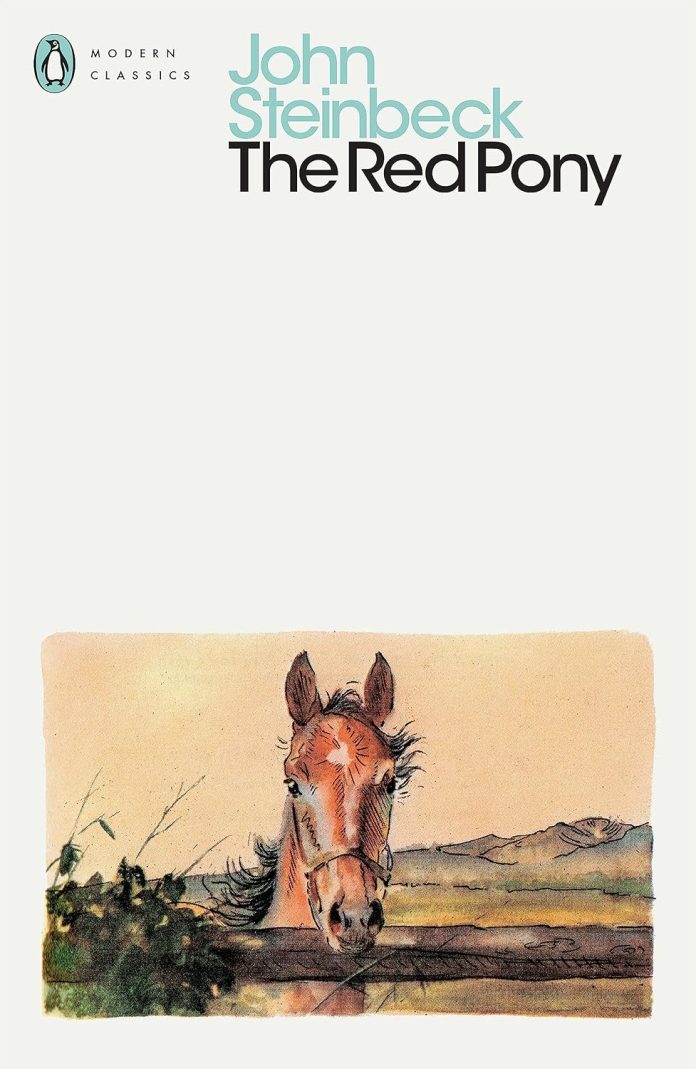
The Red Pony by John Steinbeck opens with Jody Tiflin, aged ten, being picked out of sleep by the triangle that calls the ranch to breakfast. It does not occur to him to disobey it. Nobody he knows ever has.
That is the second page of The Red Pony by John Steinbeck, and it sets the terms: a world of fixed roles on a Salinas Valley ranch, a boy inside it who has been taught that adults are reliable, and four stories dedicated to taking that apart.
The Four Stories of The Red Pony, and What Each Removes
The Red Pony by John Steinbeck is not a novel, and reading it as one flattens it. It is four pieces, written separately between 1933 and 1937 and gathered with a fourth in 1945.
The Gift. Jody is given a red pony, and Billy Buck, the ranch hand who knows everything about horses, promises it will be fine out in the corral. It rains. The pony sickens. Billy opens its windpipe on the kitchen table with a pocket knife and it dies anyway, and Jody finds a buzzard already at the body and beats it to death with his hands.
The Great Mountains. An old paisano named Gitano walks onto the ranch and says simply that he has come back, because he was born there. Jody’s father will not keep him. Gitano takes the oldest horse on the place and rides west into the mountains nobody has been into, and neither is seen again.
The Promise. Jody is promised a colt and watches the mare carry it. The birth goes wrong. Billy Buck, who made the promise, kills the mare with a hammer and opens her to get the foal out alive, and hands it to the boy covered in blood.
The Leader of the People. Jody’s grandfather arrives, tells the same wagon-train stories he always tells, and is overheard by Jody’s father saying he is sick of hearing them.
What Holds The Red Pony Together
Each story takes something away and the pattern is deliberate. The first removes the idea that an expert can be trusted. The second removes the idea that a place belongs to you. The third shows that a promise can be kept and still be terrible. The fourth removes the grandfather’s reason for existing.
What makes The Red Pony by John Steinbeck more than a catalogue of harm is Billy Buck. He is not careless and he is not a fraud; he is a genuinely skilled man who is wrong once, and who then does the worst job on the ranch himself rather than let anyone else do it. The book’s actual subject is competence meeting limits, which is a much stranger thing to hand a child than a story about a dead animal.
What works
- The prose is as spare as anything he wrote. No editorialising, no reaching for significance, and the restraint makes the violence land harder.
- Billy Buck is beautifully judged. He apologises once, awkwardly, and otherwise simply absorbs having been wrong.
- The buzzard scene is extraordinary. Jody knows the bird did not kill the pony. He kills it anyway, and his father understands and says nothing.
- The last story outgrows the book. The grandfather’s speech about westering is the best thing here and belongs to a different, larger work.
Where The Red Pony Gives Ground
- The fourth story does not match the first three. It is better, and its subject is the closing of the frontier rather than a boy’s education, so the collection ends by changing the subject.
- Carl Tiflin is thin. The stern father exists to be stern, and never acquires an interior the way Billy does.
- Jody’s mother barely registers. She has a colander and a hairpin and very little else.
- The animal deaths are unsparing in a way that regularly surprises adults who were given this at school and remember it as gentle.
The Hardest Story in The Red Pony
If one of the four parts of The Red Pony by John Steinbeck is going to stay with a reader it is usually the third, and it is worth being specific about why.
Jody is promised a colt on condition that he does the work for it, and he does: he leads the mare to be bred, waits out eleven months, and is told repeatedly by Billy Buck that everything is proceeding normally. Billy has already been wrong once, in the first story, and knows the boy knows it.
When the birth goes wrong, Billy does not consult anybody. He kills the mare with a hammer, opens her, pulls the colt out alive, and hands it over wet and bloody with an instruction to go and get hot water.
There is no scene afterwards in which anyone discusses it. The promise was kept exactly as stated, at a price nobody named when it was made, and the book simply moves on.
Content notes
The Red Pony by John Steinbeck contains detailed animal death, including the killing of a horse to deliver a foal, and the death of a sick pony described in full. The grandfather’s wagon-train speech includes casual period references to Indian attacks.
Read it if
- You want The Red Pony by John Steinbeck for the prose, which is the leanest in his bibliography.
- You like linked stories where the connection is thematic rather than plotted.
- You want to see where the Salinas material starts, a decade before the big novels.
Skip it if
- Harm to animals on the page is something you avoid.
- You want a plot, or a resolution.
- You are looking for a children’s book, which this is often mistaken for and is not.
About Those Buzzards
The birds circling the ranch in The Red Pony by John Steinbeck are turkey vultures, and Steinbeck is precise about what they do and do not do. They take carrion. They did not cause anything.
Jody knows this. The narration says plainly that he hates them as all decent things hate them and that they cannot be blamed, because they only make away with what is already dead. Then the boy kills one with his bare hands while it is feeding, and his father, arriving, makes no attempt to explain why that was unreasonable.
It is the clearest moment in the collection. Grief needs somewhere to go and goes to the wrong place, and the adult in the scene has the sense not to correct it.
Read these next
- A Literary Analysis of Of Mice and Men by John Steinbeck. Published the same year, equally spare, and also about a man doing a necessary killing himself.
- A Literary Analysis of East of Eden by John Steinbeck. The same valley, with sixty years and six hundred pages instead of four stories.
- Cannery Row by John Steinbeck. For readers who want the warm version of his short-form work.
What Stays With You
The grandfather, told to his face that his stories bore everyone, sits on the porch and tries to explain what he has actually been talking about all these years. It was never the Indians or the adventures. It was a mass of people moving west together as one crawling animal, and he happened to be its head.
Then he says the thing the whole book has been circling: that getting there did not matter, that what mattered was the movement, and that it has stopped.
Jody, who has spent four stories learning that adults cannot save anything, offers to make him a lemonade. The Red Pony by John Steinbeck ends on a small boy doing the only available kindness, which is not a consolation and is not meant to be one.