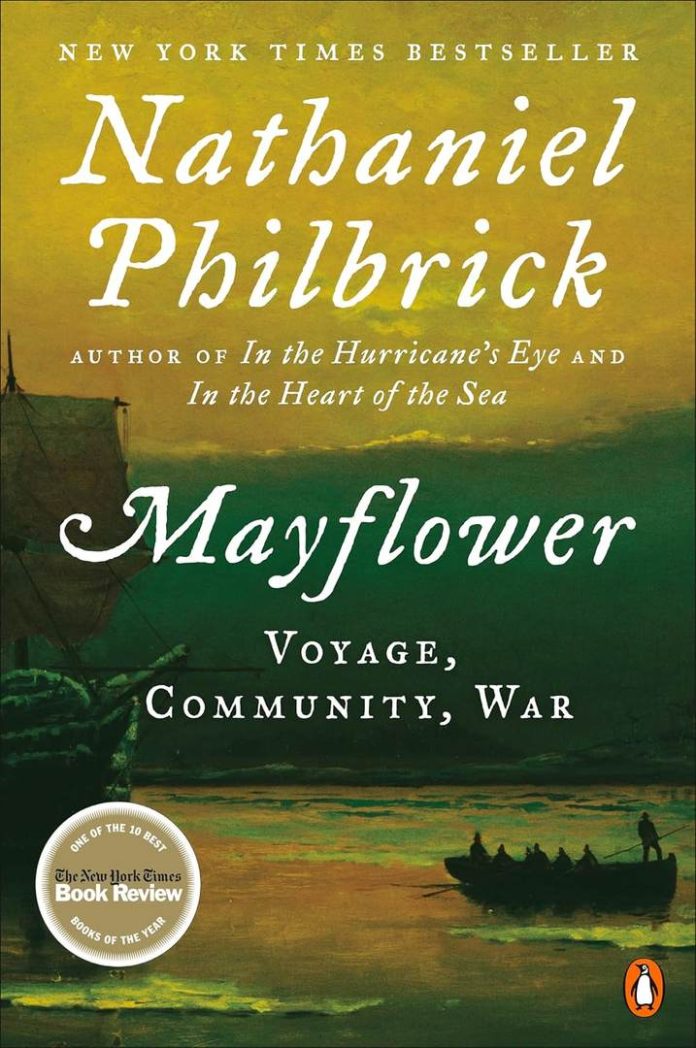





In 1676 a ship called the Seaflower left New England for the Caribbean. Its hold carried 180 Native men, women and children, condemned to slavery for their part in a war against Plymouth Colony, and the paperwork was signed by the colony’s governor, Josiah Winslow, whose parents had both crossed on the Mayflower. That is where Mayflower by Nathaniel Philbrick begins: not at Plymouth Rock but with a second voyage, fifty-six years after the first, that the holiday story leaves out. The book’s whole method is in that pairing. It wants you to hold both ships in your head at once.
How It Works
Philbrick splits fifty-six years into four movements, each named for what was happening between the English and their Native neighbours:
- Discovery (1620 to 1621): the crossing, the first winter, the treaty with Massasoit and the harvest gathering.
- Accommodation (1621 to 1623): a fragile alliance tested by rumour, hunger and a pre-emptive killing.
- Community (1623 to 1675): decades of trade, land sales and slow mutual dependence, ending in a murder trial.
- War (1675 to 1676): King Philip’s War, fought by the sons of the men who made the peace.
Two guides carry the reader through. The first is William Bradford, the pious governor whose own history of the colony is the main source for its early years. The second is Benjamin Church, a carpenter and grandson of a Mayflower passenger, who wrote a boastful memoir of how he fought, and then ended, the war. Bradford is steady and grieving; Church is vain, brave and oddly likeable. Handing the story from one to the other lets Mayflower by Nathaniel Philbrick show a generation change in real time.
The Story Nathaniel Philbrick Refuses to Cut Short
The structure is an argument. The 1621 harvest gathering arrives in chapter seven of sixteen, and Philbrick treats it with care: probably late September or early October, Massasoit arriving with about a hundred men and five deer, more Pokanokets than English present, everyone eating around outdoor fires. No long table, no pumpkin pie, no forks. The Pilgrims themselves never called it Thanksgiving. Then the book keeps going, because the point is what happened to that alliance over the next half-century and who let it fail.
Philbrick is careful with names. He mostly calls Massasoit’s people the Pokanokets, for their homeland at the head of Narragansett Bay, and suggests the wider Wampanoag confederation may have been something Massasoit built after the English arrived. Squanto appears not as a saintly helper but as an ambitious survivor playing his own game. Both corrections make the Native leaders more interesting, not less sympathetic. In the preface he names the two easy stories he wanted to avoid, the heroic Pilgrims and the purely villainous colonists, and Mayflower by Nathaniel Philbrick holds to that throughout. The war, he argues, was not inevitable. Two leaders allowed it.
What works
- The crossing. A young servant named John Howland is washed overboard in a gale and survives by clutching a trailing halyard ten feet underwater. The near-wreck at Pollack Rip off Cape Cod is told with a sailor’s eye for tide and wind.
- The first explorations. The landing parties dig up buried seed corn at what is still called Corn Hill, loot graves and empty houses, and are ambushed at dawn at First Encounter Beach. Philbrick never lets the reader forget that the colony began with theft.
- Myth-checking. In Mayflower by Nathaniel Philbrick, the legends get tested against the sources. Bradford never mentions stepping onto a rock. The Mayflower Compact gets its due as a practical answer to a near-mutiny, without being inflated into a founding constitution.
- Church at war. In the Pease Field fight, pinned behind a stone wall, Church walks back through gunfire to retrieve his hat and cutlass. The Great Swamp Fight of December 1675, ending in a burning fort, is the book’s hardest and best chapter.
Where It Gives Ground
- The crowded last third. Part IV introduces companies, captains and sachems faster than anyone can track them, with a lot of musket mechanics. Keep the maps bookmarked.
- The compressed middle. The decades between 1625 and 1660 run past as a list of debts, trials, missions and deaths, and the momentum of the first half stalls there.
- Leaning on Church. Much of the war’s final phase in Mayflower by Nathaniel Philbrick comes from Church’s own account, written to make him look good. Philbrick admits as much, but the book still enjoys his company more than it questions him.
Read These Next
If Mayflower by Nathaniel Philbrick leaves you wanting more history that sits uneasily with a national story, try these:
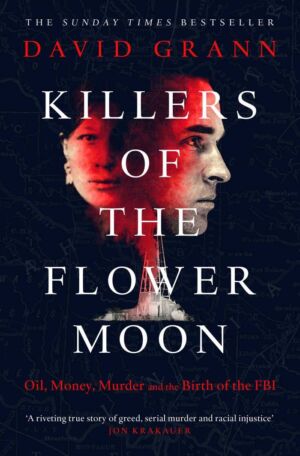
- Killers of the Flower Moon by David Grann, another narrative history of greed for Native land, three centuries later.
- This Land Is Their Land by David J. Silverman, which retells the 1621 encounter from the Wampanoag side and takes direct aim at the holiday myth.
- 1491 by Charles C. Mann, for the scale of the societies the epidemics swept away before the Mayflower arrived.
- Wandering Stars by Tommy Orange, a novel about what that long history leaves in one Native family.
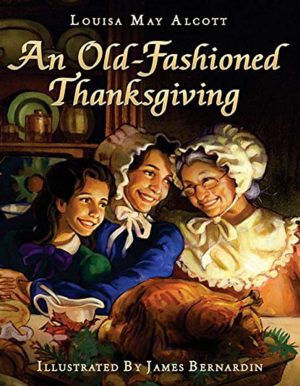
- An Old-Fashioned Thanksgiving by Louisa May Alcott, a short, sweet nineteenth-century look at the holiday the later myth produced.
About Nathaniel Philbrick
Nathaniel Philbrick was born in Boston in 1956 and grew up in Pittsburgh, the son of an English professor. He studied English at Brown and American literature at Duke, worked as a sailing magazine editor, and turned to maritime history in the 1990s. His narrative style in Mayflower by Nathaniel Philbrick and elsewhere, built on primary sources and an exact feel for weather and water, made him one of the best-selling American historians of his generation.
- His whaling history In the Heart of the Sea won the 2000 National Book Award for Nonfiction and was filmed by Ron Howard in 2015.
- Viking published this book in 2006. The New York Times named it one of the ten best books of that year.
- It was a finalist for the 2007 Pulitzer Prize for History.
- He also adapted it for younger readers the same year.
- Later books moved on to Little Bighorn, Bunker Hill, George Washington and, in 2026, the California gold rush.
Worth Your Shelf
Some readers will want the gentler version of this story at the dinner table, and that is fair. But the long weekend is a good time for the fuller one, and Mayflower by Nathaniel Philbrick tells it with real narrative pull. The war section is too crowded and its chief witness too pleased with himself. The rest is history writing at its most readable and most honest about how fragile the peace was. Read it, and the Seaflower will sit beside the Mayflower every November from now on.