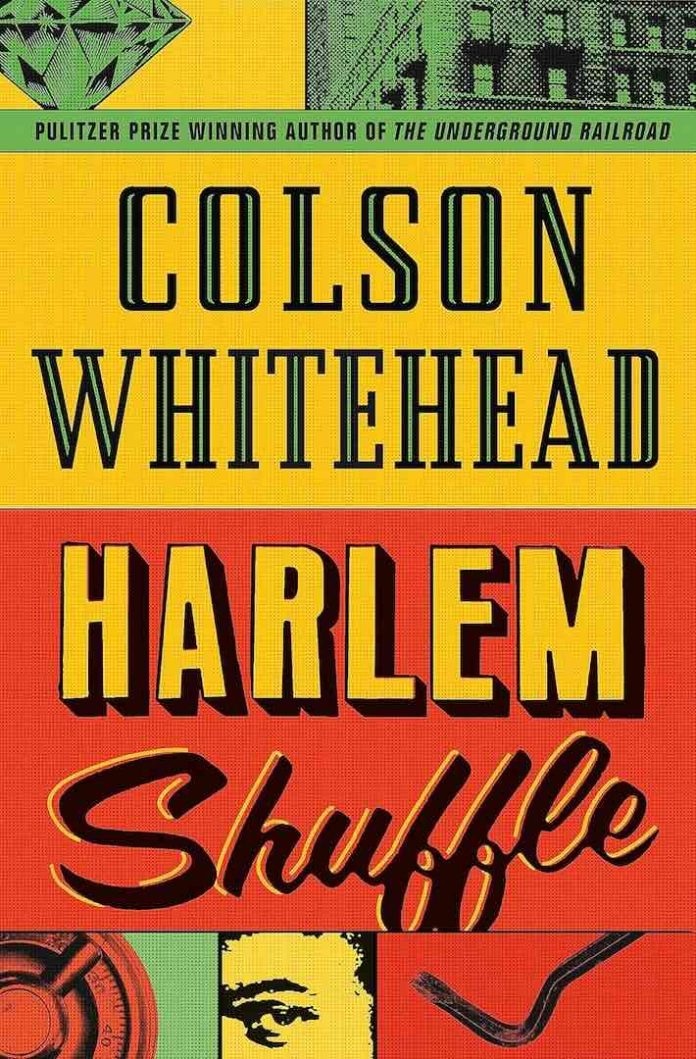
Ray Carney sells furniture on 125th Street. He has a business degree from Queens College, a signed photograph of Lena Horne on his office wall, and a wife whose parents refer to him as “that rug peddler.” He also moves the occasional stolen television, and a necklace now and then, and he has an elaborate private theory explaining why this does not make him a criminal. Harlem Shuffle by Colson Whitehead is the sound of that theory collapsing over five years, very slowly, while its owner insists nothing is happening.
The line the novel hangs itself on arrives early: Carney was only slightly bent when it came to being crooked. Whitehead spends three hundred pages testing exactly how much weight the word “slightly” can bear.
Three Robberies, Five Years, One Store
The book is built as three long novellas rather than a continuous plot, and the shape is the point.
In 1959, Carney’s cousin Freddie volunteers his name to a crew planning to rob the Hotel Theresa, “the Waldorf of Harlem,” on Juneteenth. In 1961, a banker takes five hundred dollars of Carney’s money in exchange for a place at an exclusive social club, then blackballs him anyway, and Carney spends a summer engineering an elaborate revenge. And in 1964, during the Harlem riot that followed the police killing of fifteen-year-old James Powell, Freddie turns up with a briefcase and a request.
Each section stands alone. Each is a different genre: an ensemble heist, a revenge caper, a hostage thriller. What connects them is a store, a family, and a man who keeps discovering he is deeper in than he was last time.
Where Harlem Shuffle by Colson Whitehead Sits in the Trilogy
This is the first of three, and it works completely as a standalone. Reading order:
- Harlem Shuffle (Book 1, 1959 to 1964)
- Crook Manifesto (Book 2, 1971 to 1976)
- Cool Machine (Book 3)
The later books move forward in time with the same characters. Nothing here requires them, and the ending closes its own circuit.
The Best Trick in the Book
The Hotel Theresa robbery is the finest sustained passage in Harlem Shuffle by Colson Whitehead, and the reason it works is technical rather than dramatic.
As the crew takes the lobby, the narration keeps stopping to hand a whole life to whoever happens to be standing there. The switchboard operator who has worked thirty years and whose lover visits on quiet nights, the two of them calling each other sisters. The young desk clerk who has spent his adult life getting people to call him Richard instead of Rickie, and for whom the robbery is a curse, because a porter calls him Rickie the next day and it sticks. A gigolo face-down on the carpet, calculating how soon he can get to bed. A crockery salesman from Venezuela who decides he is never visiting this city again.
None of them matter to the plot. All of them are the book. Whitehead is using a genre set piece to make an argument about who a neighbourhood actually consists of, and it lands without ever slowing the robbery down.
What Works
- The furniture is characterisation. Argent, Collins-Hathaway, Heywood-Wakefield, Moroccan Luxury. Carney’s eye prices every room he enters, including the ones where people are pointing guns at him, and it tells you more about him than any interior monologue could.
- The comedy is constant and extremely dry. Told a shipment of televisions fell off a truck, an old repairman replies, “A very short fall, then.” The book is funnier than its reputation suggests.
- Pepper. A career criminal in dungarees who built roads through Burma during the war and came back completed rather than changed. He is the novel’s best invention and steals every chapter he enters.
- The history is load-bearing, never decorative. Seneca Village, the free Black settlement razed to build Central Park, arrives as family pride and lands as prophecy. So does Radio Row, cleared for the World Trade Center.
Where It Stumbles
- The middle section sags. The 1961 revenge plot is the longest stretch of Harlem Shuffle by Colson Whitehead and the least urgent. Its machinery requires four separate favours to line up, and the reader is well ahead of it for most of the way.
- Elizabeth is underwritten. Carney’s wife runs a travel agency plotting safe routes through the Jim Crow South, which is the most interesting job in the novel, and she is mostly offstage.
- Carney’s self-deception gets repetitive. The “I may be broke, but I ain’t crooked” refrain is the point, but it is restated more often than it needs to be.
- The final act moves fast. After two leisurely sections, the third arrives at its resolution in a hurry, and one major death is dispatched in a paragraph.
Dorvay, and the Two Men in One Suit
Part two gives the novel its best idea. Carney recalls a professor explaining that before electric light people slept in two shifts, waking around midnight for a few hours of private business. The French called it dorveille. Carney, loyal to his own mistakes, calls it dorvay.
He starts waking at one in the morning to plot his revenge, and the split becomes the book’s whole thesis: the daylight salesman and the midnight schemer, kept in separate rooms. What Harlem Shuffle by Colson Whitehead eventually forces him to admit is that the partition was always imaginary. It was all him, and always had been.
Who Harlem Shuffle by Colson Whitehead Is For
Reach for it if you want crime fiction that takes its social history seriously, if you like novels where a city is a character rather than a backdrop, or if you have enjoyed Whitehead’s heavier books and want to see him having fun.
Skip it if you need a tight plot engine. This is a hangout novel with robberies in it, and the digressions are the reason to be here. Readers who came to Whitehead through his two Pulitzer winners should also know the register is entirely different: warmer, wryer, far less punishing.
Read These Next
- Harlem Rhapsody by Victoria Christopher Murray. The same few blocks a generation earlier, with the Renaissance being assembled in real time.
- Zeal by Morgan Jerkins. Black American history carried across decades through one family line.
- The Wilderness by Angela Flournoy. Contemporary, but the same attention to how people talk each other into things.
- The Underground Railroad by Colson Whitehead. His most famous novel, and useful as a contrast in temperature.
- Devil in a Blue Dress by Walter Mosley. The obvious ancestor: Black crime fiction where the detective work is really social navigation.
Mazywood by Tananarive Due works the same territory from the horror side, with 1939 chapters built around Hattie McDaniel.
The Last Word on Harlem Shuffle by Colson Whitehead
It is a novel about a man who believes he can keep two selves in separate rooms, written by an author having an obviously good time in a genre he had not tried before. The plotting is uneven and the middle third could lose sixty pages without anyone noticing.
What survives all of that is the furniture, the jokes, and the argument underneath: that respectability is a product like any other, sold to people who cannot quite afford it, on terms that were never going to be honoured. Carney would recognise the pitch. He makes it every day.







