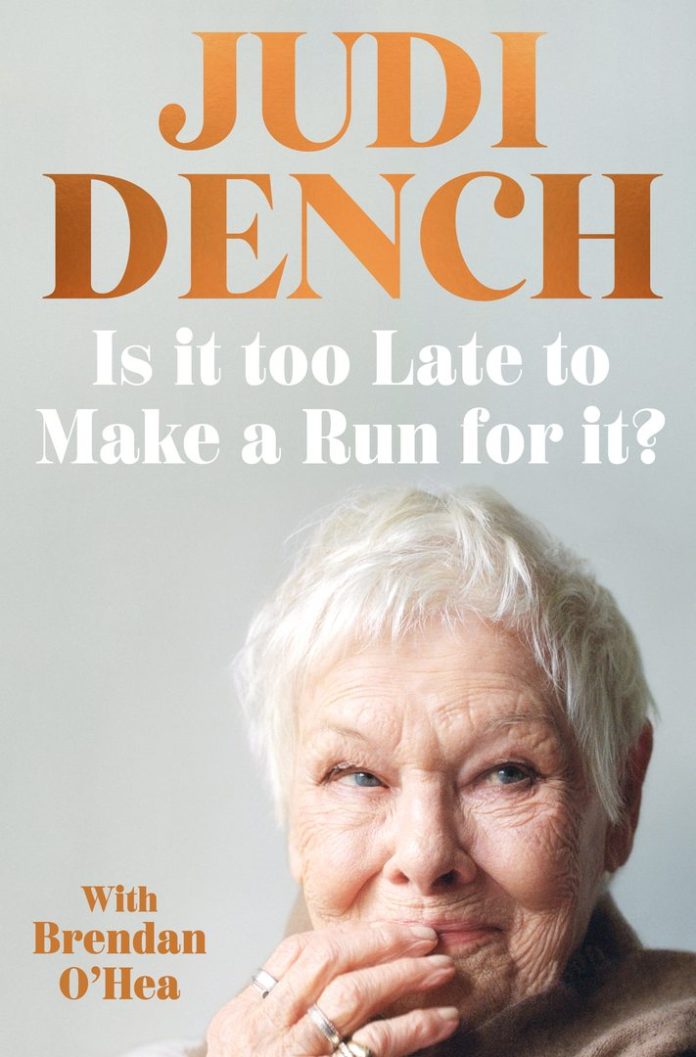



Every rehearsal room Judi Dench has walked into, she tells us near the end of this book, she has left her bag by the door. Not under a chair, not in a dressing room. By the door, in case she needs to bolt. Seventy-odd years after her first professional job, she says the fear has not faded with experience. It has grown. That is the joke in the title, and the confession inside it, and Is It Too Late to Make a Run for It? by Judi Dench keeps returning to the same unlikely pairing: a woman who has won almost everything an actor can win and who still suspects, every first night, that she is about to be found out.
First published in the UK by Michael Joseph on 22 October 2026, with the St. Martin’s Press edition following in the US on 3 November, it is out now.
Is It Too Late to Make a Run for It? Plot Summary
There is no plot, but there is a shape. Is It Too Late to Make a Run for It? by Judi Dench is a long conversation between Dench and Brendan O’Hea, a theatre director, her friend of some thirty years and her credited co-author. He asks, she answers, and he is allowed to argue back. The 26 chapters are themed rather than chronological: York, her parents, animals, musicals, gardens, her husband Michael Williams, faith, directors, playing real people, Bond, costume, comedy, ageing and, last, how she started out. A doctor’s daughter in wartime York, the Old Vic, the RSC, Cabaret, M and the Oscar all turn up, in the order the subject demands rather than the order they happened.
The Garden of Absent Friends
The thread that gives the book its weight is loss, and loss lives in her Surrey garden. For decades she and Williams planted trees for dead friends, and the gardens chapter becomes a slow walk among them. The singer Stephen Hanley, tall and pale, became a silver birch that finches now nest in. Chita Rivera, who wore loud lipstick, is a pussy willow whose catkins come out cerise. Williams himself has two: a crack willow he used to lean against in the evenings with a glass of red, and an oak from his last stage job. Dench writes that touching the bark feels like touching what was alive in the person, and the idea never curdles into whimsy.
That chapter sets up the one that follows, and the chapter on her husband, whom she always calls Mikey, is the best thing in Is It Too Late to Make a Run for It? by Judi Dench. She refused his first proposal, on an Australian beach, because it was too perfect to trust. After the sitcom A Fine Romance, he sent her a red rose every Friday for a year, then kept going for the rest of his life. Then, in 1999, while she was on Broadway in Amy’s View, a phone call: lung cancer, inoperable. A last driving trip to Scotland he insisted on making alone. A papal knighthood the day before he died, relayed to the overflow of friends downstairs through a baby monitor. A red coat at the funeral, because he loved her in red. She does not dwell, and the restraint is what hurts.
The Tearaway Who Never Grew Up
Against the grief runs a second thread: Dench is a menace, and proud of it. As a girl she and her brother fired dried peas through a brass curtain rod at the patients queuing for her father’s surgery. At her Quaker boarding school she tied the belts of the girls in front to the backs of their chairs during Meeting, so they could not stand for the hymn. Decades later, bored in a play she disliked, she and her fellow cast spread ever wilder rumours about Ian McKellen and Patrick Stewart, who shared a dressing room nearby, and timed how fast each came back.
The mischief is also her method. Some of the most useful pages in Is It Too Late to Make a Run for It? by Judi Dench are about craft, and they tend to arrive disguised as anecdotes. Struggling with a top note in Cabaret in 1968, she was told by the director Hal Prince that Sally Bowles is not meant to be able to sing, so she should act failing to reach it, and the fear went. Clint Eastwood, she reports, got a scene in J. Edgar in a single take while she and Leonardo DiCaprio thought they were still waiting to start.
Where Is It Too Late to Make a Run for It? Gives Ground
- The themed shape repeats itself. Because chapters are organised by subject, stories leak between them. Her running joke about tall men turns up again and again, and a Hollywood producer’s early verdict that her face was wrong for film is told twice.
- Some chapters are lists. Bugbears is a run of grumbles about phones, satnav, lateness and grammar, and the food chapter drifts into favourite restaurants and comfort food. Pleasant, slight.
- The name-dropping can turn into a roll call. Famous dressing-room visitors get a line each in Is It Too Late to Make a Run for It? by Judi Dench, and a list of names is not a story.
- The depth is uneven. Her husband’s death gets a few restrained pages while her running argument with a voice assistant gets nearly as much room. Admirers will call that tact. Others will want more.
About Judi Dench
Born in York in December 1934, Dench trained at the Central School of Speech and Drama and made her debut as Ophelia at the Old Vic, a part she lost after bad reviews, as Is It Too Late to Make a Run for It? by Judi Dench recalls without self-pity. Film found her in her sixties, after decades of classical theatre. Her earlier books include the memoir And Furthermore (2010) and a book on Shakespeare’s roles made with O’Hea.
- She won the Academy Award for playing Elizabeth I in Shakespeare in Love, a part of roughly eight minutes on screen.
- She played M in eight Bond films, from GoldenEye in 1995 to Skyfall, the first woman in the role; our review of Ian Fleming’s Casino Royale goes back to where M began.
- Her eight Olivier Awards are a record, as O’Hea reminds her in the chapter on honours.
Read These Next
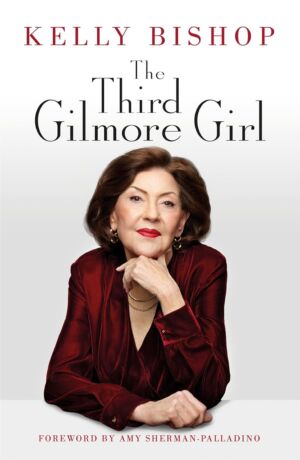
- The Third Gilmore Girl by Kelly Bishop, another stage-trained actress looking back from her eighties, with more career and less mischief.
- Sonny Boy by Al Pacino, for an actor who still thinks of the theatre as home, told with similar self-doubt.
- Shakespeare: The Man Who Pays the Rent by Judi Dench and Brendan O’Hea, the earlier conversation book, play by play, for readers who want more of her on the verse.
- Making It So by Patrick Stewart, the other half of that dressing-room rumour, on a long classical career and a late turn to screen fame.
What Stays With You
It would be easy to read Is It Too Late to Make a Run for It? by Judi Dench for the stories, and they are very good stories. What lingers is a woman past ninety who cannot see the bluebells any more, knows the colour from memory, and walks her garden saying hello to the people she has lost. The jokes keep her upright. The trees keep her company.
The bag is still by the door. She has never once picked it up.
Content notes tap to reveal
Where to read Is It Too Late to Make a Run for It?
Amazon lists the current Kindle, print and audiobook editions, and shows whether the ebook is in Kindle Unlimited right now.
To borrow it free, try your library: Libby and OverDrive lend ebooks and audiobooks with a library card, and WorldCat finds print copies near you.
We don’t link to “free PDF” sites. Those copies are pirated and pay the author nothing.