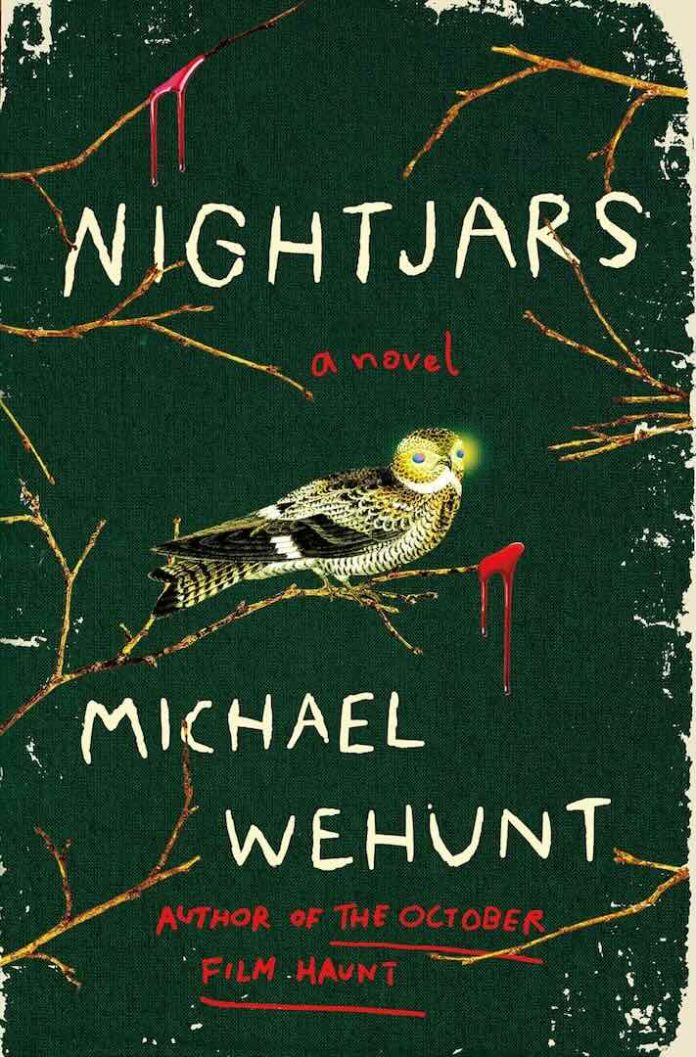
A woman walks into a secondhand bookshop in Decatur, browses, and leaves a Polaroid face up on the counter. The photograph is from 1993. The boy in it is the shop’s owner, aged eleven, standing in the dark beside a pickup truck he has no memory of. On the white strip beneath the image, in handwriting he does not know, is a riddle about whether a certain bird remembers a certain night. Nightjars by Michael Wehunt opens on that object and spends four hundred pages making it unbearable.
How Nightjars by Michael Wehunt Is Assembled
The architecture is the first thing to talk about, because the novel is organised more deliberately than most horror this long.
There are four named parts. The first two belong to Luke Oshel, thirty-nine, bookseller and recovering alcoholic, in first person past tense. The third hands the book to his ex-wife Kristen Meyer, a poet with one collection and bad lungs, in third person and present tense. The fourth alternates between them chapter by chapter.
That switch is the single best structural decision in Nightjars by Michael Wehunt. Luke’s narration is interior and compromised by his own blackouts, so the reader spends two hundred pages unable to verify anything. Kristen arrives with a working memory and a willingness to knock on doors. The book changes more than its narrator. It changes the reliability of the whole enterprise, at the exact page where a reader would otherwise get restless.
Parts One and Two also come with a frame. Luke is typing them as a record for his daughter, in case this ends the way he thinks it will, and Kristen eventually finds the file. The frame earns its keep while it lasts.
The Photographs
The engine of the first half is a sequence of pictures, each delivered like a bill. They arrive by hand, by post, tucked into stock. Some are decades old, some were taken last week. Each carries a riddle about nightjars in the same handwriting, and each shows Luke somewhere he cannot have been. Meanwhile he is waking with gaps in his week, and women in the metro area are turning up dead with no blood left in them.
Nightjars by Michael Wehunt understands the useful thing about photographic horror, which is that a photograph is evidence. The reader is not asked whether a ghost is real, but what a jury would make of a man with a camera-shaped alibi and nothing else. Two DeKalb County detectives turn up with the same question, and one of them has no patience for the answer.
Underneath sits a childhood Luke has paid a therapist for years to help him reach: a father who drove trucks, drank, hit his son while they watched old films, and took the boy into the Georgia mountains to a cabin he had named.
What Michael Wehunt Does with the Vampire
The mythology is where a novel like this usually goes soft. Here it is the strongest material in Nightjars by Michael Wehunt.
Wehunt rebuilds from the ground up. There is a mountain with something running through it, a thing that drank from it a very long time ago, and a supply problem, because what it drank is running out. Everything else follows from that shortage: why more of these creatures exist, why they are all sick, why one family in north Georgia matters, why the killing started again after twenty-five years.
One rule does most of the work. These things can wear the face of anyone whose blood is still fresh in them. That generates the photographs, the frame-up, the body horror and the worst image in the novel, at no cost in exposition. The invitation rule turns out to be true, stated plainly by the creature itself, and the sunlight rule holds. Silver is a slow poison rather than a weapon. A crucifix is a nuisance. An ultraviolet torch is a toy.
The folklore arrives in a second voice. Pages keep falling out of a self-published 1970s volume on Appalachian disappearances, running heads and page numbers intact, written by a schoolteacher looking for his missing son. It is the best kind of found document, because the man writing it is a crank who happens to be right, and it failed him anyway. The nightjar itself is a real bird, nocturnal and cryptically feathered.
Where Nightjars by Michael Wehunt Gives Ground
Four things, and the first is the real one.
- The hypnosis. Almost all of the backstory is delivered through recovered-memory sessions with a therapist. It is a tidy pipeline, used again and again, that hands over information exactly when the plot needs it. The technique is also clinically contested in ways the novel never raises, and a book this careful about its other rules should have said something about that one.
- The villain explains itself. The climax stops so the creature can narrate its own several-hundred-year history at length, with a four-year-old a few feet away. The information is good. The placement is the worst available.
- The middle repeats. Blackout, blood, photograph, decision not to call anyone. That loop runs four times, and the last two turns buy less than the first two.
- The frame is dropped. The manuscript conceit is set up with real care and then quietly abandoned once the book starts narrating in real time. It is the one promise Nightjars by Michael Wehunt makes and does not keep.
Read It If, Skip It If
Nightjars by Michael Wehunt is a horror novel with a domestic drama load-bearing inside it.
Read it if:
- You want vampires taken seriously as a supply-and-demand problem rather than as a romance.
- You liked the structural nerve of The October Film Haunt and want the second novel to try something harder.
- You can take a book whose real subject is what one man did to his son, dressed as a monster hunt.
Skip it if:
- Threats to a pregnant woman and a small child are not something you read for pleasure.
- You want a fast horror novel. The middle third is deliberate and feels it.
- You need an ending that restores everybody. This one negotiates.
Content Notes
Child abuse at the centre of the book: a father beating his son, and coercing him at eleven and again at twelve into drinking from a woman he has killed. Serial murder of women. A recovered memory carrying a necrophilic implication. An elderly man assaulting a pregnant woman by the throat. Sustained danger to an unborn child, including fingernails on a pregnant abdomen. A child abducted. Decapitation, a torn-away jaw and an eye injury, all on the page. Addiction, relapse, a marriage lost to it. Asthma attacks from the inside. Sudden bereavement. Gun violence. Wasps in quantity. Live burial and total darkness.
Read These Next
Five of ours for readers who finish Nightjars by Michael Wehunt.
- The October Film Haunt by Michael Wehunt is the first novel, and the found-footage version of the same obsessions.
- The Southern Book Club’s Guide to Slaying Vampires by Grady Hendrix for another Southern suburb with a blood problem and a woman nobody believes.
- Sometimes I Scare Myself by Jeneva Rose if you prefer your dread in shorter doses.
- How to Survive a Horror Story by Mallory Arnold for a novel that plays with the machinery rather than rebuilding it.
- Bone-Chilling Classic Horror Books to Keep You Up at Night for the lineage it argues with.
The Verdict
The title is the tell. A nightjar is a bird, and it is also a word a violent man taught a small boy to say about the two of them, a catechism with a question and an answer, repeated in a dark room with the television on. Everything frightening here comes out of that arrangement rather than out of the cave. The monster wants a supply. The father wanted a son who would agree with him.
What holds it up is Kristen, who should by rights be the wife in the trunk of this plot and is instead its most competent person. Her asthma is characterisation rather than jeopardy, a poet’s discipline about breathing. She bluffs a confession out of an old man using a children’s video cassette. Every man in the book tells her to go home, including the one she is marrying, and she declines. Nightjars by Michael Wehunt is smart about its monster and very good on its architecture, but Kristen Meyer is the reason the last hundred pages land, and the reason the final chapter hurts more than anything in the dark.