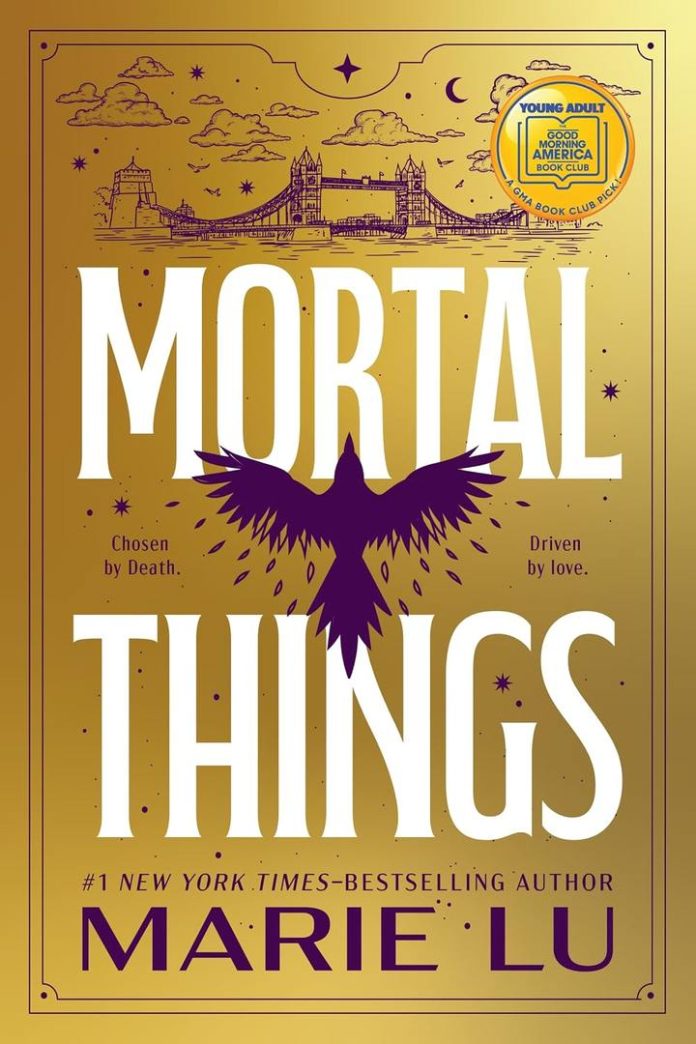



The man at Paddington Station knows he is going to die before Rose Lin Fairchild reaches him. He bolts through the ticket barrier and onto a departing train, and when she catches him, time stops for everyone except her. That is the job. A year ago Rose made a bargain with Raven, the god of Death: her service in exchange for her best friend’s life. Now she claims souls on his orders, and her touch drains a body the way a heart attack would. Mortal Things by Marie Lu opens on that first claim and spends its first chapter laying out the machinery underneath it, which is exactly where its strengths and its problems begin.
How It Works
Every god in Lu’s world once lived a mortal life, and every god needs mortal things to survive. War feeds on blood, Water on rain, Death on souls and the possessions of the fallen. To gather that energy, gods recruit Harbingers: people offered a second chance at the moment of death, provided they give up their free will and accept that everyone who knew them will forget they ever existed.
Each Harbinger carries a drop of their god’s power and an Artifact, an enchanted object (Rose has a ring with a living sapphire eye that glares at her when she dawdles). Each god also names a Regent, who leads their Harbingers and inherits the throne if the god dies. When Raven’s Regent turns up dead, his soul missing, Raven nominates Rose. The god of Lies objects, and the rules say she must now pass two of three tests set by his Regent, Étienne Beauchard, a French illusionist with green eyes and a different origin story every time she asks. If she fails, she becomes the property of the god of Lies. If she loses her tie to Raven, her friend dies.
Meanwhile Wraiths, the splintered soul fragments Rose has always pitied as harmless, have started hunting in packs. That is the whole board: three tests, one rival, a dead Regent, and monsters that should not be able to touch anyone. Mortal Things by Marie Lu explains all of this briskly in its opening chapters, which is a relief in a genre that often buries its rules in glossaries.
Where Mortal Things Plays Fair, and Where It Cheats
The clever part of Mortal Things by Marie Lu is that the tests are puzzles with rules the reader already knows. Étienne’s power is illusion, and illusion only holds while the brain accepts it, so Rose wins by finding the glitch: a seam in a wall, a briefcase that passes through a chain. The first test, inside the Met, turns a sculpture hall into a loop and then floods it with freezing water, and the way out is to stop believing in the water. The second, in the rain near Leicester Square, hinges on a car crash and on Rose working out which side of it she is supposed to be on. Both read like heists in which the stolen object is her certainty.
The world of Mortal Things by Marie Lu holds up too. Gods live in places mortals walk straight past: a boarded-up Fulham pub hung with wisteria in December, a Holland Park estate built around a white tree made from every soul that has ever lived, a Richmond food court that is secretly the home of Lies. Lu has always written cities well, and her London is festive, freezing and full of doors.
What works
- The rivalry romance. Rose and Étienne spar like people who enjoy it, and his lies are funny until they are not. The slow turn from contempt to something warmer is earned scene by scene.
- A narrator with a lens. Rose translates fear into physiology, which gives her a voice of her own and makes the god of Death’s choice of a would-be doctor feel deliberately cruel.
- Horror that bites. The Wraiths are genuinely unsettling, all wrong proportions and too many teeth, and one sequence in a nightclub alley is the scariest stretch in the book.
- Stakes that hurt. The forgetting clause turns every Harbinger into someone grieving the living, and the novel never lets you forget it.
Where It Gives Ground
- The answers arrive in a pile. For two thirds of the book the mystery advances through action. Then several major revelations land within a handful of chapters, most of them as characters explaining the past to Rose. It is a lot of plot delivered sitting down.
- The final power is too convenient. A force introduced early as cosmic background becomes the key to the climax, and the mechanism comes down to belief. After all that careful rule-setting, it feels like the book changing the rules of its own game.
- The fact habit becomes a tic. Poliosis, hypothermia thresholds and cortisol are charming the first dozen times. By the climax, Rose reaches for a textbook at nearly every moment of crisis.
- It does not end so much as pause. The romance gets a happy-for-now, but the larger conflict is left wide open. Readers expecting a contained story will be frustrated.
None of these sink the book, but together they explain why Mortal Things by Marie Lu feels stronger in its first half than in its last fifty pages.
Read These Next
If the hidden city and the sparring were what kept you turning the pages of Mortal Things by Marie Lu, these are the natural next stops.
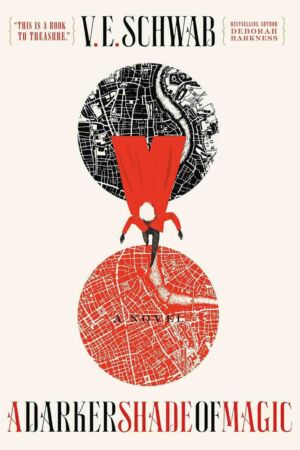
- A Darker Shade of Magic by Victoria E. Schwab for a magical London layered over the real one and a charming thief who lies easily.
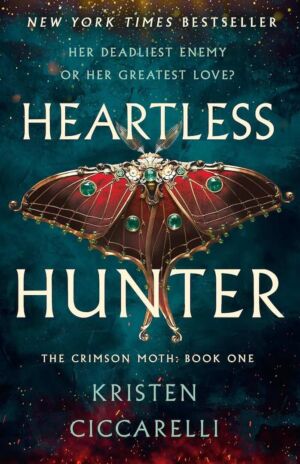
- Heartless Hunter by Kristen Ciccarelli for rivals with secrets falling for each other while both are working an angle.
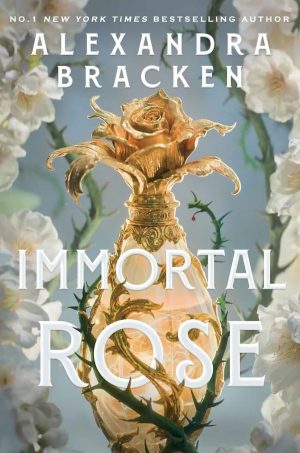
- Immortal Rose by Alexandra Bracken for a heroine tangled up with gods who once lived mortal lives.
- Warcross by Marie Lu, still the best entry point to her YA backlist if this is your first of her books.
About Marie Lu
Born in Wuxi, China, in 1984, Marie Lu worked as an artist at Disney Interactive Studios before she published a word of fiction, and the cinematic set pieces here suggest she still thinks in scenes. Mortal Things by Marie Lu is her return to young adult fiction after a turn toward adult readers.
- Her debut, Legend (2011), began the dystopian series that made her name.
- She has since written the Warcross duology, set inside a virtual reality game, and Batman: Nightwalker for DC.
- Her first adult fantasy, Red City by Marie Lu, came out in October 2025, and its sequel, Silver Dawn, is due in 2027.
- This book is out now from Farrar, Straus and Giroux Books for Young Readers, released on 27 October 2026.
The Last Word
The figure of a guide who walks the dead out of the world, the psychopomp of a hundred mythologies, is old enough to feel worn. What Lu adds is a guide who hates the work and argues with her boss about it. Mortal Things by Marie Lu is at its best in its tests, its hidden London and its sparring pair, and at its weakest when it stops to explain itself. It is a strong opening move that has not yet finished its game.
Take the tests at face value, look for the seam in every wall, and do not trust anyone who offers you a bracelet that detects lies.
Content notes tap to reveal
Where to read Mortal Things
Amazon lists the current Kindle, print and audiobook editions, and shows whether the ebook is in Kindle Unlimited right now.
To borrow it free, try your library: Libby and OverDrive lend ebooks and audiobooks with a library card, and WorldCat finds print copies near you.
We don’t link to “free PDF” sites. Those copies are pirated and pay the author nothing.