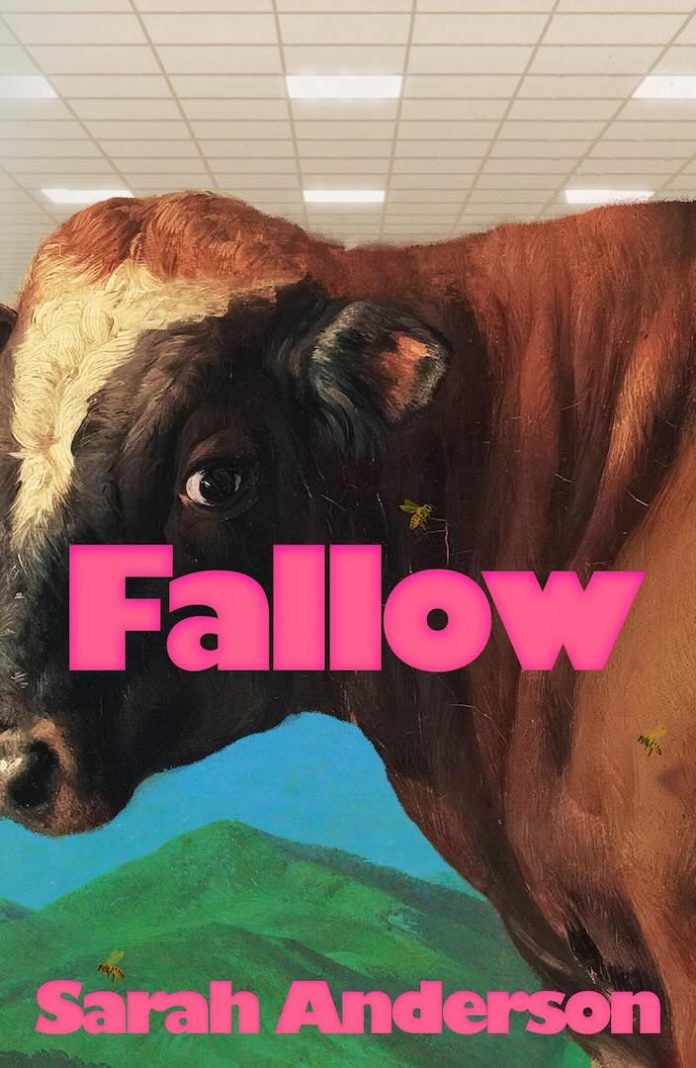
It starts with a dental bill. Eight hundred dollars, possibly eleven hundred, for four wisdom teeth that a dentist with a taxidermied tapir on his shelf says will burst through her gums within six weeks and wreck her jaw. She is twenty-three. She answers a whistleblower hotline for a living, documenting harassment at Cold Stones and injuries at bottling plants, and she has never in her life held a job that covered teeth. Fallow by Sarah Anderson is about what she does next, and the answer runs to a ten-year contract, seven pregnancies and one of the more genuinely strange American novels of the year.
What Sarah Anderson Is Actually Tracking
The surrogacy is the premise. The subject is work.
Natalie Gallagher does not hate her job. She hates jobs, all of them, as a category, and she has known this since she was eleven and watched her sisters develop scooping muscles at an ice cream counter. She rations how often she looks at the clock. And she has worked out that even the good parts of employment feel like buying back her own time at a markup, and she says so early enough that the reader cannot pretend the book is about anything else.
There is one exception, and it is the key to her. At sixteen she looked after the chameleons in a reptile shop, an animal that arranges your whole life around it and does not want to see you. She loved it. She was good at it. The job, as she puts it, of keeping something alive. She was fired for the resource burden of the two dozen hatchlings she produced.
So when the contract arrives she runs the sum out loud. One decade of a body, against the rest of a life with no alarm clock in it. You can buy a new body. You cannot buy more time. It is a clean piece of reasoning and the entire novel is the slow demonstration of what it leaves out, which is roughly everything the theory of alienation says it would.
The Company, and the Comedy That Carries It
The satire is broad, and it works anyway.
Project Genesis exists because the Company recently achieved a majority-female C-suite and then discovered that senior women occasionally want children. Maternity leave is presented in a slide deck as Financial Loss, Emotional Toll and Community Erosion. The proposed fix is one full-time gestational carrier for the executive floor, pitched as an equity initiative and defended with references to bees, and to a passage in Genesis that the pitch does not examine too closely.
Around this, Fallow by Sarah Anderson builds a cast of small monsters. There is Shane, a vice president who conducts strategy sessions from an exercise bike and speaks entirely in acronyms. There is Dr. X, author of a bestselling natural-birth manual and owner of a large collection of painted folk-art birds, who has strong views on raw milk and a superstitious insistence on a medical clown after every embryo transfer. And there is the electrode speaker strapped to the belly for the contractually required hour of foreign-language tapes per day, from week ten, fifteen weeks before the fetus can hear anything at all. There is a clause listing the emotions the carrier must avoid, grief and rage and shame among them, as though those were within anybody’s gift.
The contract is reproduced on the page in full legal deadpan, and it is the best joke in the book because none of it is a joke.
Where Fallow by Sarah Anderson Changes Shape
About halfway through, the novel walks away from its own premise.
A client is terminated. The story goes to the press. The machinery Natalie has spent seven years trusting turns out to be considerably less interested in her than she assumed, and Fallow by Sarah Anderson relocates to somewhere none of the first two hundred pages would have predicted. Nothing about that turn will be spoiled here. It is enough to say that the second half is looser, warmer and much stranger than the first, that the change of altitude is the best decision Anderson makes, and that readers who came for corporate satire should be warned they are getting something else after the interval.
What Sarah Anderson Gets Right
- The voice. Natalie is vain, incurious, funny and almost entirely without survival instinct, and she narrates her own worst behaviour with a flatness that keeps being hilarious about two seconds before it turns awful.
- The women around her. A French roommate who undresses in one movement and treats gossip as a sacrament, and a client whose relentless, radish-earringed cheerfulness turns out to be armour. Both are drawn far better than the plot strictly requires.
- The refusal to redeem anybody quickly. Fallow by Sarah Anderson lets its narrator be cruel, lets her know she is being cruel, and does not hand her a lesson for it.
- The animals. Chameleons, an ancient cat kept alive on sashimi and stubbornness, chickens with terrible pun names, a dairy cow who will not look at her paddock-mate. Anderson is unusually good at how creatures reorganise a person.
Four Places Fallow Gives Ground
- The first act runs long. Seven years pass in a rush and then the novel settles in for a slow stretch of appointments and errands before the plot arrives.
- Some targets are too easy. Corporate jargon has been shot at by a lot of novels and there is only so much left in a values acronym.
- The antagonist is a cartoon. Shane is very funny and never once frightening, which leaves the book’s real threat, the institution behind him, having to be frightening in the abstract.
- Passivity is the theme and also a drag. A narrator who will not act is the point, and there are stretches where being trapped with her is more tiring than interesting.
Content Notes and Heat Level
Fallow by Sarah Anderson is a harder book than its comic surface suggests. On the page or closely recounted: a coerced medication abortion, an earlier teenage abortion, pregnancy loss and infertility, a traumatic forceps delivery and a resulting injury to a newborn, heavy drinking and drug use with a blackout, an obscene caller described in some detail, workplace coercion and surveillance, captivity, gun violence, cosmetic surgery and disordered attitudes to the body, and the death of a pet. Sex happens and is not dwelt on. The heat level is low.
Read These Next
Five for readers who finish Fallow by Sarah Anderson and want to stay in this weather:
- The Compound by Aisling Rawle. The same argument about comfort, consent and what people will agree to for a nicer bathroom.
- Friends of the Museum by Heather McGowan. For the institutional comedy and the same ear for people talking past each other.
- The Summer I Ate the Rich by Maika Moulite and Maritza Moulite. Capitalism satire with teeth, and a narrator who enjoys herself.
- Fable for the End of the World by Ava Reid. If the part that held you was a corporation owning a person outright.
- I’m Sorry for My Loss by Rebecca Little and Colleen Long. The nonfiction companion, on what American reproductive care actually does to people.
The Last Word
The thing I keep coming back to is the flyer.
It turns up at a blood bank, handed over by a nurse with a felt strawberry in her hair, and it is printed on paper so expensive that Natalie notices the paper before she notices the words. Across the top: generous salary with benefits. Further down, under Requirements, three items. Healthy lifestyle. Birthing hips. Discretion.
That is the novel in one piece of card stock. Fallow by Sarah Anderson is about what a person will sign when the alternative is a sink with no handle, a roommate who melts Tupperware onto the hob, and a mouth full of teeth she cannot afford to have removed. Anderson never lets the arrangement be simply monstrous, which is the hardest thing she does. Natalie is well fed, well housed and well paid, and the horror is that the deal is, on its own terms, a good one. Read it for the jokes. Stay for the bill.







