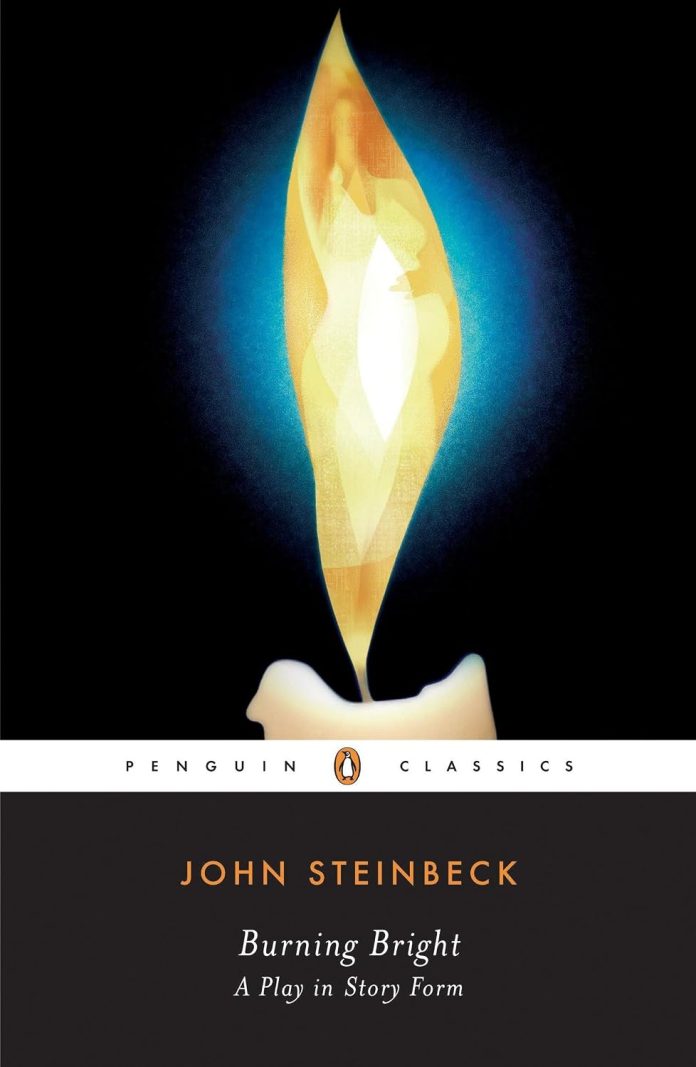
Burning Bright by John Steinbeck opens on an acrobat of nearly fifty in a dressing tent, dyeing the grey at his temples and flexing his hands without knowing he is doing it. His friend, a clown in half make-up, watches the hands and asks what is wrong. Three years into a second marriage, there is no child.
That is the whole plot, and it is a good one. Then Act Two opens on a farm, and the acrobat is a farmer, and the clown owns the next holding, and nobody mentions the circus.
How Burning Bright Is Built
Burning Bright by John Steinbeck runs to four characters and three acts. Joe Saul is the man who cannot have a child. Mordeen, his young wife. Victor, the brutal young assistant. And Friend Ed, who is the conscience of the thing.
In the first act they are circus people. In the second they are farmers. And in the third Joe Saul is a ship’s captain, Victor his mate, Friend Ed a seaman shipping out on another vessel. The final short scene is a hospital room and refers to none of the settings, so it serves as an ending for all three.
No explanation is offered. The relationships, the dialogue and the crisis carry straight across, and only the trades change. Steinbeck’s early working title for the piece was Everyman, which tells you exactly what the device is for.
What works
- The central situation of Burning Bright by John Steinbeck is genuinely strong. A man whose entire identity is a trade handed down through generations discovers that the line stops with him, and what he grieves for is not a baby but an inheritance.
- Mordeen is better than the scheme deserves. Her answer to Victor, when he insists that all sex is the same and she must secretly want a young man, is that the missing ingredient is affection and that most people never learn it.
- The form does what the Foreword claims. Steinbeck argues that the printed play is read almost entirely by theatre people, and that a play written as fiction will reach readers who would never open a script. He is right, and the descriptive passages give an actor more to work from than “businessman, aged forty”.
- One speech is worth the book. Old Joe Saul, the grandfather, telling the children on the training mat that of all the families on earth only two are genuinely ancient and certain of their descent, and that they are clowns and acrobats, and everyone else is a newcomer.
Where Burning Bright Gives Ground
- The invented language of Burning Bright by John Steinbeck is close to unreadable. Characters say wife-loss and friend-right, they lesson each other on the mat, they say see you remember that. The dialect exists so that no line will be tied to a region, and the cost is that nobody sounds like a person.
- The allegory is announced rather than built. In Act One Joe Saul states aloud that this trouble could fall on anyone at all, naming a farmer, a sailor, a person with no face. The shifting settings then go on to demonstrate a sentence he has already spoken.
- The ending is a monologue. His conversion from private bloodline to the whole species arrives as a four-hundred-word speech delivered over a hospital bed to a half-conscious woman, and it explains itself twice.
- Victor has no interior. He is written as an instrument, a man who mis-sees and mis-hears by nature, and against Burning Bright by John Steinbeck‘s three thinking characters he is a plot requirement with shoulders.
What the Broadway Run Says
The stage version of Burning Bright by John Steinbeck opened in 1950 and closed after thirteen performances. The producers were Rodgers and Hammerstein, the director was Guthrie McClintic, Kent Smith played Joe Saul and Barbara Bel Geddes played Mordeen. One of the co-producers later said he had known it was doomed after the first night.
The title tells its own story. Steinbeck wanted to call it In the Forests of the Night, from Blake’s The Tyger. The producers thought that too long and too literary, so he took a shorter phrase from the same four lines instead.
Afterwards he was oddly cheerful, saying he was determined to learn something about the theatre, that they had been kicked around like dogs, and that his continued interest showed a pure quality of stupidity. He never wrote for the stage again.
Read it if
- You want Burning Bright by John Steinbeck as the most formally ambitious thing he attempted, and do not mind that it fails.
- You read plays and are interested in a serious argument for publishing them as fiction.
- You will read a hundred-page book that is wrong in an interesting way.
Skip it if
- Invented dialect will defeat you, and here it very well might.
- You need a moral to be dramatised rather than delivered.
- You came to Burning Bright by John Steinbeck for the Salinas Valley, because there is no place in this book at all, by design.
Where Burning Bright Sits in the Backlist
Burning Bright by John Steinbeck is the low point of the mature work, and a more interesting low point than the other one.
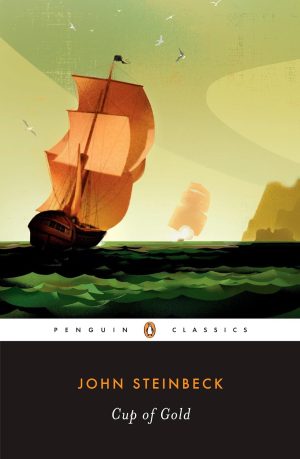
Cup of Gold fails because a man of twenty-seven was imitating writers he admired. Burning Bright by John Steinbeck fails because a man of forty-eight at the height of his reputation decided to strip every particular from a story and see whether the bones would still stand up. They do not, but the attempt is not embarrassing in the way the pirate novel is.
What makes the failure sad rather than merely instructive is where it sits. This is 1950. The Grapes of Wrath is eleven years behind him, East of Eden two years ahead, and the friend who had mattered most to him was recently dead. The book is dedicated to Elaine, whom he married that December.
Content notes
Burning Bright by John Steinbeck turns on a wife who deliberately conceives by her husband’s assistant so that he need never learn he is sterile. It also contains an attempted assault, a hard labour, and page after page treating childlessness as the end of a man.
Read these next
- A Literary Analysis of Of Mice and Men by John Steinbeck. The first play-novelette, and the one where the form worked completely.
- A Literary Analysis of East of Eden by John Steinbeck. What he wrote next, and the full-length version of the same question about inheritance and how far it binds anyone.
- The Timshel Debate. On moral choice, which is precisely what Joe Saul is handed in the last scene.
- A Literary Analysis of The Pearl by John Steinbeck. The parable told well, three years earlier, for contrast.
The Last Word
A failure worth knowing about, and not worth a second reading.
The strange thing about Burning Bright by John Steinbeck is how completely he believed in it. The Foreword is not defensive; it is a confident argument for a form he thought nobody had tried, with reasons set out in order and an invitation to other writers to explore it. He was wrong about the form’s prospects, wrong about the language, and wrong about whether an audience would sit still for the device.
But he was right about the thing underneath, which is why the last page half works despite the speech. A man who has spent three acts grieving for his own seed finally says that the knowledge, the pride, the warmth and the companionship are what he actually has to hand on, and that the species rather than the bloodline is what staggers forward. He arrives at it by monologue instead of by drama, which is the book’s whole problem in one sentence. He still arrives.
Thirteen performances, and then he put the theatre down for good.