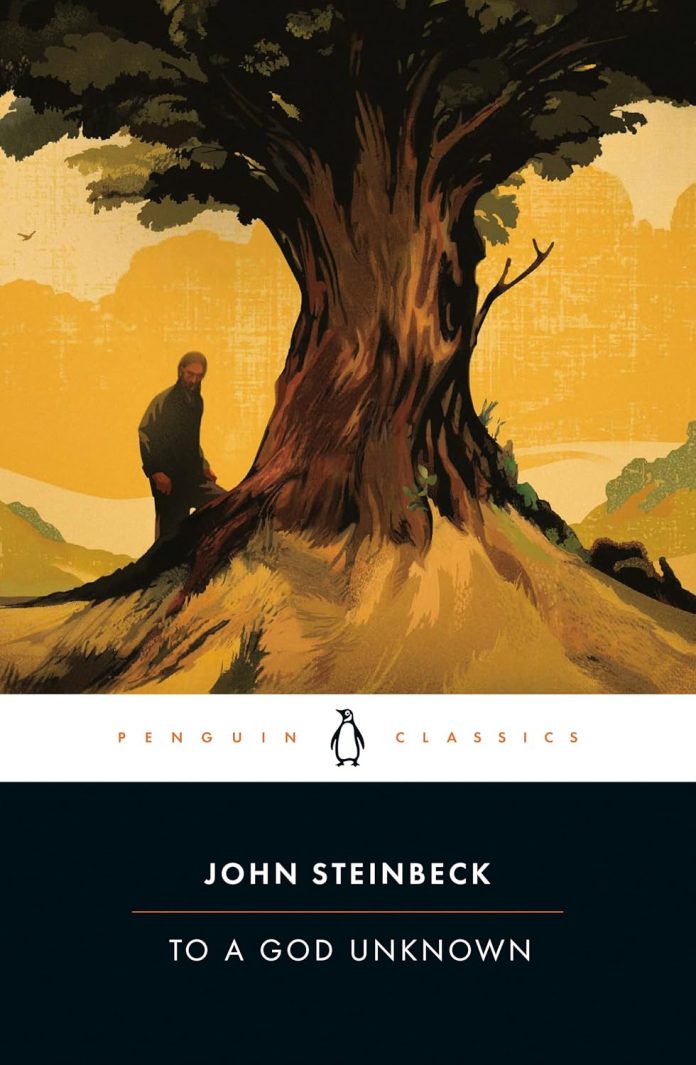
To a God Unknown by John Steinbeck opens with Joseph Wayne asking his father for permission to leave the Vermont farm because the land will not feed all four brothers. The old man gives it, and tells him the land suffices. Then he dies, and Joseph, five hundred miles west in a California valley, decides that his father has entered a great oak standing beside the new house.
He is not speaking figuratively. To a God Unknown by John Steinbeck means it, holds that position for two hundred pages, and never once offers the reader a rational exit.
How To a God Unknown Works
The machinery of To a God Unknown by John Steinbeck is mythic rather than novelistic, and the book is open about it from the epigraph, which comes from the Vedas and asks who the god is to whom sacrifice should be offered.
Joseph takes up homestead land in the valley of Nuestra Señora and sends for his brothers. Thomas is silent and understands animals. Benjamin is a drunk with no interest in anything. Burton is a hard Protestant who watches his brother talking to a tree and recognises it, correctly, as paganism.
Each brother is a position rather than a person, and the plot proceeds by testing Joseph’s belief against them. Burton eventually girdles the oak and kills it. The rains stop. The valley dries, the stock dies, and Joseph becomes convinced the drought is his fault for having let the tree go.
What works
- The prose is remarkable for a writer of thirty-one. The passages describing the valley as a female body, with its green halls and alcoves, outclass anything in Tortilla Flat from two years afterwards.
- The land is the actual protagonist. Weather, soil and water have more agency than most of the people.
- Rama is the one fully alive character. Thomas’s wife, contemptuous of nearly everything men think, and the only person who speaks to Joseph as an equal.
- The ending is genuinely bold. It commits completely to its own logic and declines to retreat into psychology.
Where To a God Unknown Gives Ground
- The brothers are allegory with names on. Three of the four in To a God Unknown by John Steinbeck exist to hold a position. Burton exists to be puritanical, Benjamin to be weak, Thomas to be mute. None of them develops.
- Elizabeth deserves better. The schoolteacher Joseph marries is sharp and observant for fifty pages and is then disposed of to serve the plot.
- It has no humour at all, which in a Steinbeck novel is startling and makes the solemnity harder to carry.
- The symbolism is relentless. Tree, rock, spring, drought, blood. The book never trusts the reader to notice anything once.
Read it if
- You want To a God Unknown by John Steinbeck for the prose and for the oddity, which is considerable.
- You are interested in pre-Dust-Bowl Steinbeck, before the politics arrived.
- You like novels that take mysticism seriously rather than explaining it away.
Skip it if
- Allegorical characters frustrate you.
- You need irony, or jokes, or relief.
- You came for the social realism he became famous for.
Where To a God Unknown Sits in the Backlist
To a God Unknown by John Steinbeck was his third book, published in 1933 after roughly five years of work in various forms. It sold badly, as the first two had.
What is useful about reading it now is seeing which parts survived. The valley, the ranch, the family who come west and are changed by the ground they take up: all of that reappears, sixteen years later and with sixty years of chronology attached, in East of Eden. The idea of a man convinced the land is alive and owes him something resurfaces in several places. What vanished completely was the solemnity. Two years after this he published Tortilla Flat and became a comic writer, which is one of the stranger career turns in American letters.
The Oak Is the Argument of To a God Unknown
Everything in To a God Unknown by John Steinbeck runs through one tree, and it is worth being precise about what he does with it.
Joseph does not use the oak as a comfort or a memorial. He addresses it as his father, directly, and begins leaving things at its base. When his wife is pregnant he takes her to it for approval. The reader is never given a moment of distance, never shown him doubting, and never offered the usual novelistic cue that grief has displaced reason.
Burton, watching this for months, acts on exactly the diagnosis a modern reader is resisting: that his brother is worshipping a tree, and that it is idolatry. He strips a ring of bark from the trunk one night and the oak dies slowly over the following weeks.
What follows makes the book’s position unmistakable. The rain stops. The grass fails. The stock starve or are driven out. The novel does not frame this as Joseph’s perception; it is simply what happens next.
Read these next
- A Literary Analysis of East of Eden by John Steinbeck. The same obsession with inheritance and land, with the architecture to carry it.
- Tortilla Flat by John Steinbeck. Published two years later and almost unrecognisably different in temperament.
- The Red Pony by John Steinbeck. The same ranch country handled with restraint instead of ritual.
Do You Need the Earlier Books?
No. This is the third novel but it stands entirely alone, and reading Cup of Gold or The
Pastures of Heaven first will tell you nothing useful about it. If anything the useful order is backwards: come
to it after the famous books, when the contrast between this voice and the one that wrote the
Dust Bowl novels is at its most startling.
Content notes
Self-inflicted death, bereavement, prolonged suffering and death of livestock in drought conditions, and a portrait of religious obsession that the book never treats as illness.
The Last Word
The final act of To a God Unknown by John Steinbeck is the reason to read it and the reason most people bounce off it.
With the valley dying, Joseph climbs to the rock in the glade, lies down on it, and opens his own wrists so that the land will drink. The rain begins while he is bleeding out. The book does not wink. It does not suggest coincidence. The sacrifice works.
The last scene belongs to Father Angelo, the local priest, listening through his door to the villagers celebrating the rain with guitars and chanting, stripping off and rolling in the mud, wearing animal skins without knowing why. He takes up his crucifix, opens the door, stands in the roaring rain, and then quietly closes it again and puts the cloak away.
That is the novel’s real argument: the old religion is still down there, it still works, and the man whose job it is to stop it has decided not to.