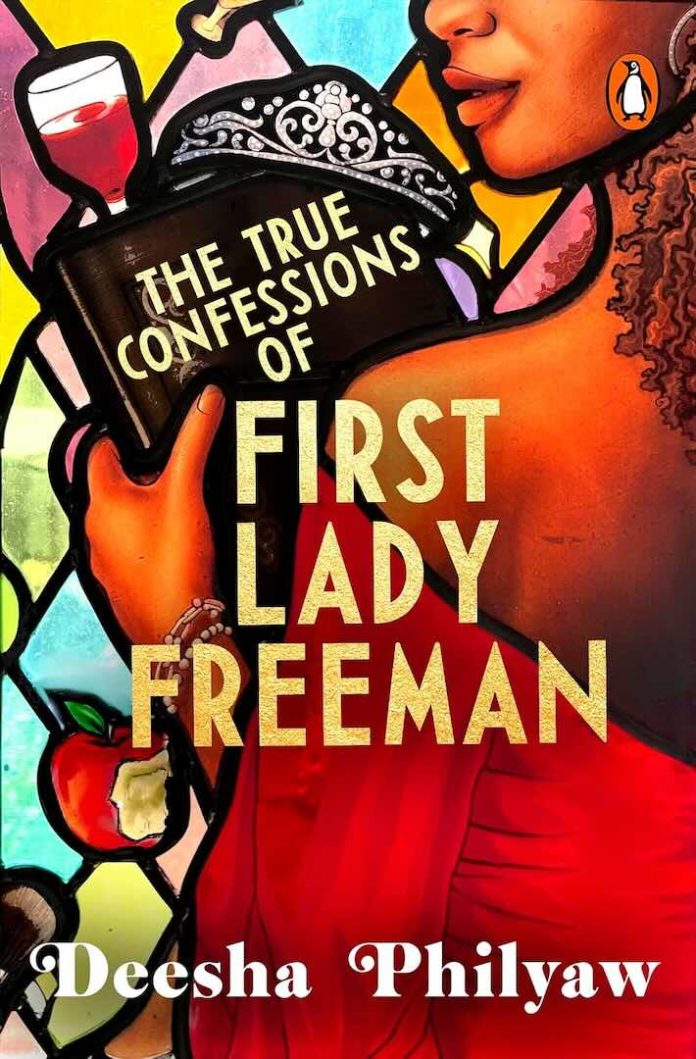
The First Lady USA pageant was founded in 1961 by a preacher and his wife whose sixteen-year-old daughter had missed her debutante ball, having spent nine months at an unspecified clinic in California. Two years later, safely married to a pastor, she was crowned the first winner of a contest her parents rigged for her. That is the institution at the centre of The True Confessions of First Lady Freeman by Deesha Philyaw, and it tells you everything: a celebration of Christian womanhood built on a girl’s concealed harm, photographs taken, paperwork filed.
Scharisse Freeman has wanted that crown for eighteen years. She is forty, married to the third-generation pastor of a Georgia megachurch with twenty-five thousand members, with a Yale degree, a salad dressing line and a co-authored marriage memoir a president once named a favourite book of the year. She also has no father listed on her birth certificate, a mother dead at twenty-eight, and an aunt she has not visited in sixteen years. The pageant is meant to settle all of it.
The Second Voice Inside These Confessions of First Lady Freeman
Roughly sixty footnotes run along the bottom of The True Confessions of First Lady Freeman by Deesha Philyaw, all in Scharisse’s voice, and they are the most interesting thing about it. Some are jokes that would not fit in the scene above. Some are corrections. And some are small factual essays on Moms Mabley, on gospel miming’s origins in Pittsburgh, on a child prodigy whose mother beat her. And some are what Scharisse cannot say aloud, delivered under the page while the woman in the chapter keeps smiling.
That split is the design. The chapters are performance, the footnotes are the performer, and the gap between them shows a woman so fluent in self-editing she needs a second channel to be honest on. Read the footnotes as the argument the narrator cannot make aloud, and the book snaps into focus.
The same instinct drives the found documents: email threads, an obituary, a pageant itinerary, a crisis-PR statement, text exchanges, dossiers on her ten rivals. A three-act play script stages the 1993 afternoon when she dropped her best friend as maid of honour on a church mentor’s instruction. The email chain from the pageant’s new owners, two stoned millennial twins chasing secular sponsors, is a comic triumph, and one contestant’s fundraising slogan for a wigs-for-widows charity is the funniest line here.
Lady Freeman, Deesha Philyaw, and the Arithmetic of a House of Cards
The plot turns on a meeting Scharisse is summoned to beside a condemned motel in a former sundown town. There she learns who her father was, what he did to her mother when her mother was fifteen, and what he later gave her. Photographs leak. The man beside her in them confesses at a press conference to an affair rather than expose his father’s crimes, because his congregation has forgiven him five times already and this is the cheaper lie.
What follows will keep book clubs up late. Scharisse’s husband does not disbelieve her. He believes her and calculates anyway. His elders threaten to remove him unless she publicly claims an addiction she does not have, and he arrives with a consultant’s packet, a scriptural justification and a vow-renewal ceremony with a themed cocktail. These men will lose a pastor over his failure to control his wife. They will not lose a building.
Philyaw is precise about that arithmetic, and the satire in The True Confessions of First Lady Freeman by Deesha Philyaw is load-bearing, not decorative. Its best-known set piece is a couples’ retreat Scharisse organised for a sex toy company a decade earlier, which ended with seven of twelve pastors’ wives on antibiotics and Scharisse permanently exiled. It plays as farce until someone explains the punchline: nobody had told these women how their own bodies work, because the institution selling them virtue also sells them ignorance, and one went eight years untouched and assumed it was her fault.
The book’s emotional floor sits elsewhere, in a spa sauna, where the aunt finally tells the whole story. It is the most tender writing here and it arrives almost entirely in comedy, the only delivery system that could carry it. Philyaw refuses to simplify the mother, holding both that she was a child who could not consent and that years later, as an adult, she went back. A minor character explains why survivors sometimes do that, excusing nobody, and it is the most generous thinking here.
Where the True Confessions of First Lady Freeman Gives Ground
Five things keep The True Confessions of First Lady Freeman by Deesha Philyaw from being the book it nearly is.
- The middle idles. Once Scharisse capitulates in May, the pageant is six months away and the plot has nowhere to be. Several chapters restage the same deadlock with her husband, and the book runs on set pieces instead of momentum.
- The husband is thin. He is a position plus an appetite. We hear twice that he used to play funk guitar in the basement; that man never arrives, and the marriage’s collapse loses weight for it.
- The romance is the weakest thread and the most repeated. Engineered encounters in the pantry, the garage, a hot tub, plus footnotes on the narrator’s arousal. It lands the softest ending in a book otherwise allergic to them.
- The footnotes outstay themselves. Superb for twenty. By the sixtieth, several repeat work the prose already did, and a few puncture scenes that were landing.
- The coda explains itself three times. The pageant monologue states the thesis. A talk-show transcript restates it. The epilogue states it again, in Scharisse’s summary of the book she wrote about her life.
Read It If, Skip It If
The True Confessions of First Lady Freeman by Deesha Philyaw does not suit every reader, and is not trying to.
Read it if:
- You want satire with a real crime underneath it and can hold both registers.
- You like formally restless novels: footnotes, documents, a play script, shifting tense.
- You came from The Secret Lives of Church Ladies and want four hundred pages of that voice.
Skip it if:
- You need a tight plot. This one takes a long lunch between its two best scenes.
- Explicit, frequent sex on the page is not for you.
- You want the church treated gently. It is not.
Content Notes
The True Confessions of First Lady Freeman by Deesha Philyaw carries a heavy load. Grooming and rape of a minor by a clergyman, discussed at length, never depicted. HIV and AIDS illness, death and 1980s stigma. Maternal violence against a pregnant teenager. Crack addiction, overdose and suicide. Explicit consensual sex throughout. Sustained coercive pressure on a woman to lie publicly. Strong language on nearly every page.
Read These Next
If The True Confessions of First Lady Freeman by Deesha Philyaw lands for you, these five are the closest matches on our shelves.
- Kin by Tayari Jones for the other Georgia novel about a marriage an institution decides it can afford to break.
- Colored Television by Danzy Senna if the self-reinvention plot grips you and you want it meaner.
- The Seven Daughters of Dupree by Nikesha Elise Williams for sexual violence held inside a family’s official story.
- Cursed Daughters by Oyinkan Braithwaite on shame passed down the female line like a diagnosis.
- Zeal by Morgan Jerkins for a Black American history assembled out of documents and silences.
Philyaw’s only previous book, the story collection The Secret Lives of Church Ladies, won the PEN/Faulkner Award and the Story Prize. This is her first novel, written across roughly twenty years, and the seams show in both directions.
Worth Your Shelf
Something Scharisse understands late and the novel understands from page one: the men here are extended grace and the women are managed. Grace is given. Management is performed on you, and you pay for it. It matters that she builds her routine in the costume of Moms Mabley, a comedian assaulted twice as a child, who bore both babies, ran at fourteen and spent fifty years making rooms laugh. Scharisse wrote her college thesis on her. She took a long time to apply it.
The True Confessions of First Lady Freeman by Deesha Philyaw is baggy, over-explained at the close, and occasionally in love with its own footnotes. It is also the rare comic novel whose jokes are all pointing at something true, and its last real scene earns every page it took to reach. Read it for the voice. Stay for the aunt.







