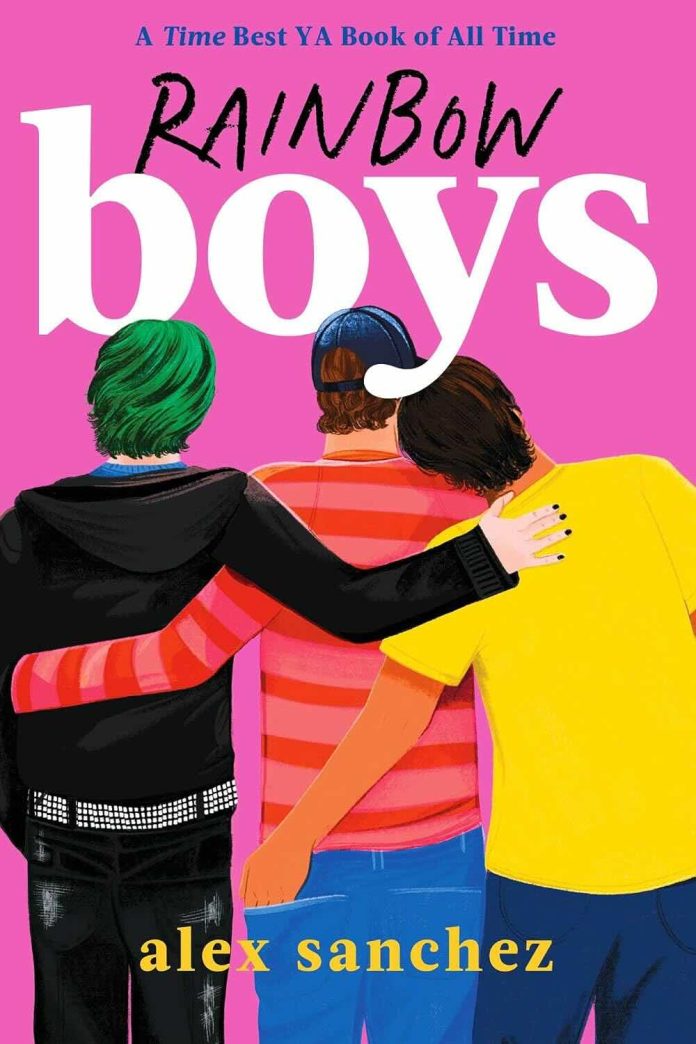
In the first chapter of Rainbow Boys by Alex Sanchez, the school’s loudest out kid presses a badge into the hand of the school’s basketball star. The badge announces that nobody knows the wearer is gay. It is a joke, a provocation and a small cruelty at once, and the boy receiving it spends the rest of the book furious about it, mostly because it is accurate. Nothing else here is that neat. What is remarkable about Sanchez’s 2001 debut is not the premise but the machinery: twenty-two chapters, three narrators, one chapter each in strict rotation, with no deviation at all.
Three Narrators, Twenty-Two Chapters, No Protagonist
Jason, Kyle, Nelson. Jason, Kyle, Nelson. Seven full cycles, then a twenty-second chapter returning to Jason, and stop. Each boy narrates in close first person and sees only what he is present for, so the reader assembles the book from three partial accounts and always knows more than any of the three.
The effect is not showy and it works hard. Kyle spends a hundred pages convinced that a boy holding his hand in a cinema means nothing, and we have already sat inside that boy’s head while he decided to do it. Nelson is certain his best friend is oblivious to him, he is right, and we watched it happen. Nobody gets the leading role. Each is a supporting character in the other two stories, which is the truest thing Rainbow Boys by Alex Sanchez says about being seventeen.
What Rainbow Boys by Alex Sanchez Knows About Staying Silent
Jason is the most conventional of the three and the most interesting to argue about, because the novel gives him a good reason to keep quiet. He is a basketball player with a scholarship in reach, a violent alcoholic father, and a memory of being beaten at ten for touching another boy and told what would happen if it happened again. His silence is not cowardice in the abstract. It is a calculation with a price attached, and everyone around him keeps handing him the numbers.
The book is unusually fair to him and to the people he hurts. His girlfriend of two years is lied to for months, and when he finally tells her she hits him and uses the worst word she knows. His best friend’s advice is to stop being seen with the gay kid, offered with real affection and entirely self-serving. Sanchez lets both responses be understandable and indefensible at once.
The Chapter Nobody Else Gets to See
The rotation gives Rainbow Boys by Alex Sanchez one consequence it exploits ruthlessly. Because each boy narrates only his own chapters, the worst thing in the book happens where the other two cannot see it.
Nelson, rejected by the friend he loves and humiliated by an older boy who stops when he finds out how young he is, answers a message from a stranger twice his age, goes to a flat alone, and has sex without a condom. Then he stops going to school. The two people who would have helped him find out afterwards, in pieces, from him. His mother’s first reaction is not the one the reader expects: she is angry chiefly because a delay of days has cost him preventive treatment she knew about and he had forgotten.
And then the novel does something that still feels brave. It brings in a boy who is living with HIV, gives him a page of his own to tell an almost identical story, and never tells us Nelson’s result. The book closes with that question open, on purpose.
How Rainbow Boys by Alex Sanchez Wins Its Student Club
The plot that holds all this together is bureaucratic, which is why it works. Two of the boys want to start a gay-straight alliance, and the principal says no in his office in one sentence. He is beaten not by a speech but by a seventeen-year-old who has read the Equal Access Act online and asks, politely, whether the school means to break federal law.
From there it is forms, a faculty sponsor, a parents’ committee meeting, a man with a placard, and a mother who brings a photograph of her son on his first morning of kindergarten and explains what word he learned that day. The club is won on procedure and testimony, not on anyone’s change of heart, and the novel is clear-eyed that this is how such things get won.
Where Rainbow Boys by Alex Sanchez Shows Its Age
- The rotation is rigid to a fault. Holding the order means some chapters exist to fill their slot, and two or three of Nelson’s mark time until his turn comes round again.
- The girlfriend is a function, not a person. She is written well enough to deserve an interior and never gets one; she is lied to, she strikes out, and she returns to forgive on schedule.
- The adults sort cleanly into helpful and hostile. The art teacher is faultless, one mother is faultless, the principal is a coward until the plot needs otherwise, and the fathers either convert or leave.
- One punch resolves a decade of violence. The father’s exit is the tidiest thing in the book, and the novel wants that catharsis more than it wants the mess.
- The issue-per-chapter rhythm is visible. Coming out, bullying, federal law, eating disorders, the Kinsey scale, post-exposure treatment, dating across a difference in status. All accurate, all sequenced.
- Jason’s own word for himself is bisexual throughout, and the book largely treats it as a waystation rather than a destination. A reader in 2026 will notice; the novel does not really argue the point.
Also period, not flaws: cassette mixtapes, one landline per family, dial-up chat rooms, magazines hidden in a bedside drawer, one state cited as the progressive outlier.
Content Notes
Rainbow Boys by Alex Sanchez carries more than its cover suggests. Homophobic slurs on almost every page, from classmates, from a father, and by omission from staff. Bullying escalating from name-calling to a thrown bottle to a beating in the street. A father’s violence towards his son, including a beating recalled from childhood, and his alcoholism. On-page unprotected sex between a seventeen-year-old and a man of twenty-nine met online, framed by the novel as a serious mistake with consequences. HIV anxiety, testing, and a character living with the virus. Bulimia, purging and diet pills. Suicidal ideation. A girlfriend hits her boyfriend and uses a slur. One non-explicit sex scene between the two leads.
Read These Next
- Ramin Abbas Has MAJOR Questions by Ahmad Saber. The nearest contemporary equivalent for a teenager asking the question rather than answering it.
- Fruit Fly by Josh Silver. Far darker, and useful for how much harder queer YA can now go.
- Mazeltov by Eli Zuzovsky. For the multiple-perspective structure done with more literary ambition.
- The Lovers, the Liars, and Me by DeAndra Davis. For readers who came for the friendship triangle rather than the romance.
- Books About Bisexuality to Read This Pride Month. Worth having beside this one, given the word Jason chooses for himself.
Worth Your Shelf
The trilogy runs Rainbow Boys, then Rainbow High, then Rainbow Road, and this first volume ends where it should: at a door. There is a meeting in a conference room, a knot of boys outside jeering at whoever goes in, and one of the three standing with his hand on the handle, still able to turn round.
What has lasted is the small stuff rather than the milestones. A boy who wears the same baseball cap for twenty-one chapters and leaves it behind in the twenty-second. A six-year-old who works out what the word means on her own and offers her brother a definition kinder than anything the adults manage. A teacher who answers a sneering question with the same question back, once, and is never asked again. Twenty-five years on, Rainbow Boys by Alex Sanchez has dated in its furniture and barely at all in its mechanism, and the choice to split it three ways still looks like the right one.
A note on how this copy reached me, in a book full of people asking each other to keep things quiet: Simon & Schuster Books for Young Readers sent it, and the one thing nobody attached to it was a request for silence. They asked for an honest opinion. The badge in chapter one gets its meaning from being unwanted; this review has the opposite problem, and it is the better one to have.







