Nobody knew where the dog came from. He turned up in a village of six hundred people, refused every offered home, and slept on a different porch each night until four children put their arms around his neck and made him theirs. Two months later he came loping back into town alone, whining at car doors, with dried blood on his pale fur.
That is the last time anybody sees the Dixons.
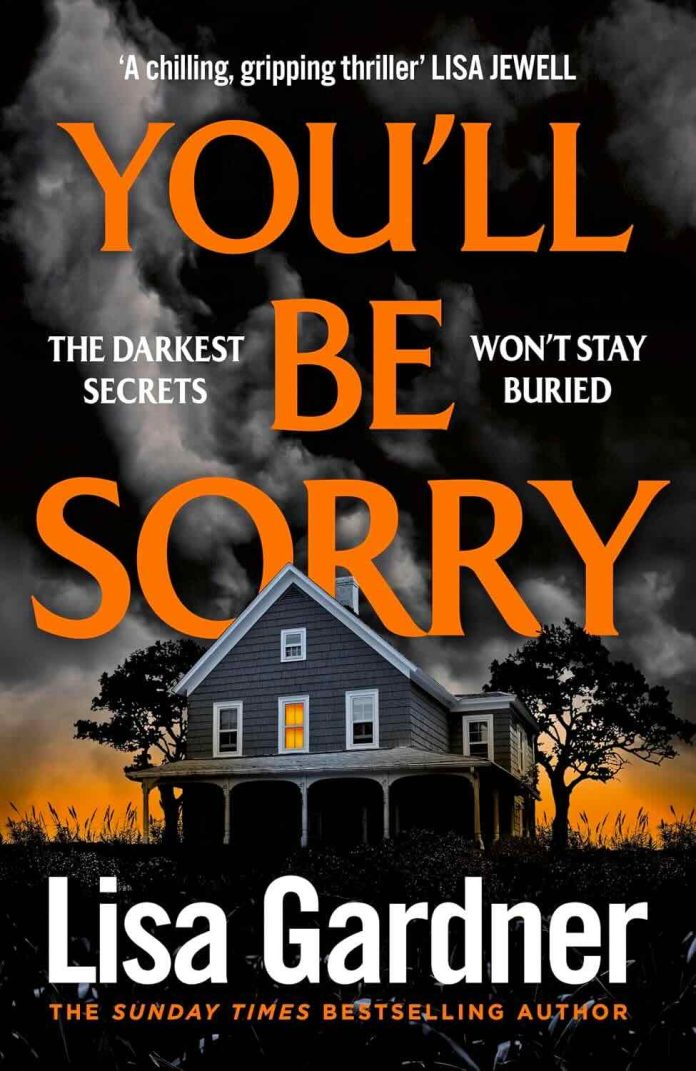
You’ll Be Sorry by Lisa Gardner opens in 1998, in Shereford, New Hampshire, where a summer family of six walks out of a lit house during a thunderstorm and never returns. Half-eaten crackers on the table. A jigsaw puzzle barely started. Wallets, car keys and coats untouched, and a trail of bare bloody footprints looping through the great room in patterns nobody has ever been able to explain. Thirty years on, the property finally sells. Theo and Raquel Collins arrive from Boston with money, charm and an unnervingly specific list of questions about the original investigation, and within days a new stray shows up on their porch and starts digging behind the collapsed barn.
The Forensics Are the Best Thing Here
Gardner has always done her homework, but You’ll Be Sorry by Lisa Gardner operates at a different order of research. The novel turns on forensic podiatry, on the difference between what a bloody footprint could tell investigators in 1998 and what a photographic analyst can peel out of the same image now, and on the crucial distinction between one blood type and one donor. When the excavation begins, the procedure is unglamorous and completely convincing: an assistant deputy medical examiner whose go-bag contains soup and hand warmers, a forensic anthropologist who talks a nervous volunteer firefighter through a rope descent, unfused clavicles and perimortem fractures and the patient business of wet screening.
The other pleasure is the town. Shereford is drawn with the affectionate exasperation of someone who lives somewhere like it: a department of four whose duties include stray dogs, a stolen-vehicle call that resolves itself in the best possible way, a historical society president who guards his crockery like a dragon, ninety-year-old twins running a hundred-acre farm and a menagerie of three-legged rescues. You’ll Be Sorry by Lisa Gardner understands that policing a place where everyone remembers you at six years old is a genuinely different job, and Mandy Grady, sworn in as chief on her dead father’s reputation, is the best small-town cop Gardner has written.
Three Voices, Two Centuries
The structure alternates Mandy’s investigation with Raquel’s perspective, and threads a third strand between them: unnumbered interludes in which an unnamed narrator addresses the reader directly, quotes entries from a 1790 midwife’s diary, and promises that the truth is coming. It is a bold device, and for most of the book it works, largely because the historic material is genuinely disturbing. A young woman arrives out of a blizzard with no shoes, nurses the town’s sick for a winter, and is accused of witchcraft when its babies begin to die. Readers who admired The Frozen River by Ariel Lawhon will recognise the debt, and Gardner acknowledges it, along with the real diaries of the Maine midwife Martha Ballard that inspired both.
What Works
- Raquel. A woman who has legally buried her own name, who can appraise a corpse with less flinching than anyone in uniform, and who is quietly falling apart over a loss she cannot discuss. The best character Gardner has built in a decade.
- Theo. In lesser hands the sunny, wealthy, unfailingly decent husband would be a plot device. Here he is a load-bearing wall, and his refusal to be curious about his wife’s silences is written as love rather than naivety.
- The dog. Used with real restraint. He is never psychic, never a mouthpiece, and the two scenes in which he simply sits and stares at the tree line are the eeriest in the book.
- The caves. One interlude is set in the boulder caves at Lost River Gorge, squeezing through sixteen inches of granite, and it does more character work in three pages than most backstories manage in fifty.
- The historical thread. What was actually happening in that village in 1790 is far nastier than a witch story, and Gardner refuses to soften it.
- Small-town procedure. Budget approved line by line at a town meeting, mutual aid from neighbouring departments, a fire chief who is the community’s moral centre. It is specific in a way most thrillers never bother to be.
Where It Stumbles
- The reveal is heavily signposted. One character’s identity is telegraphed by a scar, a phobia and a childhood memory long before it is confirmed, and the book keeps circling it as though the reader has not already arrived.
- The epigenetics framing does not pay off. The interludes lecture at length on inherited trauma and conditioned rats, and none of it turns out to be doing plot or thematic work. Cut every paragraph of it and nothing changes.
- The coincidence load is heavy. A stray finds a structure that eluded the National Guard, and a new owner’s private history mirrors the historic crime almost exactly. Either would be a stretch. Together they strain.
- One character’s night of work is superhuman. The logistics of what gets moved, sealed and staged in a single storm are described in detail and remain difficult to believe of one exhausted person.
- The climax is generic. After three hundred pages of patient forensic work, the resolution arrives as a shovel, a shootout and a fairly conventional pursuit through snow.
A Word on Content
Infanticide, including the discovery of infant remains. Sustained pregnancy loss and stillbirth, described in detail. Matricide. Munchausen syndrome by proxy. Child death and murdered children. Historic sexual assault, drugging and coerced pregnancy. Alcoholism, self-harm, a hostage standoff, and a dog in peril.
Who This Is For
Reach for You’ll Be Sorry by Lisa Gardner if you want a cold case worked properly rather than intuited, if a two-hundred-year-old crime bleeding into a modern one appeals, and if you like your thrillers grounded in real institutional detail. Skip it if the content list above is a problem, or if you need your final act to match the ambition of what preceded it.
Read These Next
- The Frozen River by Ariel Lawhon. The direct ancestor: a colonial midwife, a frozen body, and a community protecting its powerful men.
- I Have Some Questions for You by Rebecca Makkai. For a New England town relitigating a death everybody thought was settled.
- Something I Keep Upstairs by J.D. Barker. Another New Hampshire property with a memory.
- The Missing Half by Ashley Flowers. If the vanished-without-a-trace hook is the draw.
- Gothictown by Emily Carpenter. For outsiders buying into a picturesque town with an appetite.
The Last Word
This is Gardner’s first standalone in some time, and the ambition is obvious: a small-town procedural, a historical atrocity and a domestic-suspense character study braided into one book. Two of those three are excellent. You’ll Be Sorry by Lisa Gardner is at its most powerful when it is simply watching careful people do difficult work in the cold, and at its weakest when it stops to explain its own themes. The Dixons deserved a better ending than the one the world gave them. This book gives them a good one, even if it takes a slightly clumsy route to get there.