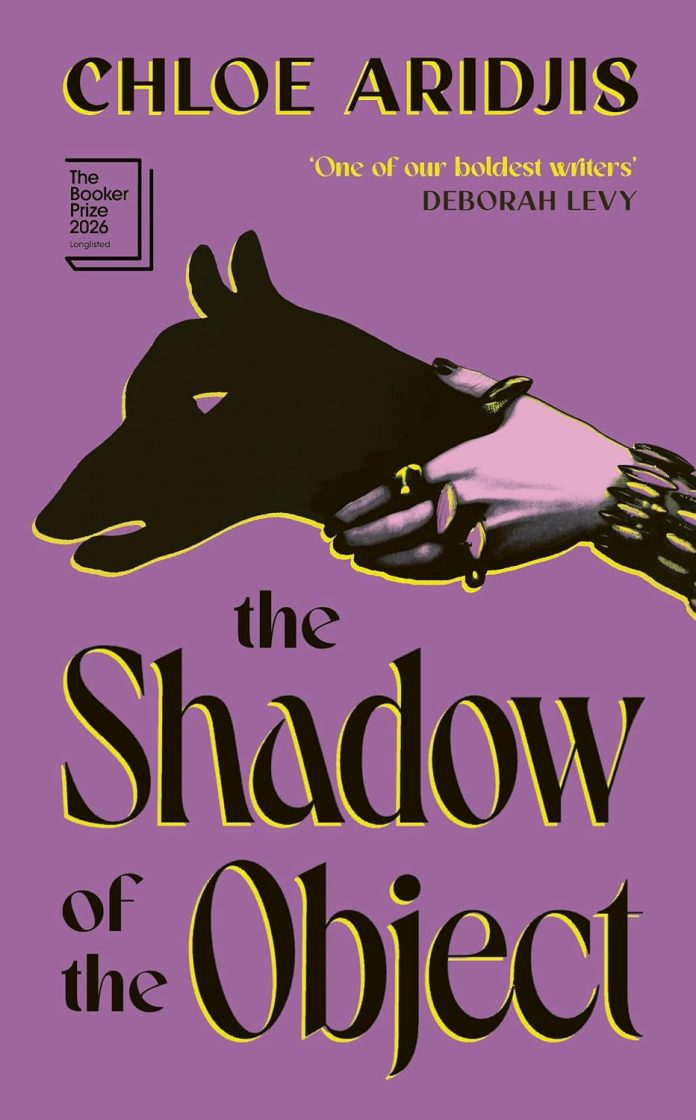
The Shadow of the Object begins with a wave goodnight, and a dog that sees a hand with no body attached to it. Eleven years of good behaviour ended in that second. Eight deep bites, splintered bone, three operations, and a hospital stay long enough that the outside world began to feel optional.
That is the first page of The Shadow of the Object by Chloe Aridjis, and it is a very good demonstration of what the whole novel is about: the moment an ordinary object comes loose from its context and turns into something else.
What Happens in The Shadow of the Object
Flora is in her early forties, born in Mexico to an English father who walked out of the family one Sunday and turned out to have a second one up north. She lives in London now, in three rented rooms above a retired couple and their cats, and she is a master polisher at a silver jewellery shop in Soho. Skull rings, cat rings, a ring with an eye infection.
Home in Mexico City for the first time in three years, she is bitten. And in the corridor of a private hospital at night she meets Wilhelmina Blau: German, seventy, in for pneumonia, furious about being denied a cigarette, and formerly the owner of one of the world's great collections of pre-cinema optical instruments. Magic lanterns and zoetropes, phenakistoscopes, peep boxes, thaumatropes, shadow puppets: some forty thousand items in all, dispersed at auction after the drowning of her husband in the water beyond their terrace.
For a handful of nights they talk. Then Wilhelmina dies, and Flora flies home to London carrying her bag, her last magic lantern, and her ashes.
The Shadow of the Object Has the Best Sentences on the Longlist
Aridjis writes prose of a quality that makes you slow down whether you want to or not. A thing dies "at the very spot" you were not looking. A hospital drip bends over a bed "like an arthritic nurse". The narrator observes that fantasy life thins with age, that the options narrow, and that her own harbour had started emptying by her mid-thirties.
The novel's real subject is the strange charge objects carry, and The Shadow of the Object by Chloe Aridjis keeps producing set pieces that would justify it on their own.
What Works
- The lantern show. The high point of The Shadow of the Object. Wilhelmina, dying and not saying so, sets up her lantern in her hospital room and projects a nun with a scarlet dagger, a skeleton in a plumed hat, a Venetian funeral, a chartreuse Medusa. Nurses gather at the door. It is the most purely beautiful scene in any book on this list.
- The Falk history. Late on, in a hobbyist newsletter, we learn who made the lantern. Johann Falk, a Jewish toymaker of Nuremberg, forced to sell his firm in 1936, who left for New York and died in 1942 still waiting for his citizenship papers. Eight Falks perished in the Shoah. Aridjis delivers this in the flat register of an article and it lands like a hand on your shoulder.
- The mouse gets a chapter. Isidore, retrieved from the Warburg Institute after chewing the corner of a facsimile, narrates several pages of his own about nesting materials and the relative edibility of old paper. It should be twee. It is glorious.
- The memorial. A chorus of unattributed voices at the Ragged School Museum describing Wilhelmina, contradicting each other, none of them mentioning her son, who is standing at the back in a tracksuit.
- The Sales and Wants pages. Real classified listings from magic lantern collectors, quoted at length. "Man diving off a cliff, dog tries to stop him, tears his coat, dives into oblivion."
Where It Stumbles
- Max never arrives. Wilhelmina's son is the second half's centre of gravity and he is a vacancy: guarded, monosyllabic, permanently just out of focus. Flora describes him as an unfinished portrait, which is honest and does not solve the problem.
- The romance is inert. They drink, they sleep together, they say very little. I never believed in it as anything more than a woman circling a dead woman's house.
- The second half loses pressure. Part one of The Shadow of the Object has a hospital, a deadline and a dying woman. Part two is a series of walks, digressions and objects, exquisitely rendered and going nowhere in particular.
- The climax is a deliberate flop. The lantern show the whole book builds toward is stiff, joyless and unmagical, which is clearly the point. Earned anticlimax is still anticlimax.
The Shadow of the Object Deals in Illusion, Not Magic
Flora is careful about the distinction, and so is the novel. She does not believe in an afterlife. Her father worked for the electricity board and told her that when a colleague was electrocuted, aquí se acaba: it ends here. A flickering bulb is a flickering bulb.
What she does believe in is the magic lantern as a machine: a box, a lens, a light source, no mystery at all in its optics, and yet something happens in the beam. Wilhelmina puts it better. Her instruments demonstrated the persistence of vision, and inside that she found something deeper, which is that human emotions are finite and repeated, and that watching gestures cycle through her machines she was watching "one vast theatre of the soul".
That is a book's worth of argument, and Aridjis is disciplined enough never to state it twice.
Who This Is For
Reach for The Shadow of the Object by Chloe Aridjis if you read for sentences and images rather than plot, if you have ever stood too long in a museum wanting to touch something, if the phrase "a novel about a collection" appeals rather than alarms. Skip it if you need momentum, or a love story that behaves like one.
It is short, it is unhurried, and it rewards the kind of attention it keeps recommending.
Read These Next
- Asunder by Chloe Aridjis. Her own best companion piece: a guard at the National Gallery watching paintings and moths. If this novel works for you, that one will too.
- The Empusium by Olga Tokarczuk. A sanatorium, a collection of male certainties, and the same European unease about who is really being observed.
- The Rings of Saturn by W.G. Sebald. The obvious ancestor for a narrator who walks, digresses, and lets historical atrocity surface inside an anecdote about an object.
- We Do Not Part by Han Kang. For a similar structure of one woman taking on the burden of another's memory, and a bird that must be kept alive.
- May We Feed the King by Rebecca Perry. Also on this year's longlist and uncannily close in preoccupation: replica objects, dead strangers, and the ethics of curating a person.
The Last Word on The Shadow of the Object
The judges on the Booker Prize 2026 longlist called this one mysterious and free-wheeling, and said the most meaningful truths are found in the shadows. That is generous and roughly right. What they did not say is that it is also a novel with a hole in the middle where a second character should be, and that the hole is deliberate and still a hole.
But then there is the last page. Not a scene, not a line of dialogue. A description of a single blank slide: no image, only fingerprints. Accidental design, the capture of a moment, impossible to recreate.
That is what Wilhelmina left, and what Flora carries. The Shadow of the Object by Chloe Aridjis is a book about what stays on a thing after the person who handled it has gone, and it is worth reading for the first half and the sentences. The second half, once the pressure of the hospital is gone and Max has arrived to absorb it, drifts a long way from what makes the opening so good.
She waved, and a hand came loose from a body, and nothing was ever quite attached in the same way again.







